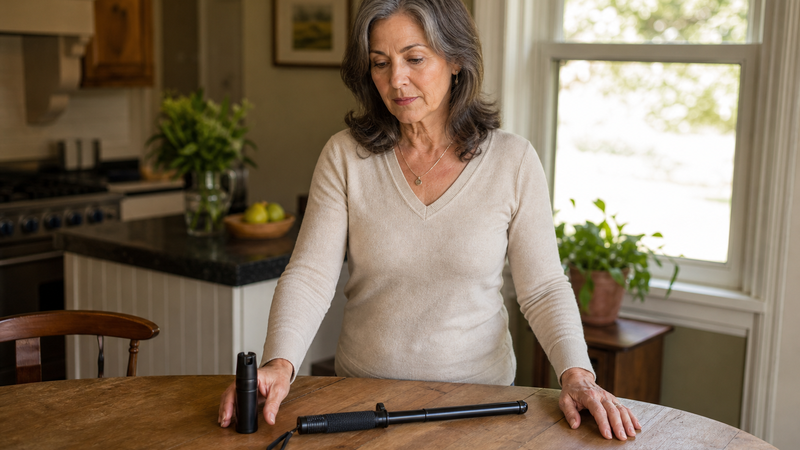
For most people in most situations, pepper spray is the stronger choice over an expandable baton for everyday self-defense. It works at a distance — typically eight to twelve feet — requires no physical strength, no close contact, and no practiced technique to deploy effectively. A baton demands proximity, skill, and the physical capacity to follow through. That said, the right answer depends on your legal situation, your environment, and what you are genuinely prepared to carry and use.
Now let me tell you something: this is not a question most people think through carefully enough. They see a baton, they think it looks serious, looks capable, looks like something that means business. And they are not wrong — it does. But looking capable and being the right tool for the person carrying it are two entirely different things. When you are choosing something you may one day depend on for your safety, you owe yourself more than a first impression. You owe yourself a real evaluation.
What does an expandable baton actually require to be effective for self-defense?
An expandable baton — sometimes called a telescopic baton or ASP — collapses down to a manageable size and extends with a flick of the wrist to anywhere from sixteen to twenty-six inches of solid steel. That is real stopping potential. Used correctly, it can create enough pain and disruption to stop a threat. The word that matters there is correctly.
To use a baton effectively, you need to be close enough to make contact — which means the threat is already within arm’s reach, or close to it. You need to know where to strike, how to strike, and what to do when someone grabs for it. If you have had formal training in impact weapons, a baton can be a serious tool. If you have not, it can be taken from you, turned against you, or simply miss at the worst possible moment under adrenaline and fear.
There is also the question of physical capacity. A baton is a physical, athletic instrument. It favors people who are strong, practiced, and comfortable with confrontation. For an elderly person, a smaller woman, someone with limited mobility, or someone who has never been in a physical altercation — the baton asks a great deal. And if you want to understand how baton length factors into real-world carry decisions, the post on how long a telescopic baton should be for self-defense goes into the specifics worth knowing before you buy.
None of this means a baton has no place. For someone trained, physically capable, and in a jurisdiction where carry is legal, it is a legitimate option. But for most people reading this, that description does not apply — and there is nothing wrong with knowing that honestly.
What makes pepper spray a smarter everyday carry choice for most people?
Pepper spray does something a baton cannot: it stops a threat before that threat is close enough to touch you. That distance — those eight to twelve feet between you and someone who means you harm — is not a small thing. It is the difference between a confrontation and an attack that never fully happens.
The active ingredient in quality pepper spray is OC — oleoresin capsicum, the concentrated oil from hot peppers. When it reaches the eyes and respiratory system, it causes immediate, involuntary closure of the eyes, intense burning, and difficulty breathing. It does not care how large the person is, how determined they are, or how much they have had to drink. The body’s response is not optional. That is what makes it reliable.
Good pepper spray also requires no particular strength, no trained technique, and no willingness to get close. You aim, you spray, you create distance, you leave. That is a sequence almost anyone can execute under stress. If you are looking at pepper spray for non-lethal defense, you will find options calibrated for exactly this kind of real-world use — not theoretical, not tactical, but practical and effective for everyday people.
There is also the question of what you will actually carry. The most sophisticated self-defense tool in the world does not protect you if it is sitting on your nightstand. Pepper spray comes in keychain canisters, belt clips, and even wearable formats like a pepper spray bracelet that stays on your wrist. That kind of access matters. A baton in a bag, unextended, in a stressful moment is a problem. Spray on your keys is not.
How do the legal considerations differ between batons and pepper spray?
This is where the conversation gets serious, and where a great many people make an expensive mistake by assuming that because something is sold legally somewhere, it is legal everywhere.
Expandable batons are prohibited outright in several states and cities. California, where I live, has historically had strict restrictions on baton carry for private citizens — the laws are specific and have real consequences. Other states have their own regulations. Even where batons are technically legal to own, carrying one in public can be treated differently. Before you purchase any impact weapon, you need to know your state’s laws, your city’s ordinances, and what constitutes legal carry versus mere possession.
Pepper spray has restrictions too — container size limits, concentration limits, age requirements — but it is legal to carry for personal protection in all fifty states, with varying conditions. That is a meaningful distinction. The broadly legal option is the one that keeps you protected without putting you at legal risk. I never give specific legal advice, and you should consult your local laws directly. But the contrast in baseline accessibility is real and worth weighing.
Who should seriously consider an expandable baton over pepper spray?
There are situations and individuals for whom a baton makes genuine sense — and I want to be fair about that.
If you are in a profession that sometimes puts you in close physical altercations — security work, certain delivery routes, facilities management in high-risk areas — and you have had training in impact weapons, a baton gives you a durable, reusable tool that does not run out the way a canister eventually will. It also has utility in situations where deploying spray in a confined space (a car, a small room, a hallway) could affect you as much as a threat.
Some people also live or work in environments where wind, rain, or close quarters make spray genuinely impractical as a primary tool. In those cases, a baton as a secondary or backup option — carried by someone who knows how to use it — is a reasonable consideration.
But notice the conditions stacking up: training, the right environment, physical capacity, legal jurisdiction. When all of those align, the baton earns its place. When one or more of them is missing, the risk calculus shifts back to the simpler, more accessible option.
What should you look for in a high-quality pepper spray worth carrying?
Not all pepper spray is equal, and this is where the difference between a thoughtful choice and a shelf-clearance impulse purchase becomes clear. The two things worth evaluating are concentration and formulation.
Major heat rating systems — SHU (Scoville Heat Units) and OC percentage — tell you something about potency, but they do not tell the whole story. What matters most is the quality of the oleoresin capsicum used, the delivery method (stream, cone, gel, fog), and the reliability of the safety mechanism under real carry conditions. Gel formulations reduce blowback in wind. Stream patterns give you precision at range. Foggers cover wider areas but can drift.
Brands like Wildfire, Mace, Streetwise, and Pepper Shot each bring something specific to the table in terms of formulation strength and delivery. These are not random choices — they are tools with engineering behind them. If you have questions about strength specifically, the post on what the strongest pepper spray you can legally buy is a good place to anchor your research.
And if budget is a constraint — which is a real and honest consideration — there are genuinely effective options in the lower price tiers. The pepper spray under $10 category has options that are not compromises. They are smart, economical choices for people who want protection without pretending cost is not a factor.
Can you carry both an expandable baton and pepper spray at the same time?
Yes, and for people in higher-risk situations, layering tools is not excessive — it is smart. The idea is that different tools solve different problems. Spray handles range and surprise. A baton handles close-contact situations where spray is not practical. Having both, understanding both, and knowing which to reach for in which situation is the mark of someone who has thought this through rather than grabbed the first thing that looked intimidating at the store.
If you are a delivery driver, a night-shift worker, or someone whose job takes you into unpredictable environments regularly, the conversation about layered tools is worth having seriously. The page on pepper spray for delivery drivers addresses some of this directly — and the situations described there are ones many people recognize from their own daily reality.
Frequently Asked Questions About Expandable Batons vs. Pepper Spray
Is an expandable baton legal to carry in California?
California law restricts baton carry for private citizens in meaningful ways. Generally, carrying a baton in public without specific professional authorization can expose you to criminal charges under California Penal Code section 22210. Laws vary by city and change over time, so you should verify current local regulations before carrying any impact weapon. Pepper spray remains legal for adult civilians in California within specified size and concentration limits.
How far does pepper spray reach compared to a baton?
Quality pepper spray typically reaches eight to twelve feet depending on the delivery method — stream formulas reach farther with more precision, while fog and cone patterns cover a wider area at shorter range. An expandable baton requires you to be within striking distance, usually two to four feet. That distance difference is significant in a real threat scenario — it means you may be able to stop a threat before it becomes physical contact.
Does pepper spray work on people who are drunk or on drugs?
Pepper spray works on the body’s involuntary systems — the eyes close, mucous membranes react, breathing is affected. These responses happen regardless of intoxication in most cases, which is one reason law enforcement has used OC spray for decades. High-potency formulations from brands like Wildfire and Streetwise are specifically designed to be reliable even on determined or chemically altered individuals. No tool is one hundred percent guaranteed, but spray remains broadly reliable.
What is the shelf life of pepper spray?
Most pepper spray canisters have a shelf life of two to four years from the manufacture date, printed on the canister. After that point, the propellant pressure may diminish and the OC concentration can degrade. Treat your spray the way you treat a smoke detector battery — check it, replace it on schedule, and do not wait until you need it to find out it is past its prime. Mark your replacement date when you buy it.
Do you need training to use pepper spray effectively?
Basic pepper spray use does not require formal training, which is a significant practical advantage over impact weapons. That said, familiarity with your specific canister — how the safety engages, how far it sprays, what the stream pattern looks like — is worth practicing before you need it. Some people do a test spray outdoors when they buy a new canister. Knowing your tool calmly is very different from figuring it out under stress.
What is the best pepper spray format for someone who carries a bag every day?
For everyday bag carriers, a keychain canister or a belt-clip canister that attaches to the outside of a bag are both strong options. The goal is access — a canister buried under your phone, wallet, and keys is not useful in a fast-moving situation. If you prefer something always on your body, a pepper spray bracelet keeps it on your wrist regardless of what else you are carrying. The best format is the one you will actually have in your hand when you need it.
Can pepper spray be used indoors?
Pepper spray can be used indoors, but there are real considerations. Spray in a confined space — a small room, a car, an elevator — can affect everyone in that space, including you. Gel formulations have significantly less drift and blowback than fog or cone spray, which makes them a smarter choice for environments where close quarters are likely. If you spend significant time in enclosed spaces, factor that into your formulation choice.
Is a baton better than pepper spray for someone who has taken self-defense classes?
Someone with real, practiced training in impact weapons has a meaningfully different calculus than someone who has not. Formal training can close some of the gap between a baton’s demands and your ability to meet them. That said, even trained individuals benefit from carrying spray as a range option, since a baton still requires proximity. Training expands your options — it does not make one tool universally superior to another.
The best self-defense choice is never the most dramatic one. It is the one that fits your life, your body, your legal environment, and your actual level of preparation — not the one that looks most capable on a shelf. For most people, in most places, on most days, that answer is pepper spray. It is range, reliability, and accessibility built into something that slips onto a keyring. If you are ready to look at what is actually worth carrying, start with what you will genuinely have on you when it matters — not what you hope you will have.