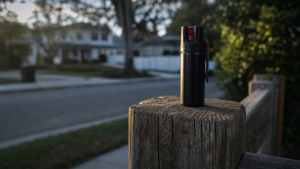
Self-defense keychains with pepper spray built in are compact canisters — usually half an ounce to one ounce — attached directly to a keyring clip or integrated into a keychain-sized case. Brands like Mace, Wildfire, and Pepper Shot make keychain-specific pepper spray units that slip onto your keys and stay with you every time you leave the house. They deploy the same active ingredient as full-sized canisters: OC, or oleoresin capsicum, derived from hot peppers, which causes immediate eye closure, skin burning, and breathing difficulty in an attacker.
Here is what most people do not realize: a keychain pepper spray is not a scaled-down version of real protection. A half-ounce keychain canister carrying a 1.4% Major Capsaicinoids formula — that is the actual heat-producing compound, not just the pepper percentage — hits just as hard as something three times its size. The question is not whether it works. The question is whether you know exactly what you are carrying, how it deploys, and whether it is legal where you live and travel. Let’s go through all of it, carefully.
What makes a pepper spray keychain different from a standard canister?
Size is the obvious answer, but it is not the whole story. A standard pepper spray canister might hold half a fluid ounce to four ounces and give you anywhere from six to thirty-five one-second bursts. A keychain version typically holds a quarter ounce to one ounce and delivers between five and ten bursts — enough to stop a threat and get away, but not enough to waste on practice shots. Every burst counts.
The delivery mechanism also matters. Most keychain units use a flip-top or twist-off safety cap to prevent accidental discharge in your bag or pocket. Some use a flip-top with a finger-grip design that lets you deploy one-handed without fumbling. The Wildfire keychain units, for example, use a safety cap flip-top that is firm enough to prevent accidental activation but fast enough to open under pressure. Pay attention to that mechanism before you buy. A safety that is too stiff is a problem when your hands are shaking.
Spray pattern is the third difference worth knowing. Many keychain units spray a stream rather than a cone or fog. A stream is more accurate at close range — six to ten feet — and less likely to blow back in your face in wind or a tight space. If you want to understand the full difference between delivery patterns, read through our breakdown of gel pepper spray vs. stream before you decide.
Which pepper spray keychain styles are worth paying attention to?
There are three main form factors on the market. Know them before you shop.
Cylinder with keyring clip. This is the most common style — a small cylindrical canister with a ring at the top that connects directly to your keyring. Units from Pepper Shot and Wildfire use this style. It is straightforward, widely available, and easy to reload or replace when the canister expires. The downside is that it hangs loose on your keys and can rotate in your hand when you reach for it in a hurry. Practice orienting it quickly.
Lipstick or disguised design. Some keychain sprays are built to look like a tube of lipstick or a small cosmetic container. The idea is that they draw less attention when carried in a purse. Mace makes keychain units in this style. They work fine — same formula, same range — but the disguised design can slow your deployment if you are not practiced with it. A tool you have never drilled with is a tool that may fail you under stress.
Combination units. A few products combine a keychain pepper spray with a secondary feature — a personal alarm, a striking tip, or a key organizer. The best self-defense keychains for women often use this layered approach: pepper spray for distance, an alarm for attention, and a hard striking surface as a last resort. More layers means more options. It also means more to learn and maintain, so choose based on what you will actually practice with.
How strong is the pepper spray in a keychain-sized canister?
This is the question that matters most, and it is the one most product listings answer poorly. Do not be distracted by the Scoville Heat Unit (SHU) number or the OC percentage on the label. Those numbers tell you how hot the pepper extract is before it is blended — not how effective it is on impact. The number you want is Major Capsaicinoids (MC) percentage. That is the concentration of the actual capsaicin compounds that cause the physiological reaction.
A keychain canister with 1.4% MC will stop a threat. That is the standard used by many law enforcement agencies. Some formulas go higher. Wildfire 1.4% MC is one we carry, and it earns its reputation. Anything below 0.18% MC is considered weak by law enforcement standards — avoid it regardless of how dramatic the label sounds.
If you want to go deeper on potency and what the legal maximums look like by state, this post on what is the strongest pepper spray you can legally buy lays it out clearly. Read it before you buy. Some states restrict canister size, MC percentage, and purchase age. Know your state’s rules.
Is pepper spray on a keychain legal to carry everywhere?
No. And this is where people get into trouble assuming that because pepper spray is non-lethal, it travels freely across state lines or into any building. It does not.
Most U.S. states allow adults to carry pepper spray with restrictions on canister size, MC concentration, and age. A few states — New York, Massachusetts, and California among them — have specific rules about where you can buy it, what size you can carry, and whether felons may possess it at all. Some states restrict minors from carrying it without parental consent. If you are buying pepper spray for a teenager, check your state law first.
Federal law prohibits pepper spray in checked or carry-on luggage on commercial flights. Courts, schools, government buildings, and many private properties have their own restrictions. None of this means you should leave it home — it means you should know exactly where yours can and cannot go.
How do you carry a pepper spray keychain so it’s actually accessible when you need it?
This is the practical question most product pages skip, and it is the one that determines whether your keychain canister helps you or not.
First rule: it has to be in your hand before you feel threatened, not after. If you are walking to your car in a dark lot, your pepper spray should come off your bag or out of your pocket and into your grip the moment you start that walk. Not when someone is ten feet away. You do not have that kind of time.
Second rule: practice the motion. Clip it to a carabiner on the outside of your bag or to a belt loop where you can grab it without digging. Practice flipping the safety cap with one hand until it is a reflex. Practice orienting the nozzle correctly — it should point away from your face without you having to look at it.
Third rule: replace it on schedule. Keychain canisters have a shelf life, usually two to four years depending on the formula. Check the expiration date printed on the base. A canister past its date may lose pressure and fail to spray at the range and volume you need. Set a reminder on your phone. When it expires, replace it. This is not a one-and-done purchase.
If you want to look at the full range of what we carry, browse our pepper spray for non-lethal defense category and filter by size. The keychain options are easy to spot.
What should you check on a pepper spray keychain before you buy it?
Run through this list. Every point matters.
- Major Capsaicinoids percentage. Look for 1.0% MC minimum. 1.4% MC is better. If the label only shows OC percentage or SHU, ask for the MC figure before purchasing.
- Spray pattern. Stream for accuracy and blowback resistance. Cone or fog for wider coverage but higher blowback risk. Know which you are getting.
- Number of bursts. Five to ten one-second bursts minimum. Fewer than five is too lean for real-world use where your first shot may miss.
- Safety mechanism. Test the safety cap in a store or with an inert training unit. It should open fast under one-handed pressure but not accidentally.
- Expiration date. Confirm the canister has at least 18 months of shelf life from the date you purchase it.
- Clip or attachment style. Make sure it fits how you carry. A keyring clip that pulls loose under stress defeats the purpose.
- State compliance. Confirm the canister size and formula are legal in your state before the order ships.
Frequently Asked Questions About Self Defense Keychains With Pepper Spray
How far does a keychain pepper spray shoot?
Most keychain-sized pepper spray canisters have a range of six to ten feet using a stream spray pattern. Some compact cone-spray units reach eight to twelve feet but with less accuracy. At typical threat distances — someone closing in from several feet away — a six-foot range is workable if you deploy early and aim at the face. Do not wait until they are within arm’s reach.
Can I put a pepper spray keychain in my purse?
You can, but it is not the safest carry method. Loose in a bag, it can shift to the bottom, get buried under other items, or accidentally discharge if pressure is applied to the safety. A better option is clipping it to a carabiner on the outside of your bag or carrying it in a dedicated pocket where you can grab it in one motion without looking.
How long does pepper spray last on a keychain before it expires?
Most keychain pepper spray canisters carry a manufacturer-stamped expiration date of two to four years from the production date. After that, internal pressure drops and the formula may degrade. Check the expiration date printed on the canister base when you buy it and again every six months. Replace it before it expires, not after. An expired canister at the moment you need it is the same as no canister at all.
Is a keychain pepper spray strong enough to stop an attacker?
Yes, if the formula contains adequate Major Capsaicinoids — aim for 1.0% to 1.4% MC or higher. At that concentration, the active compounds cause immediate, involuntary eye closure, intense skin burning, and restricted breathing on contact. A full-sized canister and a keychain unit with the same MC percentage hit equally hard. The canister’s size affects how many bursts you get, not how hard each burst hits.
What is the difference between OC pepper spray and Mace?
The term “Mace” originally referred to a chemical irritant (CN gas) different from pepper spray. Today, Mace is a brand name that manufactures OC-based pepper spray products. When you see Mace on a label in a self-defense store, you are almost certainly looking at an OC pepper spray product — the same oleoresin capsicum found in other brands. The name is a brand, not a different formula. We carry Mace products that use OC formulas.
Can teenagers carry pepper spray on a keychain?
In many states, yes — with restrictions. Some states require a minimum age of 16 or 18, parental consent for minors, or prohibit possession by anyone under 18 without adult supervision. Schools almost universally prohibit pepper spray on campus regardless of age. If you are buying for a teenager, check your state’s specific statute first. Our page on pepper spray for teenagers covers the most common state-level considerations.
Can I buy pepper spray keychains in bulk for a group or family?
Yes. Buying multiple units at once is a practical choice for families, church groups, workplaces, or anyone who wants to equip several people at once. Bulk pricing is available and makes sense when you are outfitting more than two or three people. See our bulk pepper spray options for quantity pricing. Buying in bulk also means you can hand one to your sister, your mother, and your neighbor Miss Rosa without making three separate trips.
Should I get a pepper spray keychain or a personal alarm?
Both serve real purposes and both answer different moments. A personal alarm is passive — it screams 130 decibels and draws attention without requiring you to aim or close any distance. A pepper spray keychain is active — it requires deployment, accuracy, and proximity. Ideally, you carry both. Many combination keychain units include a small alarm function alongside the spray. If you are deciding, read more about whether a personal alarm qualifies as a non-lethal self-defense product and how it compares to other carry options.
Here is what it comes down to: a pepper spray keychain is only useful if it is on you, accessible, and not expired. Those three conditions are where most people fail — not in the choosing, but in the carrying. Decide now where it will live on your body, practice opening it one-handed until it is a reflex, and mark your calendar for the expiration date the day it arrives. Do all three of those things, and you have got something real.
Browse what we carry in our full pepper spray for non-lethal defense collection. The keychain units are there. So are the answers to questions you have not thought to ask yet. Go in knowing what you are looking for, and you will leave with something you can actually count on.