Yes — a personal alarm is absolutely considered a non-lethal self-defense product. It causes no physical harm to anyone. Instead, it works by releasing a piercing burst of sound, typically between 120 and 130 decibels, loud enough to stop a threat in its tracks, draw immediate attention from bystanders, and give the person carrying it the seconds they need to get away safely. No aim required. No legal restrictions in most places. Just noise — and noise changes everything.
Now, I want you to sit with that for a moment, because I think a lot of people underestimate what a personal alarm actually does. They hear “alarm” and they think it’s the mild option. The backup plan. Something you carry when you’re not serious about your safety. That is exactly backwards. A personal alarm is a precision tool. And if you are not using one — or not using it correctly — then there are real gaps in your safety plan that need to be addressed right now.
How does a personal alarm work as a self-defense tool?
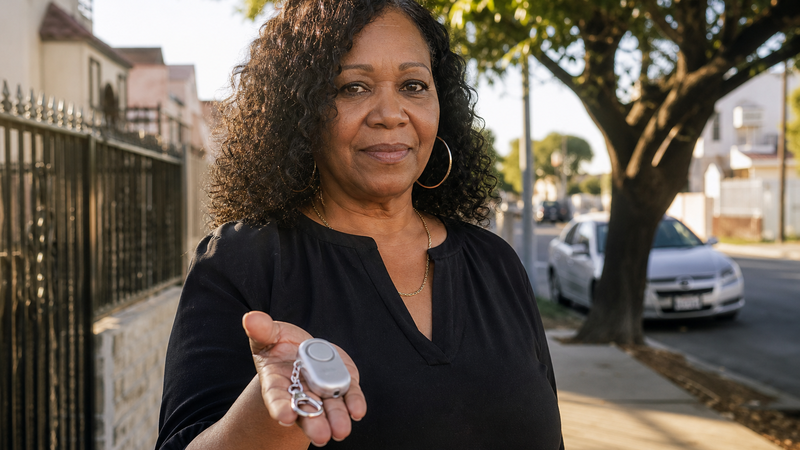
A personal alarm is a small, handheld device — usually clip-sized, sometimes keychain-mounted — that produces a loud, sustained, high-pitched sound when activated. Most quality models operate between 120 and 130 decibels. To put that in terms your body will understand: a chainsaw runs at about 110 decibels. A personal alarm set to 130 decibels is louder than that. It is louder than most car alarms. It will be heard from a significant distance, even through walls and traffic.
Activation is usually one of two methods: a pull-pin design, where removing a pin triggers the alarm and reinserting it stops it, or a push-button design. The pull-pin style is particularly effective in a self-defense scenario because if the device is yanked away from the carrier, the pin stays in the carrier’s hand and the alarm keeps screaming. That is not an accident. That is engineering designed around what actually happens when someone is grabbed.
The mechanism of protection is threefold. First, the sound startles and disorients the threat. Most predators are working with a plan — and that plan assumes silence. Sudden, deafening noise breaks the plan instantly. Second, it draws witnesses. People on the street, in nearby buildings, in passing cars — they hear it and they look. That attention is the last thing a predator wants. Third, it gives the person in danger a window. Not a fight. A window. A few seconds to move, to run, to get to a door or a phone or another person.
What makes a personal alarm different from other non-lethal self-defense options?
This is the question worth asking carefully, because not all non-lethal tools work the same way or fit the same situations. Pepper spray requires aim, proximity, and the presence of mind to deploy correctly under stress. A stun gun requires physical contact. A tactical keychain requires the willingness and ability to use it in close range. Each of those tools has its place — and I carry information about all of them right here on this site, including a breakdown of the real differences between a TASER and a stun gun if you want to go deeper on that comparison.
But a personal alarm has one thing none of those other tools offer: it requires nothing from you in terms of physical engagement. No grip strength. No precision. No split-second decision about aim or distance. You pull a pin or press a button, and the work is done. That makes it uniquely valuable for people who may struggle with other tools — elderly individuals, children, people recovering from injury, people who freeze under stress. And it makes it an essential layer even for people who do carry other tools, because the alarm can be activated before a situation escalates to physical contact.
Think of it this way: your layers of protection should work together. The alarm is the first layer — it screams before anyone touches you. What you carry alongside it handles anything that gets through that first layer. If you want to see how these tools pair together for people who are always on the move, my post on personal alarms versus pepper spray for runners walks through exactly that.
Are there any legal restrictions on personal alarms?
This is where personal alarms genuinely stand apart from nearly every other self-defense tool on the market. In the United States, personal alarms face virtually no legal restrictions. Unlike pepper spray, stun guns, or tasers — which carry state-by-state regulations and sometimes require permits or have age restrictions — a personal alarm is legal to carry in all 50 states, in most public buildings, on most college campuses, and in most situations where other tools would be prohibited or impractical.
That matters enormously for certain groups. Students in campus housing where pepper spray may be banned. Employees working in buildings with security restrictions. Travelers going through airports. People in states with strict weapon laws. A personal alarm is accessible to virtually everyone, everywhere. That universality is not a limitation — it is a feature.
One note of practical honesty: I always recommend checking local regulations yourself and speaking with someone who knows your state’s laws before relying on any self-defense tool. I can tell you how these products work. I am not able to give you legal advice specific to your situation. What I can tell you is that in my experience and research, personal alarms are among the least-regulated self-defense tools that exist.
Who should be carrying a personal alarm right now?
The honest answer is: most people. But let me be specific, because specifics are what actually get people to act.
Children walking to school or spending time in public spaces should have a personal alarm within reach. Not a weapon — an alarm. Something they can activate without hesitation if an adult approaches them in a way that feels wrong. If you have a child or grandchild in your life, look at the personal alarms made specifically for children — they are designed with small hands and simple activation in mind.
Teenagers need them too. Kids heading to school, to practice, to part-time jobs — they are out in the world without adults nearby, and they need tools that do not require a level of physical confidence they may not have yet. A self-defense keychain for teens that includes or pairs with a personal alarm is one of the most practical things a parent can put in their child’s bag right now.
Runners and walkers. Women heading to their cars in parking garages. Night-shift workers. Rideshare drivers. Anyone elderly who lives alone. Anyone who has ever walked a route and felt the hairs on the back of their neck stand up. That feeling your body gives you is information — and a personal alarm is the tool you reach for when that information arrives.
What decibel level should a personal alarm be to be effective?
Do not settle for anything under 120 decibels. That is the floor. At 120 dB, you have a tool that is genuinely disorienting to someone standing nearby and audible at a distance. At 130 dB — which is what most quality personal alarms reach — you have a sound that causes real physical discomfort at close range and can be heard from well over 1,000 feet in open conditions.
Some cheaper products advertise themselves as personal alarms but produce sounds in the 100-110 dB range. That is not loud enough to reliably draw attention in a busy urban environment or to cause the startle response in an attacker that you are counting on. When you are shopping, look at the decibel rating the same way you would look at any safety specification — it is not a marketing number, it is a performance number.
Battery life and activation reliability matter just as much as decibel rating. A pull-pin alarm that fails to activate under stress, or one whose battery died three months ago because you forgot to check it, is not a safety tool — it is a false sense of security. Check your alarm regularly. Replace batteries on a schedule. If your alarm uses a replaceable battery, make that part of your routine the way you check your smoke detector.
Can a personal alarm be used alongside other self-defense tools?
Not only can it — it should be. A personal alarm works best as the first response in a layered safety plan. The idea is that different threats arrive differently, and no single tool handles every scenario with equal effectiveness.
Runners, for example, carry specific challenges: hands that need to stay free, routes that take them away from witnesses, and physical exhaustion that can affect reaction time. A personal alarm clipped to a wrist strap or running pack is accessible in a way that digging through a pocket never is. Pair that with a self-defense keychain built for runners and you have covered two very different ranges of threat with two tools that do not interfere with each other.
For women who want something that does double-duty at close range, a cat ear keychain worn alongside a personal alarm gives you both a noise deterrent and a contact-range option. That combination costs less than most people spend on coffee in a week, and it works. The point is to build a plan, not just buy one thing and hope it covers every situation.
Frequently Asked Questions About Personal Alarms as Non-Lethal Self-Defense
Is a personal alarm really enough for self-defense on its own?
A personal alarm is a highly effective first layer of self-defense, but no single tool covers every scenario. It works best when it buys you seconds to escape or draws witnesses who change the dynamic. For complete protection, most safety experts recommend pairing a personal alarm with at least one other non-lethal option, such as pepper spray or a tactical keychain, depending on your situation and local laws.
How loud does a personal alarm need to be to actually work?
Aim for a minimum of 120 decibels — and 130 dB is better. Below 120 dB, a personal alarm may not be loud enough to reliably disorient an attacker, cause physical discomfort at close range, or be heard clearly at distance in a noisy urban environment. Always check the decibel rating before purchasing. A lower number is not a minor difference — it is a meaningful gap in performance when it matters most.
Are personal alarms legal everywhere in the United States?
Yes — personal alarms are legal to carry in all 50 states and face virtually no legal restrictions at the federal, state, or local level. They are permitted in most schools, campus buildings, workplaces, and public spaces where other self-defense tools may be prohibited. This makes them one of the most universally accessible self-defense tools available. Always verify local rules for your specific situation, but restrictions on personal alarms are extremely rare.
Can children carry personal alarms safely?
Yes, and they should. Personal alarms designed for children are built with simplified activation — typically a large pull-pin or push-button — that small hands can operate quickly. They cause no physical harm and require no training to use effectively. A personal alarm gives a child an immediate, loud way to signal danger and attract adult attention, which is exactly what you want in a tool a child is actually going to carry and use.
What is the difference between a pull-pin and a push-button personal alarm?
A pull-pin alarm activates when the pin is removed and continues sounding even if the device is taken from you — making it effective in a grab scenario. A push-button alarm requires you to maintain pressure to keep it active. For self-defense purposes, many safety professionals prefer the pull-pin design because it keeps working without any action from the carrier once activated. Both styles are widely available and effective when decibel ratings meet the 120+ dB standard.
Where on my body or bag should I carry a personal alarm?
Carry it somewhere you can reach in under two seconds without looking. A keychain loop on the outside of a bag, a clip on a waistband or jacket zipper, or a wrist attachment for runners and walkers are all solid options. The biggest mistake people make is putting a personal alarm deep inside a bag or pocket — by the time you dig it out, the window has closed. Accessibility is as important as the alarm itself.
How do I know when to replace my personal alarm?
Check battery life every 90 days if your alarm uses replaceable batteries, and replace them on a fixed schedule regardless of how the alarm sounds — batteries can weaken before they fail completely. For alarms with non-replaceable batteries, follow the manufacturer’s recommended lifespan, which is typically one to three years. Test your alarm monthly by activating it briefly in a safe location. If the sound is weaker than when you first bought it, replace the device.
Do personal alarms work against animals as well as human threats?
In many cases, yes. Sudden loud sound is startling and disorienting to most animals as well as humans, and some personal alarms are specifically marketed for use against dog attacks during outdoor activities. However, animal behavior is less predictable than human behavior, and a personal alarm should not be your only plan if you regularly walk or run in areas with stray dogs or wildlife. Pair it with pepper spray or a deterrent spray rated for animals for more complete coverage.
A personal alarm is not a compromise. It is not the option you choose because you are not ready for something more serious. It is a precision tool built around one of the most reliable truths in self-defense: attention is protection. The moment a threat becomes visible to witnesses, the moment a predator’s plan gets shattered by a sound they cannot control, the odds shift. That is what a personal alarm does. Every time. For anyone willing to carry one.
Keep it within reach. Test it. Replace the battery. And if the people you love do not have one yet, fix that today. Browse the personal alarms available here at Traceys Safety and find the right fit for every person on your list — because preparation is not paranoia. It is love, plain and simple.