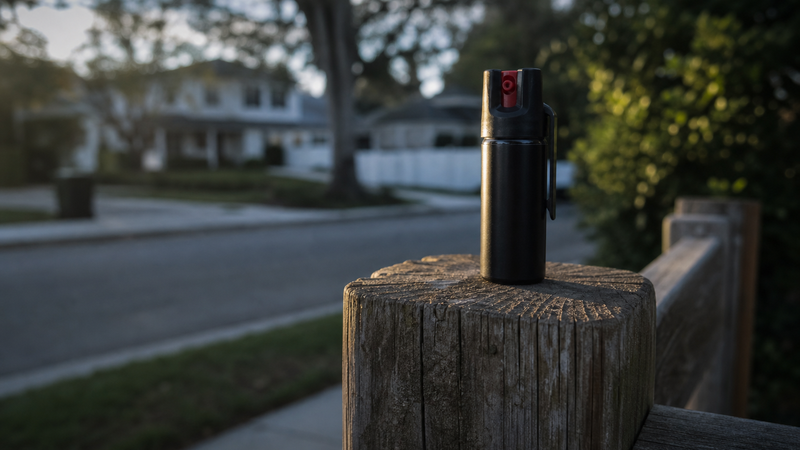
Dog repellent spray works because of a small handful of chemical compounds — the most common being oleoresin capsicum (OC), the same oil-based extract that makes hot peppers burn, sometimes combined with methyl nonyl ketone (MNK) or citronella — that overwhelm a dog’s nervous system temporarily, without causing lasting harm. The specific formula, the concentration, and the delivery method are what separate a product that actually stops a charging dog from one that just smells strong.
But here is where it gets interesting. Most people who buy dog repellent spray — mail carriers, joggers, cyclists, delivery drivers, folks who just want to walk down their own street in peace — never look past the label. They grab something that says “dog repellent” and assume the job is done. What they don’t know is that those two or three ingredients listed on the back of the can are doing very different things in a dog’s body. And understanding how they work changes the way you think about which product is worth carrying.
I’ve been around long enough to know that the quiet details matter more than the loud marketing. So let’s open this up and look at what’s really inside.
What is oleoresin capsicum and why is it in dog repellent spray?
Oleoresin capsicum — most people see it written as “OC” — is an oil extracted directly from hot peppers. It is the same compound that makes human-grade pepper spray so effective, and it carries over to dog repellent for the same fundamental reason: it triggers intense irritation in mucous membranes. Eyes, nose, mouth, throat. For a dog, whose sense of smell is somewhere between 10,000 and 100,000 times more sensitive than a human’s, even a small concentration of OC is overwhelming.
When a dog gets a face full of OC spray, it isn’t just unpleasant — it is disorienting. The eyes swell and tear. The nasal passages inflame. Breathing becomes uncomfortable. None of this causes permanent damage, but it is enough to interrupt whatever the dog was focused on. That interruption is the whole point. You don’t need to hurt the animal. You need ten seconds to change the situation.
The concentration matters. Human pepper sprays often run between 1% and 2% major capsaicinoids — the actual burn-producing molecules within the OC. Dog repellent sprays are typically formulated at a lower concentration because that level of irritation is more than sufficient for a dog without being unnecessarily harsh. Some products list OC percentage by weight; others list the percentage of the total formula. Those are not the same number. Reading the label closely is worth your time.
What is methyl nonyl ketone and how does it affect dogs differently than OC?
This is the ingredient most people have never heard of, and it is the one worth paying attention to.
Methyl nonyl ketone — sometimes written as MNK or 2-undecanone — is a naturally occurring compound found in wild tomato plants. It was actually developed and registered as a pesticide before anyone thought to use it in dog repellents. What it does is exploit a dog’s greatest strength against it: that extraordinary nose.
Unlike OC, which produces a burning, irritating sensation, MNK works more as an olfactory aversive. It smells profoundly wrong to a dog. Not painful exactly — more like a sensory alarm that tells the animal’s brain, at a very deep level, to move away from whatever is producing that signal. Some researchers believe MNK mimics certain predator-marking compounds, which is why a dog’s instinct is to retreat rather than push through it. The effect is behavioral as much as physiological.
Products that combine OC and MNK are working on two separate mechanisms simultaneously — one that physically irritates and one that triggers avoidance behavior. That layered approach is why some formulas perform noticeably better in real-world encounters than single-ingredient versions.
Does citronella actually work as a dog repellent ingredient?
Citronella shows up in some dog repellent formulas and in a lot of training sprays designed to discourage dogs from chewing furniture or jumping on people. The science behind it is more modest than the marketing tends to admit.
Dogs generally dislike the smell of citronella — there is solid enough evidence for that to build a training tool around it. But as a deterrent against an aggressive or charging dog, citronella alone is a weaker choice than OC or MNK. The irritation is minimal. The avoidance response is inconsistent. Some dogs barely blink at it.
Where citronella earns its place is in lighter-duty applications: deterring neighborhood dogs from a property line, discouraging a nuisance dog that isn’t actually threatening anyone, training a pet. For someone who regularly walks routes where dogs run loose and the encounter level is unpredictable, a citronella-only spray is working with less margin than they might realize. That’s not a reason to panic — it’s a reason to know what you’re carrying.
Are there other active ingredients used in dog repellent sprays?
Some formulas include inert carrier ingredients that do real work. The delivery medium — usually water, alcohol, or an oil-based solvent — determines how far the active ingredients travel, how they disperse in the air, and how quickly they hit the target. An alcohol base evaporates faster, which means the OC or MNK becomes airborne more quickly. A heavier base can produce a stronger stream that reaches farther before breaking up into mist.
Some sprays add bittering agents — compounds that taste extremely unpleasant — which are more relevant for training applications than for defensive use in the field. A few products incorporate UV dye, which serves as an invisible marker that shows up under ultraviolet light. That feature matters more in human defensive spray scenarios than in dog encounters, but it speaks to how much crossover there is between the formulation of human and animal repellents.
What you won’t find in a legitimate dog repellent spray is anything designed to cause permanent injury. The whole architecture of these products is built around temporary overwhelming of the senses — enough to stop behavior, not enough to cause lasting harm to the animal. That matters to me personally. Stopping a dog is not the same as hurting one.
How does the formula in dog repellent spray compare to human pepper spray?
The core active ingredient — oleoresin capsicum — is the same. What differs is concentration, secondary ingredients, and delivery design.
Human defensive sprays like those in the Mace and Wildfire lines are often formulated at higher capsaicinoid concentrations because the scenario they’re designed for — a human attacker who may be under the influence of adrenaline, drugs, or willpower — requires more stopping power. A dog, with that hypercharged sense of smell, is affected at much lower concentrations. Dog-specific repellents account for that by calibrating the formula to what actually stops a dog without being heavier than the job requires.
The spray pattern also differs. Many dog repellents use a wider cone or mist pattern rather than a narrow stream, because an animal is moving unpredictably and the goal is to get the agent in front of it, not to land a precise shot. That’s the kind of detail that only becomes obvious when you think through how these encounters actually go. A dog running toward you at speed is not a stationary target. The formula and the delivery system are designed together.
If you want to understand how formulation decisions affect real-world performance in a broader context, the breakdown on how effective bear spray is gets into capsaicinoid concentration in a way that applies here too — because the same logic runs through all OC-based animal deterrents.
Does the concentration of OC in dog spray tell you everything you need to know?
Not quite. This is the part that most product descriptions gloss over, and it’s worth understanding.
OC percentage is a measurement of the total oleoresin capsicum in the formula. But the heat — the actual burn — comes from the capsaicinoids within that OC, specifically compounds like capsaicin and dihydrocapsaicin. A product can have a high OC percentage and relatively low capsaicinoid content if the pepper extract used wasn’t particularly potent to begin with. That’s why some manufacturers list major capsaicinoid (MC) percentage separately — it’s a more precise indicator of the formula’s actual strength.
For dog encounters, this distinction matters less than it does for human defensive spray, because the threshold for overwhelming a dog’s senses is lower. But if you’re the kind of person who wants to understand what you’re buying before you carry it — and you should be — knowing the difference between OC percentage and MC percentage keeps you from being misled by a number that sounds impressive without telling the whole story.
Products like those in the MultiGuard and Mace lines are worth looking at for how they handle these specifications. Reputable manufacturers are transparent about their formulas. If a label is vague about the active ingredients or doesn’t disclose concentration at all, that tells you something.
Frequently Asked Questions About Dog Repellent Spray Ingredients
What is the main active ingredient in most dog repellent sprays?
The most common active ingredient is oleoresin capsicum (OC), an oil extracted from hot peppers. It irritates a dog’s eyes, nose, and throat on contact, causing temporary discomfort and disorientation without permanent harm. Some formulas also include methyl nonyl ketone (MNK), which triggers avoidance behavior through a dog’s acute sense of smell rather than direct irritation.
Is methyl nonyl ketone safe for dogs?
Yes. Methyl nonyl ketone (MNK) is registered by the EPA for use as an animal repellent and is not intended to cause injury. It works as an olfactory aversive — it smells profoundly wrong to dogs and triggers retreat behavior. The effects are temporary. It is a naturally occurring compound found in wild tomato plants and has an established safety profile when used as directed in repellent formulas.
What percentage of OC should a dog repellent spray contain?
Most dog repellent sprays are formulated at OC concentrations lower than human defensive sprays — often in the 0.35% to 1% range — because a dog’s sense of smell makes it sensitive to much lower concentrations. The exact number matters less than the quality of the formulation and the delivery method. Look for products that also disclose major capsaicinoid (MC) percentage for a more accurate picture of actual strength.
Can I use human pepper spray on a dog instead of dog-specific repellent?
Human pepper spray will affect a dog, but it isn’t formulated for that use case. Dog-specific repellents are designed with appropriate concentrations and spray patterns for animal encounters. Using human-grade pepper spray on a dog is not recommended — concentrations may be unnecessarily high, and the spray pattern may be less effective for a moving animal. Carry the right tool for the job.
Does citronella in dog spray actually stop an aggressive dog?
Citronella is effective for mild deterrence and training applications — dogs dislike the smell and will generally avoid it. But for a dog that is actively charging or showing serious aggression, citronella alone provides less reliability than OC or MNK-based formulas. For serious protection on routes where dog encounters are unpredictable, a formula with OC or MNK is a more dependable choice.
How long do the effects of dog repellent spray last?
The effects of OC-based dog repellent typically last between 15 and 45 minutes, depending on the dog’s size, the concentration of the formula, and how directly it was applied. MNK’s effects are similarly temporary. The goal is not prolonged incapacitation — it’s enough disruption to change the situation. Full recovery with no lasting harm is expected and intended.
Does weather or wind affect how dog repellent spray performs?
Yes, and this is one of the most overlooked practical considerations. Wind can redirect a spray back toward you, and extreme cold can reduce the propellant pressure in the canister. Heat can increase pressure and affect the spray pattern. Most repellents work best in calm conditions and within the range listed on the label — typically 8 to 12 feet. Knowing your product’s range and checking wind direction before you spray is not overthinking it. It’s just smart.
How should I store dog repellent spray to keep it effective?
Store it at room temperature, away from direct sunlight and extreme heat. Don’t leave it in a hot car for extended periods — the propellant can degrade. Check the expiration date on the canister; most dog repellents have a shelf life of two to four years. Test-spray periodically to confirm the nozzle is clear and the product still fires correctly. A canister that fails when you need it is worse than no canister at all.
The quiet truth about dog repellent spray is that the ingredients doing the real work are ones most people have never heard of and never thought to ask about. OC, MNK, citronella — each one is working on a different part of a dog’s nervous system, and the combination in a well-made formula is built on more careful science than the small canister on your keychain might suggest. Now you know what’s inside. That knowledge is not a small thing.
If you’re ready to find the right product for your routes and your risks, browse the dog repellent sprays at Tracey’s Safety and look at the formulation details with fresh eyes. You’ll know exactly what you’re reading now.