Personal alarms help college students most in the gap between “something feels wrong” and “someone actually notices” — that stretch of a dark parking lot, an empty stairwell, a walk back from the library nobody else sees. They’re not a cure-all, and they won’t stop a determined attacker on their own. But they’re cheap, small, dorm-room legal almost everywhere, and they do one thing extremely well: they make noise when a student’s voice can’t or won’t. Whether they “work” depends entirely on where, when, and how a student actually carries one.
Here’s a question nobody asks in the freshman orientation packet: what happens to that personal alarm your mother clipped to your backpack in August by the time October rolls around?
I’ll tell you what usually happens. It ends up in a junk drawer next to a phone charger that doesn’t fit anything anymore. Not because it’s a bad product. Because nobody ever explained when it actually helps and when it’s just a shiny thing dangling off a zipper doing nothing at all. There’s a whole conversation about personal alarms that parents and campus safety offices skip right past — the part where they tell you the truth instead of just the sales pitch. That’s the conversation we’re having today.
Do personal alarms actually work for college students?
Yes — but only in specific situations, and that’s the part that gets left out. A personal alarm’s whole job is to turn a quiet, isolated moment into a loud, public one. On a campus with security patrols, RAs, and other students walking nearby, that works beautifully. A 130-decibel shriek from something like the personal alarms built for women walking alone cuts through headphones, conversation, even a dorm hallway door. It doesn’t ask permission. It doesn’t care if you’re too scared to scream. It just screams for you.
Where it doesn’t work is the situation nobody wants to picture: total isolation. A back stairwell at 2 a.m. that nobody uses. A satellite parking lot three blocks from anything. An off-campus street where the nearest occupied house is dark. The alarm goes off — and nothing happens, because there’s nobody there to hear it. That’s not a flaw in the device. That’s physics. Noise needs an audience.
What situations on campus actually call for one?
The situations that matter most are the ones that feel the most routine — which is exactly why students stop being careful about them. Walking back from a night class. Leaving a library that closes at midnight. The stretch between a friend’s dorm and your own after a party winds down. These aren’t dramatic moments. They’re mundane ones, repeated dozens of times a semester, which is precisely how risk sneaks in.
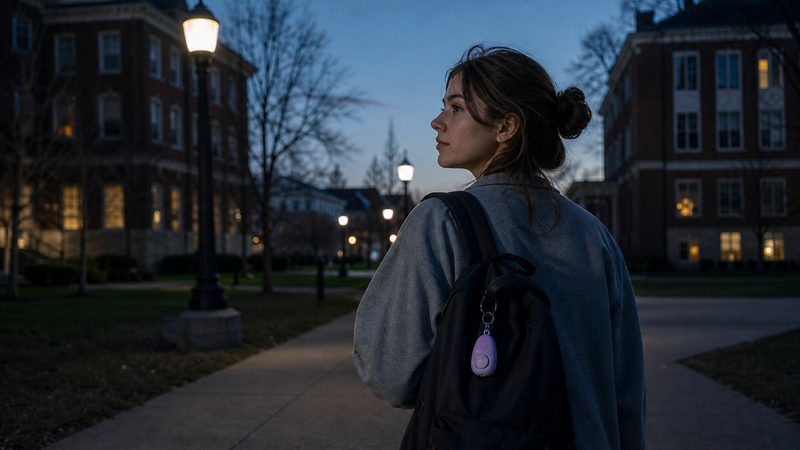
A personal alarm earns its place in those exact gaps — not as a dramatic last resort, but as a quiet insurance policy clipped somewhere your hand already goes. Students who keep theirs on a keychain or a bag zipper — where their thumb finds it without looking — get real use out of it. Students who bury it in a backpack pocket under textbooks might as well not own one. There’s a reason the same logic shows up in our piece on what to actually carry when walking alone — the tool only matters if it’s reachable in three seconds, not thirty.
What are the honest downsides nobody mentions?
The biggest one is the one I already told you: alarms need witnesses. A campus emergency blue light box works because it’s connected to something. A personal alarm works because someone is close enough to hear it and react. Off-campus housing, rural satellite lots, and late-night walks through neighborhoods that thin out after 10 p.m. — these change the math entirely.
The second downside is habit decay. Students clip an alarm to a bag in week one, full of good intentions, and by week eight it’s silent because the battery’s dead or the pin’s never been tested. A personal alarm that’s never been triggered even once in practice is a gamble on a night when there’s no time to figure out how it works.
The third downside is a quieter one — overconfidence. An alarm is one layer, not a shield. It buys attention and seconds. It doesn’t replace walking with a friend, staying in lit areas, or telling someone your route home. Students who treat it as the whole plan instead of one piece of the plan are the ones who get caught off guard when the noise doesn’t bring anyone running.
Which type of personal alarm actually fits a student’s life?
This is where most guides get vague, so let me be specific. A wearable alarm that clips to a keychain, lanyard, or bag strap outperforms one that lives loose in a pocket, every single time — because retrieval speed is the whole game. Something in the 120–130 decibel range is loud enough to cut through a crowded quad or a dorm hallway without needing to be perfectly aimed or perfectly timed.
Students who split time between campus and travel — heading home for breaks, studying abroad, taking a bus across the state — often do better with something dual-purpose, which is worth reading about in our breakdown of personal alarms built for travelers. And for students who run before dawn or after dark for exercise, the calculus shifts again — that’s covered in our comparison of a personal alarm versus pepper spray for runners, since a moving target on an empty trail has different needs than someone walking a lit sidewalk.
There’s also a version of this conversation most people never have — the version for students with siblings back home who have autism and rely on nonverbal ways to signal distress. If that’s part of your family’s world, our page on the personal alarm designed for kids with autism is worth a look, because the logic of “noise equals help” applies differently when verbal communication isn’t reliable.
What’s the one thing most students get wrong about carrying one?
They treat it like decoration instead of equipment. I’ve watched alarms hang off backpacks for an entire semester, never once tested, battery slowly dying, pin never pulled even in practice. There’s something almost superstitious about it — like just having the thing nearby is protection enough. It isn’t.
The students who actually benefit are the ones who test the alarm once a month, know exactly which direction the pin pulls, and know exactly where their thumb needs to go without looking down. That thirty seconds of practice is the difference between a tool that works when it matters and a expensive keychain ornament.
The other quiet mistake is assuming campus is uniformly safe just because it’s campus. Every school has its blind spots — a stairwell nobody monitors, a lot with a burned-out light the maintenance request never got to. Students who walk their own routes and notice where the gaps are tend to carry their alarms with more intention, because they know exactly which ten minutes of their day actually need it.
Frequently Asked Questions About Personal Alarms for College Students
Are personal alarms allowed in dorm rooms and on campus?
Almost every U.S. college allows personal alarms — they’re not weapons, so they don’t trigger the same restrictions as pepper spray or stun devices on some campuses. Still, it’s worth a quick check with your specific school’s housing policy before move-in, since rules vary slightly between institutions and residence halls.
Do personal alarms drain phone batteries or need charging?
Most personal alarms run on small replaceable batteries, not rechargeable ones, and last months or even years between changes since they only draw power when triggered. They don’t connect to your phone at all — that’s actually part of their appeal, since they work even when your phone is dead or left behind.
Will a personal alarm actually scare someone off?
A sudden 120–130 decibel blast is disorienting and startling, which is often enough to interrupt someone’s intent and buy a few critical seconds. But its real power is drawing attention from anyone nearby — the noise itself matters less than who hears it and reacts. That’s why context matters more than the device.
Should I carry a personal alarm instead of pepper spray?
They’re not really competitors — they solve different problems. An alarm draws help toward you; pepper spray creates distance from a threat directly. Many students carry both, one on a keychain and one in a bag pocket, so they’ve got a layered response rather than betting everything on one tool.
What’s the best place to clip a personal alarm for quick access?
Keychains and bag zipper pulls work best because your hand already goes there dozens of times a day out of habit, which means muscle memory kicks in under stress. Anything buried in a backpack’s main compartment defeats the purpose — if you have to dig for it, the moment it’s meant for has already passed.
Do personal alarms work off-campus in apartments or parking lots?
They can, but effectiveness drops in isolated areas where there’s no one nearby to hear the noise and respond. Off-campus students in quieter neighborhoods often pair an alarm with other precautions — walking with a friend, using well-lit routes, or sharing location with roommates — rather than relying on the alarm alone.
How loud does a personal alarm need to be to be useful?
Most effective personal alarms sit between 120 and 130 decibels, comparable to a chainsaw or a siren at close range. Anything quieter risks getting lost in campus noise — traffic, music, crowds — while alarms in that range reliably cut through and grab attention even in busy environments.
Can a personal alarm go off by accident in a backpack?
It’s uncommon with most designs, since the pin requires a deliberate pull to trigger the sound, but it can happen if the alarm gets jostled against other items with the pin loosely seated. Clipping it externally rather than burying it loose among books actually reduces this risk while also improving access speed.
Personal alarms don’t promise a guarantee — nothing does, and I’d never tell you otherwise. What they promise is a chance. A chance that someone hears, someone looks, someone’s night gets interrupted before it turns into something worse. For a college student walking that last stretch between the library and the dorm, sometimes a chance is exactly what’s needed. Carry it where your hand already goes. Test it before you need it. And know the difference between the nights it can help you, and the nights it can’t — because that knowledge matters more than the alarm itself ever will.