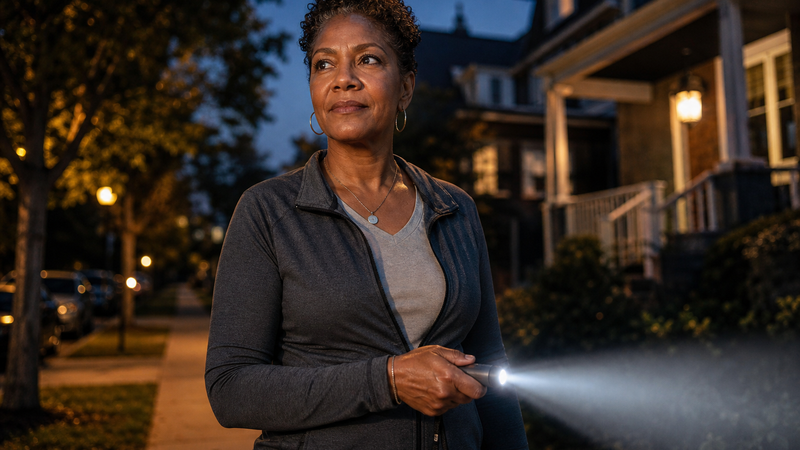
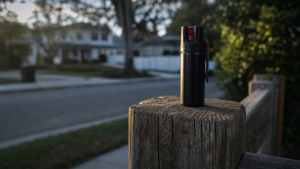
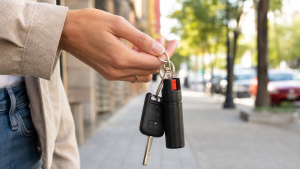
The best personal alarm with a built-in flashlight is one that delivers a minimum of 120 decibels, activates instantly with a single motion, and pairs that siren with a flashlight bright enough to light your path and disorient an attacker at close range. The Streetwise Safety Light and the Multifunction personal alarms sold at Tracey’s Safety are among the strongest options in this category, combining real stopping noise with genuine illumination in a package small enough to keep on your keychain every single day.
Now let me tell you why this combination matters more than most people realize — and why getting this choice right is not something you want to leave to chance.
Why does a personal alarm need a flashlight at all?
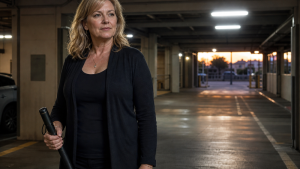
Because darkness is where bad situations go from possible to certain. Think about the moments when you actually need a personal alarm — walking to your car in a parking structure at 9 p.m., crossing that last stretch between the bus stop and your front door, navigating a trail at dusk that took longer than you planned. Every single one of those moments also involves low light. A device that can only make noise is doing half the job.
A built-in flashlight gives you three things a standalone alarm cannot. First, it lights your path so you do not trip over something and go down before anything else even happens. Second, it signals your location when you activate the alarm — the beam turns you visible to people who might help. Third, and this is the one most people do not think about, a bright flashlight pointed directly at an attacker’s eyes at close range is genuinely disorienting. It buys you the same thing the alarm buys you: seconds. And seconds are everything.
This is not about carrying a weapon. It is about removing every advantage a predator thinks they have. Darkness is cover. A flashlight alarm strips that cover away the moment it matters.
What decibel level is loud enough in a personal alarm?
One hundred and twenty decibels is your floor. Walk away from anything under that number. At 120dB, you are producing a sound roughly equivalent to a rock concert heard from the front row. At 130dB — which is where the strongest personal alarms operate — you are at chainsaw and jackhammer territory. That level of sound does not just alert bystanders. It is physically painful and deeply startling to anyone within a few feet of the device.
The reason this matters so much is physics. Sound drops off fast with distance. A 100dB alarm that sounds impressive in a quiet store will be nearly unremarkable a hundred feet away on a noisy street. A 130dB alarm still carries authority at a distance. When you are activating a personal alarm, you are not just trying to scare one person — you are trying to pull attention from every direction within earshot. That requires real volume.
Every personal alarm I carry, and every one I recommend, starts at 120dB. Most of the strongest options in stock at Tracey’s Safety hit 130dB. Do not negotiate on this number. It is the one specification that determines whether the device actually does its job.
How does a combination flashlight alarm actually work in an emergency?
The best designs in this category activate both functions simultaneously with one action — typically pulling a pin, pressing a button, or sliding a switch. That single motion is critical. In a real moment of danger, you do not have the fine motor control to push one button for the alarm and a second button for the flashlight. Stress narrows your focus and tightens your hands. The device you carry needs to assume that and design around it.
Pin-pull activation is generally the gold standard for pure reliability. You pull the pin, the alarm activates, and it stays activated until you reinsert the pin. There is nothing to hold down, nothing to keep pressed, no way to accidentally cancel it because your grip shifted. The pin can also be attached to your wrist strap or bag so that any attempt to snatch your bag triggers the device automatically.
Button activation with a recessed or guarded button works well too, particularly when the same press activates the flashlight. What you want to avoid is any design with a complicated two-step or mode-cycling system. If a person has to remember which press pattern activates the alarm versus the flashlight, that person is going to hesitate at exactly the wrong moment.
For a deeper look at how these devices compare to other alarm categories, this breakdown of panic alarms versus personal alarms is worth reading before you buy.
What size and carry method actually works for daily use?
The most sophisticated alarm in the world does you exactly zero good sitting on your dresser. That is not a lecture — it is just physics. Carry determines everything. So before you choose a device, ask yourself honestly how you are going to carry it, and whether you will actually carry it that way every day.
Keychain-style alarms are the most consistently carried because they attach to the thing you already never leave home without. A device that clips to your keys becomes automatic — it goes where your keys go. For most people, this is the right choice. Look for a unit compact enough to not add bulk but large enough to grip confidently under pressure. Many of the personal alarms designed for children at Tracey’s Safety hit this profile perfectly — and are just as effective in adult hands.
Carabiner-clip designs give you more mounting flexibility — bag strap, belt loop, backpack zipper — and are a strong choice for runners, hikers, or anyone whose keys are not always accessible. Wrist-worn versions exist and have real advantages for runners specifically, though they can feel awkward for daily carry.
One thing that matters more than most buyers think: weight. A personal alarm that feels heavy or bulky gets left behind. Lightweight design is not a compromise — it is a feature that determines whether the device actually comes with you.
Are there personal alarms built for specific users like kids or people with disabilities?
Yes, and the differences in design matter. For children, you want activation that is simple enough for small hands under stress, durable enough to survive being a kid’s everyday carry, and loud enough to alert adults from a meaningful distance. The personal alarm options designed for kids with autism at Tracey’s Safety are worth looking at specifically — they account for sensory needs and activation simplicity in ways that generic alarms do not.
For elderly users, the priorities shift toward grip-friendly designs, minimal button complexity, and activation mechanisms that work even with limited hand strength or dexterity. A pin-pull design is often ideal here because it requires almost no grip strength and cannot fail to activate once the pin is pulled.
For runners and people who need hands-free options, wrist-mount designs or carabiner clips on a hydration vest are the right direction. The alarm needs to be accessible at a full sprint without requiring you to dig through a bag or unhook something from your belt. If you are a runner weighing your options, take a look at this comparison of personal alarms versus pepper spray for runners — it lays out the tradeoffs cleanly.
What battery life should you expect and how do you maintain a personal alarm?
Most quality personal alarms with built-in flashlights run on standard replaceable batteries — typically AAA or CR2032 lithium cells — and will hold charge for months to years in standby mode. A few rechargeable USB models exist, but replaceable batteries are more practical for most users because a dead rechargeable device is dead until you find a cable and a power source. A fresh battery from any convenience store puts you back in business in thirty seconds.
The maintenance protocol for a personal alarm is simple and should become automatic. Replace the batteries on a fixed schedule — every six to twelve months, or whenever you change your smoke alarm batteries. That is the easiest way to remember. Test the alarm briefly (outside, away from people) when you replace the batteries. And if your model has a removable activation pin, check that the pin ring and cord are secure and have not worn through.
The flashlight component is worth checking too. A dim or flickering flashlight is not doing its job. If your alarm’s flashlight has lost brightness, that is your signal to replace the batteries even if the alarm itself still sounds strong. Both functions need to be working at full strength — carrying a half-functioning device gives you false confidence without the real protection behind it.
Frequently Asked Questions About Personal Alarms With Built-In Flashlights
How loud should a personal alarm with a flashlight be?
At minimum, 120 decibels. The strongest models reach 130dB, which is roughly equivalent to a jackhammer at close range. This level of sound is physically startling, carries over distance and ambient noise, and commands attention from bystanders. Anything below 120dB is not loud enough to be reliable in a real street environment where competing noise exists.
Can a personal alarm flashlight be used as an everyday flashlight?
Yes, and this is one of the best arguments for carrying a combination device. Using the flashlight function regularly keeps you familiar with how the device operates, helps you notice if battery life is dropping, and makes carrying the device feel natural rather than like something you only pull out in an emergency. Regular use means regular readiness.
Will a personal alarm work if I’m panicking and my hands are shaking?
A well-designed personal alarm is built for exactly that condition. Pin-pull models activate the moment the pin is removed and stay active without any continued action from you. Button-activation models with large, recessed buttons require minimal precision. Avoid any design with mode cycling or multiple steps — simple activation is a safety specification, not a convenience preference.
Are personal alarms legal to carry everywhere?
Personal alarms have no federal restrictions and are legal to carry in all 50 states. They are also TSA-approved for carry-on luggage. Unlike pepper spray or stun guns, they face no state-level restrictions and require no permits. They can be carried into schools, courthouses, and other locations where self-defense tools are prohibited. This makes them one of the most universally accessible safety tools available.
How far away can people hear a 130dB personal alarm?
A 130dB alarm can be heard from up to a quarter mile away in a quiet environment. In an urban setting with competing noise, effective audible range is typically one to three blocks depending on conditions. This is sufficient to reach bystanders, draw attention from nearby businesses or residences, and make an attacker aware that their presence is now very public and very loud.
Can a personal alarm replace pepper spray or a stun gun?
No — and they should not be compared as substitutes. A personal alarm is a deterrence and attention-calling tool. Pepper spray and stun guns for personal protection are direct-contact defensive tools. They serve different roles in a layered personal safety plan. Many people who carry pepper spray or a stun gun also carry a personal alarm, because the alarm can buy distance before direct defense is ever needed.
What makes a personal alarm with a flashlight better than carrying a separate flashlight?
Integration. In a high-stress moment, searching for two devices instead of one costs time you may not have. A combination device guarantees that the tool you reach for in the dark is also the tool that screams for help. Eliminating that fumble is not a convenience upgrade — it is a safety advantage. The best personal safety tools are the ones that work without requiring you to think.
Is a personal alarm effective for someone who cannot run or fight back?
Absolutely — and this is exactly the population a personal alarm is designed to protect best. For elderly individuals, people with mobility limitations, or anyone who physically cannot create distance from a threat, a 130dB alarm does the work that running would otherwise do. It removes the attacker’s cover of silence and anonymity, turning a private crime into a very public event. Sound is a great equalizer.
A personal alarm with a built-in flashlight is one of the most straightforward, no-excuses pieces of personal safety equipment you can own. There is no training required, no permit to obtain, no complicated technique to master. You pull the pin. The world stops and looks. That is the whole mechanism. And it works.
The only version of this tool that does not work is the one you left at home. Get one that fits your life — keychain, carabiner, wrist strap, whatever keeps it with you — and then keep it with you. Every single day. Browse the personal alarm options at Tracey’s Safety and find the configuration that fits your carry. The right choice is the one you will actually use.