For everyday self-defense carried by someone who walks the streets, rides the bus, or works a night shift, a folding knife with a tanto or drop-point blade between 3 and 4 inches long gives you the most reliable combination of strength, control, and legal portability. The tanto holds its point under pressure. The drop-point gives you a broader, more forgiving tip. Either one, in the right hands and the right moment, can buy you the seconds you need to get away safe.
I want to talk to you about something that took me a long time to sit down and write. Not because I don’t know the subject — I do — but because this one is personal in a way that a lot of my posts aren’t. When my cousin Darnell was walking home from his shift at the warehouse two years ago, a man stepped out from between two cars and demanded his phone. Darnell didn’t have anything on him that gave him options. He handed over his phone and made it home, thank God, but he sat in my kitchen afterward and he was shaking. That look on his face — I never want to see it again on someone I love. That’s the reason I take this seriously. That’s the reason you’re reading this. We deserve options. Real ones. Let me tell you what I know about blades.
Why does the shape of a knife blade matter for self-defense?
Most people, when they think about a self-defense knife, think about sharpness. And yes, sharpness matters. But the shape of the blade — what knife people call the grind and the profile — determines what that blade can actually do under stress, in the dark, with your hands shaking and your heart pounding through your chest.
Different blade shapes are engineered for different jobs. A blade with a thin, curved tip is wonderful for detail work — slicing rope, opening boxes, carving. But put that same tip against a heavy material under real pressure and it can snap. A blade with a reinforced, angular tip is built to drive through resistance. When self-defense is the goal, that difference is not academic. It is everything.
Think about it this way. You are not planning to fight. Nobody planning to protect themselves is planning to fight. You are planning to create enough of a disruption — enough of a moment — to get yourself or someone you love out of danger. The blade you carry needs to work the first time, with no warm-up, no second chance. The shape of that blade is part of what makes that possible.
What makes a tanto blade effective for self-defense?
The tanto blade is the one I recommend most often, and the one I feel the most confident standing behind. It has a distinctive angular look — a straight edge that meets a secondary flat grind near the tip, creating a reinforced point that is almost impossibly strong for its size. That geometry is not an accident. It was designed, originally, for penetrating hard surfaces. For self-defense purposes, that means it maintains its integrity under the kind of stress that would bend or break a thinner tip.
If you have never held a tanto, go look at our tanto blade folding knife and just look at the shape of it. There is something honest about it. It does not pretend to be decorative. It is a working blade with a clear purpose, and it carries that purpose with dignity.
The tanto also has less belly — meaning it is not as curved along the cutting edge as some other profiles. That makes it less ideal for slicing tasks, and that is a real tradeoff. But for the person whose primary reason for carrying a knife is personal safety, not camp cooking, that tradeoff is absolutely worth it. You are carrying something that is strong where strength matters most.
It also presents a psychological reality that I won’t pretend doesn’t exist. The angular, deliberate shape of a tanto, deployed at the right moment, sends a clear message: I am not a victim today. That message alone, before anything physical happens, can change the outcome of a situation.
How does a drop-point blade compare for personal protection?
If the tanto is the blade I recommend for people who want maximum structural integrity at the tip, the drop-point is the blade I recommend for people who want maximum versatility in a single carry knife. The drop-point has a spine that curves gently downward toward the tip, creating a slightly lowered point and a broad, strong blade body behind it.
That broad body gives you control. The tip, while not as reinforced as a tanto, is still quite strong and sits in a position that is very natural for a defensive grip. Many people who have never carried a knife before find the drop-point easier to orient quickly, because the curve of the spine makes the point’s location intuitive even in low light or high stress.
For someone who wants one knife that does real daily carry tasks and also rides along as a last-resort safety tool, the drop-point is a beautiful answer. It is honest about what it is — a general-purpose blade that can rise to a harder moment if that moment ever comes.
If you want to understand more about how a knife designed for defensive carry differs from what you might already have in your pocket or your junk drawer, I’d encourage you to read our post on how a tactical knife differs from a regular pocket knife. It will change how you look at what you’re already carrying.
What blade length is safest and most practical for self-defense carry?
This is the question I get more than almost any other, and I want to answer it carefully because the honest answer has two parts: what works best practically, and what keeps you on the right side of the law.
Practically speaking, a blade between three and four inches is the sweet spot for most people carrying a knife for personal protection. It is long enough to be a real deterrent and a real tool, but short enough to control precisely under stress. A blade that is too long becomes unwieldy. It is harder to draw cleanly, harder to manage in close quarters, and frankly harder to carry discreetly day to day.
Legally speaking — and I want to be clear that I am not a lawyer and you need to check the laws for your specific city and state — many jurisdictions have restrictions on blade length for concealed carry. California, where I live and where many of my neighbors carry, has a general limit of blade length you can carry concealed that varies by locality. Three inches is a length that tends to be permissible in many places, but I am not telling you to assume that. Look it up for where you live. Laws around knife carry vary enormously from city to city and state to state, and no knife, no matter how good, is worth a charge that follows you for years.
Is a serrated or plain edge better for self-defense?
Plain edge. For most people, in most defensive scenarios, a plain edge is the better choice, and here is why I believe that in my bones: a serrated blade requires a sawing motion to be effective. Under real stress, in real fear, fine motor skills go out the window. Your hands tighten, your vision narrows, your body does what it knows how to do instinctively. A plain edge cuts on a push or a draw without requiring technical technique. It does its job when your body is running on adrenaline and instinct.
Serrated edges also require more maintenance to keep truly sharp, and a dull serrated edge is dramatically less effective than a dull plain edge. A plain edge you can sharpen on a basic whetstone at home. A serrated edge needs specialized tools to maintain properly. For a working person who is not a knife enthusiast — just someone who wants to be prepared — that maintenance gap matters.
That said, some folding knives offer a combination edge — plain along most of the blade, serrated near the handle — and for utility tasks, that has real value. If you find a combination blade you love in the right profile and length, that is a reasonable carry. Just understand that in a defensive moment, you will be using the plain edge portion, so make sure that portion is doing the heavy lifting in terms of quality and sharpness.
Should a knife be my primary self-defense tool, or do I need something else?
Honey, this is the question I always wish people asked first, because the honest answer is that a knife should almost never be your first line of protection. A knife is a last resort — a tool for the moment when everything else has failed and someone is close enough to you that you have no other options. It requires you to be close to a threat to use it. That proximity is exactly where you do not want to be.
Your first line of protection is awareness. Knowing who is around you, which way your exits are, which block feels off tonight. That costs nothing and saves more lives than any product I sell.
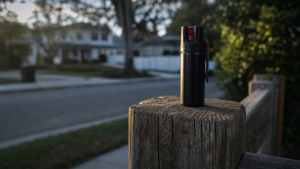
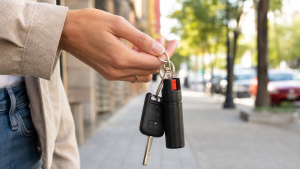
Your second line is distance — tools that let you respond to a threat before it closes on you. A personal alarm that screams loud enough to draw attention from a block away. Pepper spray that you can use from six to ten feet. These create distance and confusion that give you time to run, which is always the best outcome. If you haven’t thought about what you carry alongside a knife, read our post on the best non-lethal weapons for home protection — a lot of that thinking applies to what you carry on your person too.
A quality folding knife is a serious option for when things get close and desperate. But it works best when it is the last layer of a layered approach, not the only layer. If you’re building that layered approach and want a personal alarm that works with everything else you carry, our guide on the best personal alarm with a built-in flashlight is worth your time. Visibility and noise together are a powerful combination in the dark.
And if you sometimes carry more than one tool — a baton, say, alongside a knife — our post on how long a telescopic baton should be for self-defense addresses the same kind of practical, real-world thinking I’m applying here.
Frequently Asked Questions About Knife Blades for Self-Defense
What is the best blade shape for someone who has never carried a knife before?
For a first-time carrier, a drop-point blade is usually the most intuitive. The tip is easy to orient quickly without practice, the blade body is strong, and it handles everyday tasks well so you get comfortable with it before you ever need it in a harder moment. Start with something between three and three-and-a-half inches that folds cleanly and rides in your pocket without bulk.
Is a tanto blade too aggressive-looking to carry legally?
The appearance of a blade does not typically determine its legality — blade length, blade type (such as double-edged or automatic), and how it is carried (concealed versus open) are what most laws address. That said, laws vary significantly by state and city. A tanto folding knife in a legal length is carried every day by millions of people lawfully. Always check your local laws before carrying any knife.
Can I carry a folding knife for self-defense in California?
In California, folding knives with blades under a certain length are generally legal to carry concealed as long as they are in the folded position. The rules for fixed blades, automatic knives, and certain blade styles like dirks are significantly more restrictive. Because laws change and vary by municipality, check current California knife laws and your local city ordinances before making a carry decision.
What is the difference between a tanto and a clip-point blade?
A tanto has a reinforced, angular tip with a secondary flat grind — it is extremely strong at the point, designed to drive through resistance. A clip-point has a concave cutout near the tip, creating a fine, sharp point that is excellent for precision but less structurally reinforced. For defensive use, the tanto’s stronger tip holds up better under stress. For utility work, the clip-point is more versatile.
Does blade steel quality matter for self-defense?
Yes, significantly. A blade made from high-quality stainless steel or tool steel holds its edge longer, resists corrosion from sweat and humidity, and is less likely to chip under stress. You do not need an exotic or expensive steel, but you want something known for edge retention and toughness — not the cheapest option on the shelf. A dull blade in a crisis is worse than no blade at all.
Should I practice deploying a folding knife before I carry it?
Absolutely. The deployment — opening it smoothly and quickly with one hand — is what separates a useful defensive tool from one you fumble with when it matters. Practice opening your knife safely and consistently until it feels natural. Many folding knives have a thumb stud or flipper mechanism for one-handed opening. Get to know yours before you ever need it in a real situation. Muscle memory is built in calm, not crisis.
Is a fixed blade or folding blade better for self-defense?
A fixed blade has no moving parts to fail and is technically faster to deploy if carried in a proper sheath. However, fixed blades are significantly harder to carry legally concealed in most states, and they require open carry in many jurisdictions. A quality folding knife with a reliable locking mechanism is the more practical and legally sound choice for most everyday carriers — easier to pocket, easier to carry legally, and still entirely capable in a defensive moment.
What other tools should I carry alongside a knife for personal safety?
A personal alarm, a quality pepper spray, and a small flashlight are the tools I recommend most people carry before or alongside a knife. These tools create distance, draw attention, and disrupt a threat without requiring close contact. A knife is a close-quarters last resort. Build your protection in layers — awareness first, then distance tools, then close-range options. That layered approach is what actually keeps people safe.
I started this post with Darnell’s story because that is where all of this comes from for me — from the people I love and the world they have to move through every day. My neighbors, my family, the women at the bus stop, the man working the overnight shift. Every one of them deserves to come home. Every one of them deserves options.
A good blade, carried legally, deployed only when truly necessary, and backed up by smarter tools and sharper awareness, is one more option. Not the whole answer — nothing is the whole answer — but one more real thing standing between the people I care about and the worst that can happen. Browse what we carry at Tracey’s Safety, find what fits your life, and carry it like you mean it. You matter. Your safety matters. And I pray you never, ever have to use any of it.