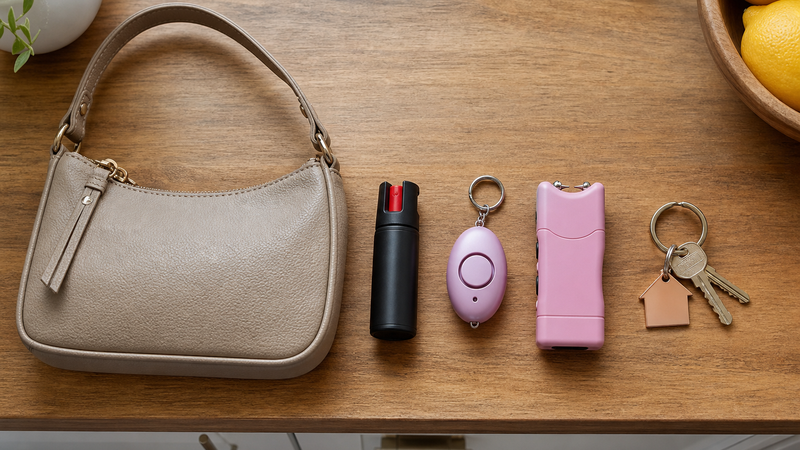
Non-lethal self-defense products typically cost between $10 and $150, depending on the type of product, its features, and its quality. Personal alarms and basic pepper sprays sit at the lower end — most run $10 to $30. Stun guns range from $20 to $80. TASER devices, which are more advanced, generally run $80 to $150 or more. You do not have to spend a fortune to be protected, but you do need to know what you’re buying.
Now listen — I say that not to overwhelm you, but because I’ve watched too many people spend money in the wrong places, or worse, skip buying anything because they weren’t sure where to start. The Alert trigger in self-defense isn’t just about carrying a tool. It’s about knowing exactly what you have, what it costs, what it does, and whether it will actually work when you need it. This breakdown is going to walk you through every category, every price range, and every question you should be asking before you spend a single dollar.
What does a personal alarm cost, and is it worth buying?
Personal alarms are the most affordable non-lethal self-defense option on the market, and for many people — seniors, teenagers, campus students — they are also the most practical. Most quality personal alarms run between $10 and $25. You press a button or pull a pin, and the device emits a piercing sound — typically 120 to 130 decibels. That is louder than a power saw. That sound draws attention fast, which is exactly the point.
What you get at $10 to $15 is a basic pin-pull alarm that clips to a keychain or bag strap. Reliable. Simple. No aim required, no safety to disengage. For a first-time buyer, a child heading to school, or an elderly neighbor who lives alone, this is a legitimate first line of defense. If you want something with added features — a built-in flashlight, a wrist strap, or a louder output — expect to pay $20 to $30.
The question I get asked a lot is whether a personal alarm is “enough.” Enough for what, I always say. If you’re a runner in a well-lit neighborhood who needs something that draws attention if you’re grabbed, yes — it can be plenty. If you’re a night-shift worker walking to a dark parking garage, you may want to pair it with something else. I wrote more about this in my post on whether a personal alarm is considered a non-lethal self-defense product — it’s worth reading if you’re still deciding.
What you should never do is buy a personal alarm you haven’t tested. Pull the pin in your hallway before you ever need it outside. Know the sound. Know how to reactivate it. Know where it sits on your keychain so you don’t fumble in the dark.
How much does pepper spray cost, and what should I look for?
Pepper spray is the single most widely carried non-lethal self-defense product in the country, and for good reason. It works. A solid canister of pepper spray costs anywhere from $10 to $30, depending on size, formulation, and spray pattern. That price gets you real protection — when it’s the right product, carried the right way.
Here is what you need to know about the formulation before you buy: the active ingredient is OC — oleoresin capsicum, derived from hot peppers. The concentration matters. Reputable brands like Wildfire, Mace, and Pepper Shot carry formulations that are potent enough to stop an attacker without requiring a perfect hit. Wildfire, for instance, runs a 1.4% major capsaicinoids formula — that’s the number that actually tells you stopping power, not just the OC percentage. Most products at the $10 to $15 range are legitimate. What you’re paying more for as you move up is typically stream versus gel versus fog spray pattern, canister size, or safety features like a flip-top guard.
Know your spray pattern before you buy. A stream is accurate but requires some aim. A cone or fogger covers more area but can drift in wind. A gel sticks to what it hits and is harder to wipe off — better for enclosed spaces. If you’re not sure which to choose, start with a stream canister and practice your draw until reaching for it is automatic.
One critical detail people overlook: pepper spray has an expiration date. Most canisters are good for two to four years. Write the date on the bottom with a marker when you buy it. Set a reminder. An expired canister may not deploy at full pressure, and that is not a risk you take with your safety.
What do stun guns cost, and what separates a cheap one from a good one?
Stun guns range from about $20 on the low end to $80 or more for a quality device. That range represents a real difference in reliability, output, and build — not just branding. A stun gun works by delivering a high-voltage, low-amperage electrical shock that disrupts muscle function. The science is straightforward. What matters is whether the device delivers consistently and holds up over time.
At $20 to $35, you’ll find compact models like the Runt or the BashLite that fit in a hand and deliver a legitimate shock. These are real products from brands I carry, and at that price they represent solid value for a first stun gun. What you’re not getting at that price is typically high-capacity battery life, a built-in flashlight, or reinforced housing.
Move up to $40 to $80 and you’ll find devices like the Strikelight 2 — a stun gun built into a tactical flashlight — or the Stun Bat, which is designed for reach and a stronger grip. These models are built for people who want something they can actually train with, that holds a charge reliably, and that has a backup function if needed. If you’re a runner, a rideshare driver, or someone who keeps a device in their car, spending the extra $20 to $30 is worth it. I have a full breakdown of how stun guns compare to TASER devices at Taser vs. stun gun for self-defense if you want to go deeper on that decision.
What separates a cheap stun gun from a reliable one is not just voltage — it’s the quality of the internal components, the safety mechanism, and whether the device has been tested consistently. Do not buy a stun gun that you never practice activating. Know exactly which direction the safety slides. Know how to hold it so your fingers don’t interfere with the prongs. That ten minutes of practice at home could be the most important ten minutes you spend this year.
How much do TASER devices cost compared to other non-lethal options?
TASER devices sit at the top of the non-lethal price range for consumer products, typically running $80 to $150 or more. This is a different category of tool. Unlike a stun gun, which requires direct contact, a TASER device fires probes on wires that deliver an electrical charge from a distance — typically 15 feet. That standoff distance changes everything in a threatening situation.
The TASER brand manufactures the devices I carry in this category, and they are designed specifically for civilian self-defense. The Pulse 2, for example, is built for one-handed operation and fires standard TASER cartridges. These devices are backed by real engineering and real testing. When you pay TASER prices, you are paying for precision and distance — two things that can matter enormously when seconds count.
Who should spend at this price level? Someone who wants a true standoff option and is committed to learning how to use the device properly. Someone who lives alone, travels frequently, or carries for work. If you’re buying your first non-lethal tool and you’re not sure you’ll practice with it, start with pepper spray or a personal alarm. A $150 device in a purse pocket you’ve never opened under pressure is less effective than a $15 alarm you know how to use cold.
What do self-defense keychains cost, and are they effective?
Self-defense keychains — including cat ear keychains, kubotan-style tools, and keychain alarms — are some of the most affordable options in the non-lethal category, running $5 to $25 for most models. At that price, they are also one of the most accessible tools for teenagers, college students, and anyone who wants something always on their person without carrying a separate device.
A cat ear keychain fits in the palm of your hand and is designed to concentrate force if you need to strike. It’s legal in most places and looks like an ordinary accessory. A keychain personal alarm serves the same carry-anywhere function with no physical contact required. If you have a teenager heading back to school or a young woman navigating a college campus, these are worth serious consideration — I’ve written specifically about self-defense keychains for teens with exactly that in mind.
The honest caveat on any striking tool: it requires some practice and physical proximity to the threat. A keychain tool is most effective when paired with awareness — knowing when someone is too close, knowing your exits, knowing how to create distance. The tool is the last resort, not the plan.
What is the total cost to put together a basic non-lethal self-defense setup?
If you’re building from scratch and you want a practical, layered setup — not one tool, but a short stack of reliable options — here is what a reasonable budget looks like:
Starter setup (under $50): One canister of pepper spray ($12–$18) and one personal alarm ($15–$20). That covers you at range with the spray and gives you an audible emergency signal with the alarm. Total: roughly $30 to $40. This is what I’d hand to a college student, a runner, or someone who has never carried anything before. For a runner specifically, a self-defense keychain built for running pairs well with this setup.
Intermediate setup ($50–$100): Add a compact stun gun to the above. Now you have three layers — audible deterrent, chemical deterrent, and contact-range electrical deterrent. This is a serious setup for a serious person who is committed to paying attention and knowing their tools.
Advanced setup ($100–$200): Replace the stun gun with a TASER device, keep the pepper spray and the alarm. You now have standoff capability, chemical deterrent, and audible signaling. This is what I’d recommend for someone who lives alone, works late, or travels regularly to unfamiliar places.
The number that matters most is not what you spend — it’s whether you know how to use every single thing you carry. A $200 setup used by someone who has never practiced is less safe than a $25 pepper spray carried by someone who draws it the same way every time.
Frequently Asked Questions About Non-Lethal Self-Defense Product Costs
How much should I spend on my first non-lethal self-defense product?
You do not need to spend more than $20 to $30 to be meaningfully protected. A quality canister of pepper spray or a 130-decibel personal alarm at that price range is real, tested protection. Start with one tool you understand and will carry every day rather than a more expensive option you leave at home because it’s bulky or unfamiliar. Build up from there as your comfort grows.
Is cheap pepper spray less effective than expensive pepper spray?
Not necessarily — the formulation matters more than the price. Look for OC percentage and major capsaicinoid content rather than assuming price equals potency. Brands like Wildfire and Pepper Shot offer strong formulations at modest prices. What you’re paying more for as price increases is typically canister size, spray pattern options, or packaging. A $12 canister of a reputable brand can be just as effective as a $30 one.
Are TASER devices worth the higher cost compared to stun guns?
For most people, the key difference is distance. A TASER device fires probes up to 15 feet away. A stun gun requires direct skin contact. If you want standoff capability — the ability to stop a threat before it reaches you — the TASER is the more capable tool. Whether it’s worth $80 to $150 depends on your situation, your comfort level, and whether you’ll commit to learning how to use it properly.
Do non-lethal self-defense products have expiration dates?
Pepper spray does — most canisters carry a two-to-four-year shelf life. After that, the propellant may weaken and the spray may not deploy at full force. Personal alarms and stun guns don’t expire in the same way, but batteries degrade and electrical components wear over time. Check your devices every six months. Write the purchase date on your pepper spray canister. Replace anything that feels sluggish, leaks, or hasn’t been tested in over a year.
Can I buy non-lethal self-defense products for a teenager without spending a lot?
Yes. A personal alarm ($15 to $20) or a self-defense keychain ($10 to $20) is a practical, affordable starting point for a teenager. These tools require no special training, have no age restrictions in most states, and are easy to carry on a backpack or keyring. If pepper spray is legal in your state for minors with parental consent, a small canister in the $12 to $18 range is also appropriate. Always go over how to use anything before handing it to a young person.
How often do I need to replace non-lethal self-defense products?
Pepper spray should be replaced before its printed expiration date — typically every two to four years. Personal alarm batteries should be checked every three to six months and replaced when output weakens. Stun gun batteries or built-in charges should be topped off regularly and the device tested with a safe discharge every few months. A device you haven’t checked in two years is a device you cannot trust in an emergency.
Is it better to buy a bundle or individual non-lethal self-defense products?
Bundles can offer value, but only if every item in the bundle is something you’ll actually use. A kit with a stun gun, a personal alarm, and a pepper spray canister from a quality brand is worth buying if all three fit your lifestyle. Avoid bundles that include items with no practical role in your daily routine — you’ll carry less and the investment goes to waste. Buy for your real life, not for a scenario you won’t encounter.
Are there free or low-cost non-lethal self-defense options?
Situational awareness costs nothing. Knowing which exits are behind you in a restaurant, walking in well-lit areas, keeping your phone visible in your hand rather than buried in a bag, making eye contact — none of that costs a dollar, and all of it reduces risk before a tool ever needs to come out. That said, carrying something physical gives you an option that awareness alone cannot provide. Even a $10 personal alarm represents real preparedness. Start wherever your budget allows, and start today.
Here is what I want you to take away from all of this: you do not need a big budget to be protected. What you need is honest information, the right tool for your actual life, and the discipline to carry it, test it, and know how to use it. A $15 alarm on a keychain that you pull without hesitation is worth more than a $100 device sitting at the bottom of a drawer.
Start where you are. Buy one thing this week. Learn it. Carry it. Then build from there. I’d rather see every person in my neighborhood carry something modest and reliable than wait for a perfect setup that never arrives. If you’re not sure where to begin, browse the options on Tracey’s Safety — there is something at every price point, and I carry nothing I wouldn’t hand to someone I love. That has always been the standard here, and it always will be.