A hidden camera for elder care is a small, discreetly placed recording device — often disguised as an everyday household object like a clock, an air purifier, or a picture frame — that lets family members monitor a senior loved one’s environment, safety, and care quality without disrupting the natural flow of their home or alerting anyone who might behave differently under obvious observation. It is part security tool, part peace of mind, and for many families, part of an act of love they never imagined they would need to perform.
I want to tell you something before we go any further. This is not a topic I can write about from a clinical distance. I have been there — sitting in my car outside my aunt’s assisted living facility, praying that the aide who just walked in through that front door was one of the good ones. That knot in your stomach when you can’t be everywhere at once? I know exactly what that feels like. And I know that the families reading this right now are carrying something heavy. So let me sit with you for a minute while we talk through this, the way I’d talk it through with someone I love.
Why do families use hidden cameras for elder care in the first place?
The honest answer is that most families turn to hidden cameras because something happened — or almost happened — that they couldn’t explain. A bruise that appeared without a clear reason. A parent who seemed withdrawn in a way they couldn’t quite name. Food that didn’t get eaten. Medication that didn’t add up. It doesn’t always start with suspicion of abuse. Sometimes it starts with a parent who has dementia and is at risk of falling, and no one is there to see it happen. Sometimes it starts with a loved one who can no longer advocate clearly for themselves, and you need to be their voice.
Whatever brings a family to this decision, the need underneath it is the same: they love someone who is vulnerable, and they cannot be in that room twenty-four hours a day. A hidden camera becomes an extension of that love. It becomes their eyes in the room when they can’t be there themselves.
The research on elder abuse tells a sobering story. The National Council on Aging estimates that one in ten Americans over sixty has experienced some form of elder abuse. And the abuse that happens behind closed doors — in private homes, in nursing facilities, in memory care units — is precisely the kind that is hardest to prove and easiest to deny. A camera doesn’t judge. It just records what it sees.
What does a hidden camera for elder care actually look like?
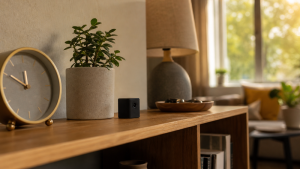
This is where I want to clear something up, because I think a lot of people imagine something out of a spy movie. The reality is much quieter than that. A hidden camera for elder care is usually a small device built into an object that belongs naturally in a room. A digital clock on a dresser. A small fan on a bookshelf. A smoke detector mounted on the ceiling. A tissue box on a side table. These cameras are designed to be invisible not because families are playing games, but because a visible camera changes behavior — and not always in the direction you’d hope.
When a caregiver knows exactly where the camera is and when it records, the value of that footage changes. A hidden camera captures the unguarded moments. The 2 a.m. check-in. The lunchtime routine. The way someone is spoken to when they spill something or ask the same question twice. That is the footage that tells you the truth.
Many of these devices record continuously to a memory card, while others connect to your home Wi-Fi and let you view live footage from your phone, wherever you are. The best ones for elder care combine good low-light performance — because a lot of what matters happens in dim rooms — with motion-activated recording that doesn’t require you to scroll through hours of an empty bed to find what you need. If you want to understand what truly separates one camera from another in terms of picture quality and facial detail, I’ve written more about that in my post on what hidden camera has the best video quality for identifying a caregiver’s face — because that detail matters enormously if you ever need that footage to mean something in a formal setting.
Where should a hidden camera be placed in an elder care setting?
Placement is everything — and I want you to think carefully about this, not just technically but emotionally. Your loved one’s dignity matters. The goal of a hidden camera for elder care is protection, not surveillance in the invasive sense of that word. So placement should focus on common care spaces: the living room, the bedroom, the kitchen, the hallway near the front door. Bathrooms are off-limits in every state for recording — full stop. And any camera you place should capture interaction and activity, not private, intimate moments.
In a home care setting, the most useful placements tend to be where caregiving actually happens: the chair where your loved one sits for most of the day, the area near their medication, the space where meals are served. A camera near the front door serves double duty — it documents who comes and goes, and it can help verify that caregivers are arriving and leaving when they say they are.
In a nursing home or memory care facility, the rules are different. Many states now have “granny cam” laws that explicitly allow residents or their legal guardians to place monitoring devices in their rooms, with certain notification requirements. Laws vary, and I want to be clear: I am not a lawyer, and you should check your state’s current statutes before you place any camera in a facility. But the law has moved significantly toward supporting families on this, because legislators have seen the same heartbreak you have.
Is it legal to use a hidden camera to monitor an elderly parent’s care?
The legal landscape for elder care cameras is state-by-state, and it has been shifting in families’ favor. As of recent years, more than a dozen states have passed explicit “granny cam” legislation giving nursing home residents — or their legal representatives — the right to install monitoring devices in their private rooms. In most of these states, the facility must be notified, but the facility cannot prohibit the camera or retaliate against the resident for using one.
In a private home — your home, or your loved one’s home — your legal footing is generally much stronger. You have broad rights to monitor your own property, particularly in common areas. The complication arises when a paid caregiver is present, because some states have two-party consent laws for audio recording. This is why I always encourage families to consult with an elder law attorney or look up their specific state’s statutes before they set anything up. What I can tell you is that the trend in the law is clearly toward supporting families who are trying to protect vulnerable people. The momentum is on your side.
If you are in the research phase and trying to understand what a camera designed for discreet use actually looks like in practice, take a look at what’s available as a fake hidden camera deterrent for context — sometimes families use a visible decoy in one spot while running an actual recording device elsewhere, which is a layered approach worth considering.
What should a family look for when choosing a hidden camera for elder care?
I’ll tell you what I’d look for if this were my mother. First, video quality that holds up in low light. Bedrooms and care rooms are rarely brightly lit, and you need footage that shows faces clearly, not grainy shapes in the dark. Look for a camera with night vision capability — infrared or color night vision, depending on the room.
Second, motion-activated recording or motion alerts. You don’t want to manage hours and hours of footage. A camera that starts recording when something moves, and sends a notification to your phone, is what actually gets checked regularly. The camera you check every day is worth more than the technically superior one you stopped looking at after two weeks.
Third, a reasonable loop recording capacity. If the camera records to a local memory card, make sure it has enough storage for at least several days of footage — and that it overwrites old files automatically so you’re never stuck with a full card and no recording.
Fourth, a discreet form factor that fits naturally in the room. A camera that looks out of place draws attention. A well-designed hidden camera for elder care should look like it belongs — something your loved one’s caregiver would walk past a hundred times without a second thought. For a deeper look at cost versus quality tradeoffs, my post on how much a good hidden camera costs breaks that down honestly.
How do you talk to an elderly parent about having a camera in their room?
This is the question I get asked the most, and it is the most human part of this whole conversation. Because your parent — however much they may need protection — also has feelings about privacy, about trust, and about what it means to have a camera watching their most private daily moments.
My honest counsel: when possible, have the conversation. Not because you are legally required to in a home setting, but because honesty with someone you love is worth more than the tactical advantage of total secrecy. Explain what you are worried about. Tell them you are not watching them — you are watching the people who come to care for them. For many elderly parents, that framing makes a real difference. They want to know someone is looking out for them. The camera becomes not an intrusion but a form of backup.
When cognitive decline makes that conversation impossible — when your loved one has advanced dementia and cannot meaningfully consent or understand — the decision falls to you, and it is a hard one. But it is a decision made from love, and I think most families in that situation make it because they have no other way to be sure. That is not a failure of values. That is what love looks like when the stakes are that high.
Frequently Asked Questions About Hidden Cameras for Elder Care
Can a nursing home refuse to allow a hidden camera in my parent’s room?
In states with granny cam legislation, nursing homes generally cannot prohibit a camera in a resident’s private room, though they may require notification and consent from roommates if the room is shared. In states without specific laws, facilities may have more latitude. Always check your state’s current statutes and, when needed, consult an elder law attorney who knows your specific jurisdiction.
What is the best disguise for a hidden camera in a bedroom or living room?
The most effective disguises are objects that belong naturally in the room and blend with existing décor. Clock radios, small fans, picture frames, air purifiers, and tissue box holders are common. The key is choosing a form factor your loved one already has in their space — a camera that looks placed rather than belonging draws attention. For more on this, see our post on the best disguised camera to catch nursing home abuse.
Do I need to tell the caregiver that a camera is present?
In a private home, you are generally not required to disclose a camera to a caregiver, though audio recording consent laws vary by state. In a licensed care facility, most granny cam laws require notifying the administration. Some families choose to disclose openly — studies suggest that known monitoring still significantly improves care quality, even when caregivers know the camera is there.
Can I watch the footage live from my phone?
Many modern hidden cameras for elder care include Wi-Fi connectivity and companion apps that let you view live footage from anywhere. Look for cameras that support both live viewing and cloud or local storage for recorded footage — the ability to go back and review what happened at a specific time is often more valuable than live monitoring alone.
What should I do if I see something disturbing on the camera?
If you observe what appears to be abuse, neglect, or mistreatment, preserve the footage immediately — save it to a secure location before it loops over. Then contact your state’s Adult Protective Services and, if the abuse appears criminal, local law enforcement. If the incident occurred in a licensed facility, file a formal complaint with your state’s long-term care ombudsman program. Document everything: dates, times, what was observed.
What is the difference between a wired and wireless hidden camera for elder care?
Wireless cameras are easier to place discreetly and don’t require running cables through the room, making them more practical for most elder care situations. Wired cameras tend to be more reliable and are not dependent on Wi-Fi signal strength, but installation is more involved. For a full breakdown of the tradeoffs, read our post on the difference between wired and wireless hidden cameras.
Can a hidden camera also help if my elderly parent lives alone and falls?
Yes, and this is an underappreciated use of elder care cameras. A motion-activated camera that sends alerts when no motion is detected for an unusual length of time can serve as a fall detection trigger of sorts. Some families set their cameras to alert them if a room goes quiet for too long. It is not a medical alert system, but it can be a meaningful layer of awareness — especially overnight.
Is there anything else I can do to protect an elderly parent at home besides a camera?
Cameras are one layer. A hidden compartment safe can protect medications, cash, and important documents from theft in a home care environment. Personal alarms that your loved one can activate if they feel unsafe add another layer. And regular, unannounced visits from family members remain one of the most powerful deterrents of all — a caregiver who never knows when family might walk through the door is a caregiver who stays on their best behavior every shift.
At the end of the day, choosing a hidden camera for elder care is not a decision that feels good to make. It means acknowledging something most of us don’t want to acknowledge — that the person we love is vulnerable, that we cannot be everywhere, and that not everyone entrusted with their care deserves that trust. But it is also one of the most determined, clear-eyed acts of love I know. You are not giving up. You are showing up — in every way you can, even from across town.
Browse the camera options at Tracey’s Safety and find something that fits your loved one’s space and your family’s needs. If you have questions, I am always here. That is what this is all about.