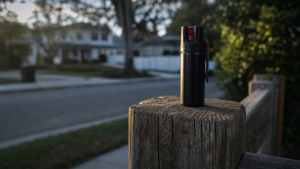
Dog repellent spray — when it makes contact with a dog’s face — typically produces effects that last between 15 and 45 minutes. That window covers the burning sensation in the eyes and nose, the temporary disorientation, and the strong urge to retreat. The exact duration depends on the formula’s concentration, the size and temperament of the dog, how direct the contact was, and whether the dog was sprayed in still air or wind. No lasting harm is done to the animal, and within an hour or so, they are back to themselves.
Now, let me tell you something I’ve learned from carrying a canister on my walks for the better part of a decade. Knowing how long it lasts isn’t just trivia — it tells you exactly what this tool is for. It is not a punishment. It is not a weapon. It is a window. A window of time wide enough to get yourself away from a situation that could go very badly. That is the whole point. And once you understand that, you start to understand everything else about how to use it right.
What actually determines how long dog repellent spray lasts on a dog?
The active ingredient in most dog repellent sprays is oleoresin capsicum — OC for short. It’s the same compound found in hot peppers, and it works by triggering intense irritation in the mucous membranes: the eyes, nose, and throat. The dog isn’t hurt in any permanent way, but it is overwhelmed. That irritation is what creates the window of time you need.
How long that window stays open depends on a few honest factors. First is concentration. Dog repellent is formulated differently than human pepper spray — the OC percentage is calibrated to deter an animal without causing unnecessary harm. A product with a higher OC concentration will generally produce stronger, longer-lasting effects. Second is the quality of the application. A direct spray to the face — specifically the nose and eyes — produces the most reliable response. A glancing shot or one deflected by wind may produce a shorter or weaker effect.
Third is the individual dog. A large, agitated, territorial dog running at full charge is in a different physiological state than a smaller dog startled off a porch. The same spray can produce a quicker retreat in one and require a moment longer in another. This is not a failure of the product — it is just the reality of biology. Plan on the low end of the window and move decisively.
Temperature and humidity can also play a role. Hot, dry air can cause the spray to dissipate faster, while cooler, calmer air tends to hold the cloud in place. If you’re a cyclist or a runner who moves through different neighborhoods and microclimates, that is worth keeping in the back of your mind. Speaking of cyclists — if you haven’t looked at options specifically designed for riding, there are pepper spray options made for cyclists that account for the challenges of using a canister while moving.
How long does the repellent effect last in the air after you spray it?
This is a question people don’t ask often enough, and it matters. The cloud of OC that hangs in the air after a spray is effective for a much shorter window than the effects on the dog — maybe five to ten seconds of active irritant concentration before it disperses. That is why spray direction matters. Spraying into the wind toward you is not protection; it is a hazard. Spray with the wind at your back, or in calm air, toward the dog.
The residue on the ground or a surface can linger longer, but a dog that is already retreating is not going to be circling back to test it. What you’re banking on is the immediate contact effect — the OC getting to the dog’s nose and eyes — not any kind of lingering barrier. Think of it as a signal flare, not a fence.
This is why understanding the tool changes how you carry it. You want it in your hand before you need it, not at the bottom of your bag. A canister that takes you ten seconds to find does you no good in a moment that moves in three.
Does dog repellent spray affect humans the same way it affects dogs?
Yes, and that’s worth being honest about. OC spray does not discriminate between species. If you get it on yourself — in your eyes, up your nose — it will cause the same stinging, tearing, and temporary disorientation that it causes in a dog. The effects are real, temporary, and deeply unpleasant. This is why spray discipline matters.
Keep the canister pointed away from your face. Practice the motion of drawing and extending your arm before you’re in a moment where it counts. Some canisters are designed with a finger grip that naturally aligns your thumb with the trigger and the nozzle facing outward — that kind of ergonomics is not an accident. If you’re shopping for a first canister, pay attention to how it sits in your hand and where the nozzle points when you pick it up quickly.
If you do get cross-contaminated during a spray, the protocol is the same as any OC exposure: fresh air, flush with water (not rubbing — flushing), and patience. The effects clear on their own. They are not permanent. But they are real, and respecting that keeps you careful.
How often should dog repellent spray be replaced for it to stay effective?
Most dog repellent sprays carry a manufacturer’s shelf life of two to four years from the date of production. That date is usually printed on the canister or the bottom of the unit. After that point, the propellant that drives the spray out of the canister can degrade, which means you might get a weak stream, reduced range, or in some cases nothing at all. The OC itself can also lose potency over time.
Beyond the expiration date, check your canister regularly for two things: the safety clip and the fill level. A canister that has been partially used has less pressure behind it, which affects both range and spray volume. If you’ve used it at all — even a test burst — take that into account when you’re deciding whether it’s still full enough to be your primary defense tool.
I keep this in mind the same way I keep an eye on the first aid kit in my car. You hope you never need it, but you do not let it sit there for years and assume it’s still ready. That’s not caution, that’s just common sense. If you’re curious about how related aerosol products hold up over time, the same logic applies to bear spray — I wrote about that in a post on how long bear spray lasts after purchase, and much of it carries over.
Is dog repellent spray legal to carry in public?
In most of the United States, yes — OC-based dog repellent spray is legal to carry for personal protection against animal attack. It is sold openly, carried by mail carriers, and recommended by postal workers’ unions. That said, local regulations do vary, and I want to be straight with you: I am not a lawyer, and nothing I write here is legal advice. Check the rules for your city and state before you carry anything, including dog repellent.
What I can tell you is that dog repellent is specifically formulated for use against animals, which puts it in a different regulatory category than human pepper spray in some jurisdictions. If you are using it as intended — to deter an aggressive dog — most places have no issue with that. If your situation involves carrying something for broader personal protection, you may want to look at options designed for that purpose. There are solid pepper spray options under ten dollars that are made for human self-defense if that’s the conversation you need to have with yourself.
Who should carry dog repellent spray, and when does it make the most sense?
The honest answer is: anybody who spends time outdoors in areas where loose or aggressive dogs are a real possibility. That covers a lot of people. Mail carriers, delivery drivers, joggers, cyclists, dog walkers, and people who walk to work through neighborhoods where fencing is inconsistent and dogs sometimes roam. If you have ever rounded a corner and felt your stomach drop because a dog came at you from a yard, you already know exactly who this is for.
Delivery drivers in particular face this risk more than almost anyone, and they face it alone, often after dark, in unfamiliar driveways. If that’s you or someone you love, there are products on this site selected with that job in mind — take a look at what we carry for pepper spray for delivery drivers.
The piece of this that matters most is habit. A canister you leave in the car when you go for your morning walk is not protecting you. The ones who get real benefit from this tool are the ones who have it accessible, who’ve practiced reaching for it, and who’ve thought through what they’d do if they needed it. That thinking — that preparation — is what separates people who feel ready from people who feel lucky. I’d rather you be ready.
If you want to understand more about what’s inside these products and why the formulas are made the way they are, we have a post that breaks down what ingredients are in dog repellent spray in plain language. It’s worth a few minutes of your time before you buy.
Frequently Asked Questions About Dog Repellent Spray Duration
How long does dog repellent spray affect a dog after contact?
Most dogs experience the effects of OC-based dog repellent spray for 15 to 45 minutes after direct contact. During that time they will typically retreat, rub at their face, and avoid the area. The effects are temporary and cause no lasting harm. The goal is to create enough time and distance for you to get away safely — not to injure the animal.
Will the spray work if the dog is very large or very aggressive?
OC spray works on dogs regardless of size because it acts on the mucous membranes — the eyes, nose, and throat — not on the dog’s mass or aggression level. A large or highly agitated dog may require a second burst or a more direct application to the face, but the physiological response is consistent across breeds. Aim for the nose and eyes, and move as soon as the dog flinches.
How far does dog repellent spray reach?
Most consumer dog repellent sprays have an effective range of eight to fifteen feet, depending on the formulation and propellant pressure. Wind conditions will affect that range — a headwind can cut it significantly. Aim to spray when the dog is at the outer edge of that range, not when it is already on top of you. Practice holding and aiming the canister before you’re in a moment where seconds count.
Can dog repellent spray be used on other animals?
OC-based dog repellent can deter other animals that have sensitive mucous membranes — coyotes in particular are known to respond to it. It is not formulated for large predators like bears, which require a much higher OC concentration and a significantly wider spray pattern. For bear encounters, bear-specific spray is the appropriate tool and not a substitute for dog repellent.
Is it safe to use dog repellent spray around children?
OC spray disperses quickly in open air, but you should always move children upwind or away from the area where you spray. If a child is exposed to OC — through drift or accidental contact — flush their eyes and face with cool water and move them to fresh air. The effects are temporary but uncomfortable. When you are in a situation that calls for the spray, your priority is creating distance. Get yourself and children away immediately after spraying.
How do I know when my dog repellent canister needs to be replaced?
Check the expiration date printed on the canister — most have a shelf life of two to four years from manufacture. Beyond the date, replace the canister if it has been used even partially (reduced pressure means reduced effectiveness), if the safety clip is damaged, or if you notice the nozzle is obstructed. Treat it the way you’d treat a smoke detector battery: set a reminder and don’t wait until you need it to find out it’s gone.
Does dog repellent spray leave a residue that keeps dogs away later?
No. Dog repellent spray is designed for immediate deterrence, not long-term territorial marking. The active OC dissipates quickly in open air, and any surface residue is minimal and short-lived. If you need to keep dogs away from a specific area over time — a yard, a gate — that is a different product category involving scent-based deterrents or physical barriers. Dog repellent spray is a personal protection tool for active encounters, not a perimeter system.
What should I do immediately after using dog repellent spray?
Move away from the area immediately — that is the whole point of using it. Put distance between yourself and the dog while it is disoriented. Do not wait to see if it’s working. Once you are safe, check yourself for any spray contact on your skin or clothing, and wash any affected areas with soap and water. Report the incident to animal control if the dog is a known hazard in the neighborhood. Document what happened, especially if you are a delivery driver or mail carrier where records matter.