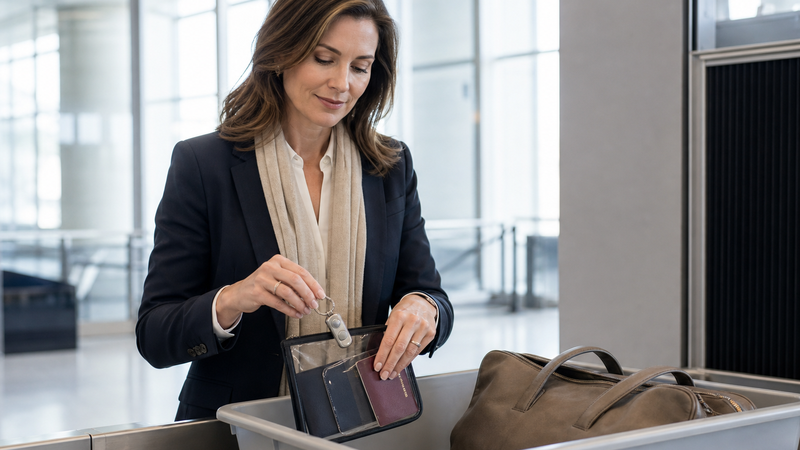
Personal alarms are TSA-approved for both carry-on and checked luggage — no permit, no declaration, no special packing required. They contain no batteries that raise flags, no chemicals, and no blade. The only thing to double-check is the specific alarm’s construction, since a small number of models include an attached whistle or clip that could theoretically snag a second look. For the vast majority of travelers, a personal alarm is one of the simplest, most trouble-free safety tools you can slip into a bag before a flight.
There’s a certain kind of traveler who has this figured out before she even gets to the airport. She’s not fumbling at the checkpoint, not explaining herself to a TSA agent, not pulling something out of her bag while a line forms behind her. She packed smart. She knew the rules before she needed to know them. That’s the traveler I want you to be.
A personal alarm is one of the few self-defense tools that sails through security without a second glance, and once you understand why, you’ll wonder why you didn’t start carrying one years ago. This isn’t about panic-buying something at the last minute. It’s about traveling the way someone with good judgment travels — prepared, unbothered, and just a little bit sharper than everyone else in the terminal.
Can you bring a personal alarm on a plane?
Yes. TSA classifies personal alarms as permitted items in both carry-on and checked baggage, and this isn’t a gray area or a “depends on the agent” situation. These devices have no blade, no chemical agent, and typically run on a small standard battery — none of which trigger the restrictions that apply to pepper spray, stun devices, or knives.
What makes this worth knowing isn’t just the yes. It’s the confidence that comes with it. You’re not gambling on whether today’s checkpoint agent is in a generous mood. You’re carrying something that’s already cleared, every time, at every airport, in every country with similar aviation security standards. That’s the difference between a tool you hope works out and a tool you know works out.
What’s the difference between a personal alarm and other self-defense items at security?
The difference comes down to mechanism. A personal alarm makes noise — that’s the entire function. There’s no propellant, no voltage, no cutting edge. Compare that to something like a stun gun with a safety pin mechanism, which is restricted in carry-on and, depending on the airline and destination, sometimes prohibited in checked baggage entirely. Pepper spray has its own set of restrictions — limited canister size, checked-baggage-only in most cases, and outright banned on certain international routes.
This is where a discerning traveler separates herself from someone who just grabs whatever’s cheapest off a shelf. The people who travel often, who’ve been through enough airports to know better, tend to build a layered approach — a personal alarm they never think twice about, paired with tools reserved for situations where flying isn’t involved. Knowing which is which isn’t a small detail. It’s the whole strategy.
Do TSA rules change for international flights?
TSA governs departures from U.S. airports, but the moment you land somewhere else, you’re operating under that country’s rules — and personal alarms are, without much exception, treated the same way worldwide. They’re considered noise-making safety devices, not weapons, so you won’t find them on prohibited lists in the UK, EU, Canada, or most of Asia.
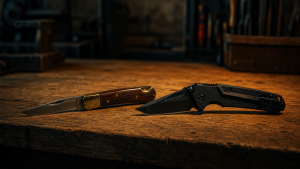
Where things get more particular is with anything that crosses into weapon classification. A knife that’s perfectly legal to carry at home may be confiscated the moment you land somewhere with stricter import laws. This is exactly why personal alarms built specifically for travelers have earned their reputation — they’re the one item you never have to research country by country. You pack it once, and it works everywhere.
What should you look for in a travel-ready personal alarm?
Look for three things: volume, size, and how it activates. A serious personal alarm should hit somewhere around 120 to 130 decibels — loud enough to turn heads in a crowded train station, not just a polite chirp. Anything quieter isn’t doing the job you’re buying it to do.
Size matters more than people expect. The alarm that actually gets used is the one that lives on your keychain, not the one buried in a suitcase pocket you can’t reach at 11 p.m. in an unfamiliar city. And activation should be instant — a pull-pin or a single button, nothing that requires two hands or a moment of fumbling when you least have one to spare.
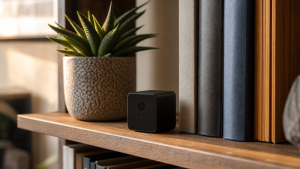
This is also where I’d encourage you to think beyond the alarm itself. A dummy camera with a blinking light for your hotel room, or a compact alarm doubling as a door stop, rounds out a traveler’s kit the way a good packing list rounds out a trip — nothing extra, nothing missing.
How should you pack a personal alarm for a flight?
Keep it accessible, not buried. The most sensible place is a jacket pocket, purse, or the outside pocket of your carry-on — somewhere you can reach it in the terminal, on the jet bridge, in the rideshare from the airport to your hotel. Burying it in checked luggage defeats the entire purpose of carrying one.
If your alarm has a pull-pin, make sure the pin is secured so it doesn’t accidentally activate mid-flight — nothing derails a boarding process faster than 130 decibels going off in seat 14C. A quick check before you leave the house solves this every time. Beyond that, there’s no special packing procedure, no bag within a bag, no declaration at check-in. It travels the way your phone charger travels.
Are personal alarms worth it if you already carry other self-defense tools?
Yes — because the tools that work in one setting rarely work in all of them. Frequent travelers, runners logging early miles in unfamiliar neighborhoods, night-shift workers walking to parking structures — the smartest among them aren’t relying on a single solution. They’re layering. A personal alarm handles the situations where drawing attention and getting help fast is the goal; other tools handle situations where alarms alone: personal alarms built for runners and travelers alike work because they’re designed for the exact moment you’re actually in — moving, distracted, hands full, and needing something that works without a second thought.
The traveler who understands this isn’t choosing between tools out of anxiety. She’s choosing with the same discernment she’d apply to anything else she invests in — quality luggage, a good coat, a hotel worth the extra fifty dollars a night. Preparedness, done right, looks a lot like good taste.
What about personal alarms for family members with different needs?
This is where a lot of families get it wrong — they buy one alarm and assume it fits everyone. It doesn’t. A alarm built for a runner needs to survive sweat and motion. One built for a hotel door needs a different kind of hold. And for households with a child on the autism spectrum, sensory needs change the equation entirely — sound sensitivity, activation method, even the texture of the device matter. A personal alarm designed for kids with autism is built with those specifics in mind, not just scaled down from an adult model.
The families who travel well are the ones who’ve thought this through in advance — not scrambling at the gift shop the night before a flight, but choosing tools that actually match the person carrying them.
Frequently Asked Questions About Flying with a Personal Alarm
Can I bring a personal alarm in my carry-on bag?
Yes. Personal alarms are permitted in carry-on luggage under TSA guidelines. They contain no blade, no chemical agent, and no restricted battery type, so there’s no need to pack it in checked luggage or declare it at the checkpoint.
Will a personal alarm set off a metal detector?
It might, depending on its casing and internal components, the same way a phone or keychain would. This isn’t a problem — it’s not flagged as a prohibited item, so it simply gets visually inspected like any other small metal object in your bag or pockets.
Can the alarm accidentally go off during the flight?
It’s unlikely if the pin or activation button is secured properly before you pack it. Most quality alarms have a firm pull-pin mechanism that won’t trigger from normal jostling in a bag. Still, it’s smart to double-check the pin position before boarding.
Is a personal alarm allowed on international flights, too?
In nearly all countries, yes. Personal alarms are classified as noise-making safety devices, not weapons, so they clear security consistently across most international airports. Always a good habit to check your specific destination’s customs rules if you’re unsure, but restrictions are rare.
Do I need to tell TSA I’m carrying a personal alarm?
No declaration is required. Unlike pepper spray or certain stun devices, personal alarms don’t fall under restricted or declared item categories, so you can pack it exactly like you’d pack a phone charger or a set of keys.
What decibel level should a travel personal alarm have?
Look for something in the 120 to 130 decibel range. That’s loud enough to startle someone and draw attention in a crowded airport, parking garage, or hotel hallway — quieter alarms simply don’t carry the same effect in a real moment.
Can hotel staff or airline staff ask me to put it away?
It’s uncommon, since the alarm poses no safety concern when inactive. If a staff member is unfamiliar with the device and asks about it, a simple explanation — that it’s a noise-based personal safety alarm — typically resolves any confusion immediately.
Should I bring a personal alarm even if I’m traveling with a group?
Yes. Group travel reduces risk, but it doesn’t eliminate the moments you’re alone — hotel hallways, early morning runs, a solo walk back from dinner. A personal alarm is small enough that there’s no real reason to leave it behind, group trip or not.
Fly Prepared, Not Anxious
There’s a quiet kind of confidence that comes from knowing you’ve already handled the details other people scramble over. You’re not the one holding up the line at security, not the one googling “is this allowed on a plane” from the gate. You packed the right thing, in the right place, for the right reason — and that’s not luck. That’s someone who takes her own safety as seriously as she takes everything else she does well.
If you’re building out a travel kit that matches how you actually move through the world — through airports, hotel hallways, unfamiliar cities — take a look at what’s designed specifically for that life. Your safety deserves the same standard you hold everything else to.