A TASER is a specific brand of electroshock weapon that fires probes from a distance and locks up a person’s muscles so they can’t move. A stun gun makes contact directly with the body and delivers pain-compliance voltage that makes someone want to disengage. One reaches out. One stands its ground. Knowing which one fits your life is the difference between buying a tool that matches how you actually move through the world — and buying one that doesn’t.
The Word “TASER” Isn’t What You Think It Is
Let’s clear this up right now, because I hear it get twisted every single day. “TASER” is a brand name — a specific company’s product — the same way “Kleenex” isn’t every tissue and “Band-Aid” isn’t every bandage. People say “taser” the way they say “Q-tip.” It’s become the word for the whole category. But a real TASER device is a very specific piece of technology, and it works nothing like the stun gun sitting in your neighbor’s nightstand drawer.
Here’s the command you need to take away from this: a TASER fires two small probes connected by wires, up to fifteen feet, and delivers what’s called neuromuscular incapacitation. That means it doesn’t just hurt — it takes over the muscles and drops a person where they stand, whether they want to fight through the pain or not. A stun gun, on the other hand, has to touch the person directly. No wires, no distance, no probes. It’s a contact weapon. You press it against a body and it delivers a jolt that overwhelms the nervous system enough to make continuing whatever they were doing feel like a very bad idea.
Both are legitimate. Both work. But they are not interchangeable, and knowing the difference puts you in charge of the decision instead of guessing.
How Does a Stun Gun Actually Work Compared to a TASER?
A stun gun works through direct contact and pain compliance. When the prongs touch skin or clothing, the electrical charge disrupts the small electrical signals your muscles use to communicate with your brain. It’s disorienting. It’s painful. It’s enough, in most encounters, to make someone let go, back off, or hit the ground trying to get away from it. But the person keeps some control of their body. If they are determined enough, or angry enough, they can push through it for a second or two.
A TASER changes the equation completely. The probes lock into skin or clothing and send a continuous electrical signal that overrides the brain’s ability to direct the muscles at all. That’s neuromuscular incapacitation — the body simply stops answering to the mind for the duration of the cycle. That’s a different level of control, and it’s why law enforcement carries the branded device specifically, not a generic stun gun.
For most of the people I talk to — women walking to their car after a night shift, college students crossing campus at dusk, seniors heading to the mailbox — a stun gun is the tool that makes sense. It’s smaller, it’s simpler, it doesn’t require aim from fifteen feet, and it puts the decision directly in your hand at the range where most real confrontations actually happen: close, fast, and personal.
Which One Gives You More Control in a Real Encounter?
I’m going to be straight with you: control is the whole point, and stun guns give the average person more of it. A TASER’s advantage — the fifteen-foot reach — only matters if you have the space, the calm, and the aim to hit two small probes on a moving target while your heart is slamming against your ribs. That’s a skill law enforcement trains for constantly. Most of us are not training for that. Most of us are walking from a lit doorway to a dark car, and the person coming at us is already inside arm’s reach before we even register the threat.
At that range, a stun gun is the commanding choice. You don’t aim it. You don’t fire it across a room. You drive it into the body — a forearm, a shoulder, a hip, wherever you can make contact — and you take charge of that second. That’s real power: not the fantasy of a long-range takedown, but the certainty of a tool that works exactly the way your body already moves under stress.
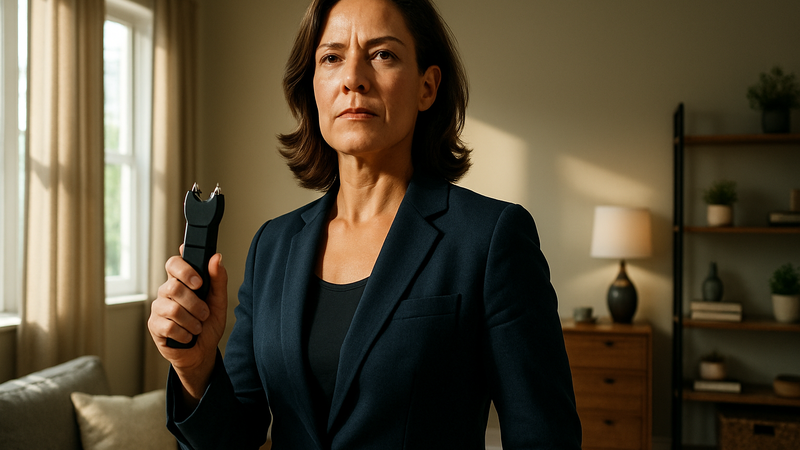
That’s why I point so many of my customers toward something like a small stun gun that fits the palm and doesn’t require a steady hand from across a room. It’s built for the fight you’re actually going to have, not the one on television.
Do You Need a Permit to Carry a Stun Gun or a TASER?
Rules vary by state and even by city, and I’m not going to stand here and tell you what your local law says — that’s between you and your own research, and I want you doing that research before you carry anything. What I will tell you, with full confidence, is this: know your law before you buy, not after. Some states treat stun guns and TASER devices identically. Some don’t allow either one. Some require a permit for one but not the other. This is not a detail to skip.
What I can say with authority is that the device itself doesn’t change your responsibility. Whichever one you choose, you carry it the same way you’d carry any tool meant to protect you — with full command of how it works, when you’d use it, and what your state expects of you as the person holding it.
Which One Is Easier to Carry Every Day?
Stun guns win this one outright, and it’s not close. A TASER-branded device is built around its cartridge system, its wires, its probes — components that make it bulkier and more deliberate to carry. A stun gun is built to disappear into your life. Slim enough for a coat pocket. Small enough for a glovebox. Rechargeable enough that you’re not hunting for batteries every few months.
That’s exactly why the compact rechargeable stun gun options move the way they do — women aren’t looking for a piece of law enforcement equipment. They’re looking for something that rides in a bag or a jacket without announcing itself, charges up like a phone, and stands ready without a second thought. If you travel often, a stun gun built for travel solves the same problem for hotel rooms, rental cars, and unfamiliar cities where you don’t know the streets yet.
What About Accidental Activation — Is That a Real Risk?
It’s a fair question, and the answer is command your gear the same way you’d command anything dangerous: with a safety built in. Quality stun guns are engineered with this exact concern in mind. A stun gun with a safety pin won’t fire if it’s dropped, jostled in a purse, or bumped against your keys. You control when it activates. Nothing else does.
This is where a lot of buyers get nervous for no reason — they picture something unpredictable. The reality is the opposite. A well-built stun gun is one of the most controlled pieces of safety equipment you’ll ever own, precisely because the entire design exists to put the power in your hands and nowhere else.
Should You Buy the Same Kind Police Carry?
If you want the closest thing to what law enforcement trusts, without stepping into TASER-brand territory and its higher price point, look at what’s built as a civilian version of a police stun gun. These are designed with the same command-the-situation mindset — higher output, rugged housing, a grip built for a firm hand under stress — just sized and priced for someone who isn’t wearing a badge but still refuses to be caught unprepared.
This is a smart move for anyone who wants maximum authority in a small package: rideshare drivers, night-shift nurses, delivery workers, anyone whose job puts them in unpredictable rooms and unpredictable parking lots on a regular basten basis.
Frequently Asked Questions About Stun Guns vs. TASERs
Is a TASER stronger than a stun gun?
Not stronger in voltage necessarily, but different in effect. A TASER causes neuromuscular incapacitation — it overrides muscle control entirely from a distance. A stun gun requires direct contact and works through pain compliance, meaning the person can still technically move, even if they very much don’t want to.
Can I use a stun gun and a TASER interchangeably?
No. They require completely different skills and ranges. A TASER demands accuracy at distance. A stun gun demands you close the gap and make contact. Choose based on the situations you actually find yourself in, not which one sounds tougher.
Which is better for a woman walking alone at night?
For most women, a stun gun is the more practical choice. It doesn’t require aim, it works at the range most attacks actually happen, and it fits easily in a coat pocket or bag. Confidence in a tool you can operate under stress matters more than raw technology.
Do stun guns hurt the user if used incorrectly?
No, quality stun guns are insulated and designed so the charge only transfers on contact with the target, not back through the handle. As long as you’re holding it correctly, you’re not at risk from your own device.
Is it legal to carry a stun gun in my state?
Laws vary significantly by state and city, and some jurisdictions restrict or ban stun guns and TASER devices entirely. Always confirm your local and state regulations before purchasing or carrying any electroshock device.
How many times can I use a stun gun before recharging?
It depends on the model, but rechargeable stun guns typically deliver dozens of charge cycles before needing a recharge. For a full breakdown of how battery life holds up over time, this comparison of rechargeable versus replaceable battery stun guns covers what actually lasts.
Can I carry a stun gun in my purse safely?
Yes, as long as it has a safety feature and sits in a dedicated pocket away from keys and loose metal. For the full breakdown of what works and what to avoid, see this guide on carrying a stun gun in your purse.
What’s the difference in price between a stun gun and a TASER?
TASER-brand devices generally cost more due to their cartridge system, wireless probe technology, and law enforcement-grade engineering. Stun guns are typically more affordable and still deliver strong, reliable protection for everyday civilian carry.
The Bottom Line: Choose the Tool That Commands Your Situation
Here’s what I want you walking away with: a TASER and a stun gun are both real, both legitimate, and both built to give you the upper hand. But they’re not the same tool, and pretending they are is how people end up carrying something that doesn’t match how they actually live. If your world is close-range — a parking garage, a front porch, a dark stretch of sidewalk between the bus stop and your door — a stun gun puts the power exactly where you need it: in your hand, under your control, ready the second you decide to use it.
Take command of the decision the same way you’d take command of anything else that protects your life. Know the difference. Know your state’s rules. And choose the device that matches the fight you’re actually likely to face — not the one that sounds the most impressive on television.