
A purse-worthy stun gun needs three things a bargain-bin model rarely has: a snag-free safety mechanism, a size that doesn’t disappear into clutter, and a charge that’s still there when you need it. The stun guns that fail women aren’t weak — they’re the wrong shape, the wrong weight, or buried under lip gloss and loose receipts where a hand can’t find them in a hurry. Choose one built for the bag, not just for the shelf.
Not every stun gun deserves a place in your handbag. That’s not opinion — that’s the difference between a tool that’s ready when your hand closes around it in a dark parking structure, and one that’s wedged sideways under a paperback and a half-empty pack of gum. A handbag is not a drawer. It’s a moving, shifting, zippered environment, and the product you carry in it has to be built for that reality, not just marketed to it.
This is where discernment matters. Anyone can drop a stun gun into a shopping cart. Fewer people take the time to understand which features actually hold up inside a bag carried daily, jostled constantly, and reached into under pressure. That’s the standard we’re setting here — not “does it work,” but “does it work for how you actually carry.“
What makes a stun gun purse-friendly instead of purse-clutter?
A purse-friendly stun gun is compact enough to sit in a dedicated pocket without shifting to the bottom of the bag, textured enough to grip without fumbling, and shaped without sharp edges or long barrels that snag on fabric linings. The best options are designed with the carrier in mind — not adapted from a bulkier model as an afterthought.
Size is the first filter, but it’s not the only one. A stun gun that’s too small can be just as much a problem as one that’s too large — if it’s small enough to get lost among keys and cosmetics, it fails the same test as one too bulky to carry at all. This is why a genuinely lightweight stun gun designed with a defined shape and a non-slip grip earns its place over something generic. It should feel intentional in your hand, not like a stray object you’re patting around for.
The second filter is the safety mechanism. A stun gun that activates too easily is a liability inside a bag full of moving parts. A stun gun that’s too stiff to activate quickly under stress is just as much a problem. This is precisely why a stun gun with a safety pin tends to outperform designs with exposed switches — the pin gives you a deliberate, single motion to disengage safety, without the risk of accidental discharge against your wallet or keys.
Where in your purse should you actually keep it?
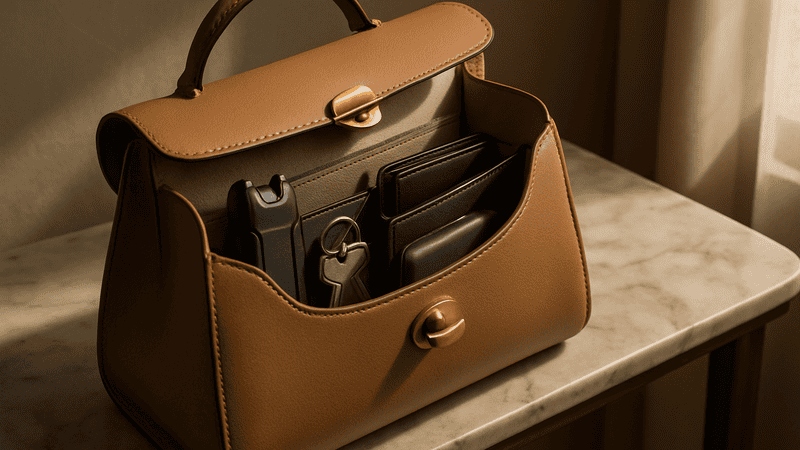
Your stun gun belongs in its own pocket — ideally a zippered or clearly defined compartment near the top of the bag, not buried beneath everyday items. The goal is a clean, repeatable motion: reach, grip, activate. If retrieving it requires digging, it has already failed its purpose.
Consider the geography of your own bag. Most women’s handbags have at least one interior slip pocket meant for a phone or a small item. That is exactly where a compact stun gun belongs — not the main compartment where it competes with a water bottle, a planner, and a makeup bag. If your current bag doesn’t have a dedicated pocket suited to this, it’s worth considering a small pouch you keep in the same spot every time, so muscle memory does the work when your mind is racing.
This same principle of designated placement is why we recommend women think about carry position the way they’d think about a car’s emergency brake — it only works if it’s always in the same place, every single time, regardless of what bag you’re switching to that day.
What should you avoid when choosing a stun gun for a purse?
Avoid stun guns with exposed metal prongs that can snag fabric, oversized units built for belt holsters rather than bags, and any model without a visible charge indicator. These three issues account for most of the frustration women report after buying the wrong stun gun for everyday carry.
Exposed prongs are more than a snagging risk — over months of use, they can wear against the lining of a bag, catch on a phone charging cable, or scratch other items. A stun gun designed for concealed, bag-based carry typically houses its contacts in a way that protects both the device and everything around it.
Oversized units are the second mistake. Some stun guns marketed broadly are genuinely better suited to glove compartments or work bags than the compact interior of a daily handbag. If you’re comparing options, look at actual dimensions, not just marketing photos next to a hand for scale — hands vary, and so do bags.
The third and most overlooked mistake: no visible charge indicator. A stun gun that’s silently lost its charge over three weeks of non-use is worse than not carrying one at all, because it gives you false confidence. This is a smart moment to get familiar with how stun gun battery life differs between rechargeable and replaceable models — because the maintenance routine you choose should match how consistently you’re willing to check it.
Should you choose a rechargeable or battery-powered model for purse carry?
Rechargeable stun guns tend to suit purse carry better than battery-powered models, simply because they build a habit — plug it in every few weeks, and it’s ready. Battery-powered models require you to remember to check and replace, which is an easy task to forget when life is busy.
That said, a rechargeable model is only as good as your discipline. If you’re not someone who reliably plugs things in, a battery-powered option with a clear low-charge indicator may actually serve you better. The right answer depends on your habits, not on which model sounds more advanced. This is the kind of honest assessment worth making before you buy, not after you’ve carried a dead unit for three months without knowing it.
Is a stun gun enough, or should you carry something alongside it?
A stun gun is a strong primary tool, but the women who feel most prepared typically pair it with one additional layer — a personal alarm for immediate attention-drawing, or a small canister of pepper spray for distance a stun gun can’t cover, since a stun gun requires contact. The two are not redundant; they solve different problems.
A stun gun works when someone is already close enough to touch you. Pepper spray and personal alarms work at a distance, buying you space before it ever gets to contact range. Women who carry both tend to think of their purse the way a well-prepared professional thinks of a toolkit — not one solution for every situation, but a small, considered set of options for different distances and different moments.
If you’re building this kind of layered setup, it’s also worth looking at what’s already trusted by professionals who carry daily under real scrutiny. A police stun gun available for civilian carry is often designed to the same reliability standard officers depend on, which tells you something about the engineering behind it — these aren’t hobbyist products, they’re tools built to a higher bar.
Does where you live or work change what you should carry?
Yes — your daily environment should influence your choice as much as your bag does. A student walking between night classes has different needs than a nurse finishing a 12-hour shift, and both differ from a delivery driver moving in and out of a vehicle all day.
Students benefit from something compact enough for a backpack or crossbody bag rather than a full handbag — this is exactly the thinking behind a stun gun designed for college campus carry, built with a size and activation style suited to someone moving quickly between buildings after dark. Night shift workers have their own considerations entirely — we’ve laid out the specific tools worth keeping in reach during overnight hours in our piece on what night shift nurses should carry in their scrubs pocket. And if your work has you behind the wheel more than on foot, the legal considerations shift too — our guide on what delivery drivers need to know about carrying self-defense tools at work covers ground specific to that situation.
The point isn’t that one stun gun is objectively superior to another. It’s that the best choice reflects your actual life — the bag you carry, the hours you keep, the distance between your car and your front door.
Frequently Asked Questions About Carrying a Stun Gun in Your Purse
Is it legal to carry a stun gun in my purse?
In most U.S. states, yes, though rules vary by state and sometimes by city. Some areas have age restrictions or require the device to remain unmodified. Always confirm your local and state regulations before purchasing, since laws differ enough that a device legal in one state may face restrictions in another.
Will a stun gun accidentally go off in my purse?
A well-designed stun gun with a safety pin or dual-switch activation is built specifically to prevent this. The risk comes from lower-quality models with exposed, easily-triggered switches. Choosing a model with a deliberate, multi-step activation process all but eliminates accidental discharge inside a bag.
How often do I need to charge a stun gun I carry daily?
Most rechargeable stun guns hold a charge for several weeks to a few months of standby time, but daily carry with occasional testing can draw it down faster. A good habit is to check the charge indicator monthly and recharge fully every four to six weeks, regardless of whether it’s been used.
What size stun gun actually fits in a purse without being noticed?
Look for models under six inches in length with a slim, contoured profile — these sit naturally in an interior pocket without adding bulk. Bulkier models built for belt or holster carry are typically better suited to a car or home rather than daily handbag use.
Can I carry a stun gun and pepper spray in the same purse?
Yes, and many women do exactly this. They solve different problems — a stun gun requires contact, while pepper spray works at a distance. Carrying both, each in its own designated pocket, gives you options for different situations rather than relying on a single tool.
What’s the difference between a cheap stun gun and a higher-quality one?
The difference usually shows up in the safety mechanism, the durability of the casing, the reliability of the charge indicator, and the consistency of the output over time. A well-built stun gun is engineered to perform the same way on day one and day five hundred — a lower-quality one often isn’t.
Should I test my stun gun to make sure it still works?
Yes, testing periodically — following the manufacturer’s guidance — confirms the charge is holding and the unit activates properly. Many models include a visible or audible spark test that doesn’t require contact with a person or object, making it simple to check without any risk.
What if my purse doesn’t have a good pocket for a stun gun?
Consider a small dedicated pouch that stays in the same position inside any bag you switch to. Consistency of placement matters more than the specific bag — the goal is that your hand finds it in the same motion every time, without thinking.
Conclusion
A stun gun is only as good as its fit into your actual life — your bag, your hands, your habits, your routine. The women who feel most prepared aren’t the ones who bought the flashiest option on the shelf. They’re the ones who thought it through: the right size, the right safety mechanism, the right pocket, checked and recharged on a schedule they can actually keep. That’s not an accident. That’s discernment.
If you’re ready to choose with that same care, take a look at our full range of stun guns built for both home and everyday carry and find the one that actually fits how you live — not just how you shop.