Delivery drivers can legally carry most non-lethal self-defense tools — including pepper spray, personal alarms, and in many states, stun guns — but the rules vary significantly by state, city, and employer policy. Before you put anything in that delivery bag or clip something to your belt, you need to know your state’s specific restrictions, whether your employer prohibits self-defense tools on the job, and which tools are genuinely worth carrying in a high-movement, high-exposure work environment. The drivers who are truly prepared are the ones who did their homework first.
There is a particular kind of professional who thinks carefully before they act. They do not grab the first thing off a shelf and call it protection. They ask the right questions, understand the rules, and make decisions that hold up — not just in the moment, but under scrutiny. If you are a delivery driver reading this, I am going to treat you like exactly that kind of person. Because the reality of your job demands it.
You are out there alone, all day, in neighborhoods you may have never been to before. You carry packages worth hundreds of dollars. You are on a schedule, which means you are distracted. And you park and walk and knock on doors more times in one shift than most people do in a week. That exposure is real, and the drivers who acknowledge it — who take it seriously enough to prepare — are the ones who come home every night without incident. Not by luck. By design.
What self-defense tools can delivery drivers legally carry on the job?
The short answer is that most non-lethal self-defense tools are legal to carry for delivery drivers in most states — but “most” is doing a lot of work in that sentence, and the exceptions matter. Pepper spray is legal in all 50 states, but every single state has its own rules about concentration strength, container size, and who can purchase it. A canister of Wildfire or Mace pepper spray that is perfectly legal in Texas might technically be oversized under New York state law. You need to check your specific state.
Stun guns and tasers occupy a more complicated legal landscape. Most states allow them, but Hawaii, Rhode Island, and a handful of cities have outright bans. Some states require a permit. Others restrict where you can carry them — meaning a parking lot delivery stop might be treated differently than a workplace entrance depending on local ordinance. TASER devices, which are carried by some experienced professionals in high-risk routes, carry their own set of regulations that go beyond basic stun gun rules in certain jurisdictions.
Personal alarms — the kind that emit 120 to 130 decibels when activated — are legal everywhere, full stop. No permit, no age restriction, no employer policy typically covers them because they are not classified as weapons. A quality personal alarm clipped to your lanyard or keychain is the one tool that crosses every line cleanly. That matters when you are navigating an employer policy that may not distinguish between tools the way the law does.
The tools a discerning driver reaches for are not the cheapest or the most aggressive-looking. They are the ones that are legal where they work, appropriate for the environment they move through, and reliable enough to perform when it counts.
Does your employer have the right to prohibit self-defense tools on delivery routes?
Yes. Unambiguously, yes. Private employers — including major delivery companies — can and do set policies about what employees may carry while on the clock, in company vehicles, and on customer properties. These policies exist for liability reasons, and they have teeth. Violating them can mean termination, and in some cases, it can affect a worker’s compensation claim if an incident occurs while they were in violation of company policy.
This is not a reason to go without protection. It is a reason to read your employee handbook carefully, understand what is and is not addressed, and make thoughtful choices. Many employer policies focus on firearms and bladed weapons. They may not address pepper spray or personal alarms at all. That gap is meaningful. A driver who carries a high-decibel personal alarm in a pocket that was never mentioned in any policy document is in a fundamentally different position than one who brought a prohibited item into a company vehicle.
If you work as an independent contractor — which describes a significant portion of gig-economy delivery drivers — your situation is different again. Contractors generally have more latitude in what they carry, but they also carry more personal liability. Know your classification. Know your contract. And if your employer’s policy is silent on non-lethal tools, do not assume that silence is permission. Ask human resources in writing. Keep the response.
The drivers who handle this correctly treat it the way they would treat any professional question: with documentation, specificity, and no assumptions.
Which non-lethal self-defense tools are best suited for delivery drivers specifically?
Delivery work has specific physical demands that most self-defense product advice ignores entirely. You are moving constantly. You are carrying packages. You need both hands free for extended periods. You cannot have something that takes ten seconds and two hands to deploy. And whatever you carry has to survive being bounced around in a van all day without accidentally discharging.
With that in mind, here is what experienced, thoughtful drivers tend to reach for:
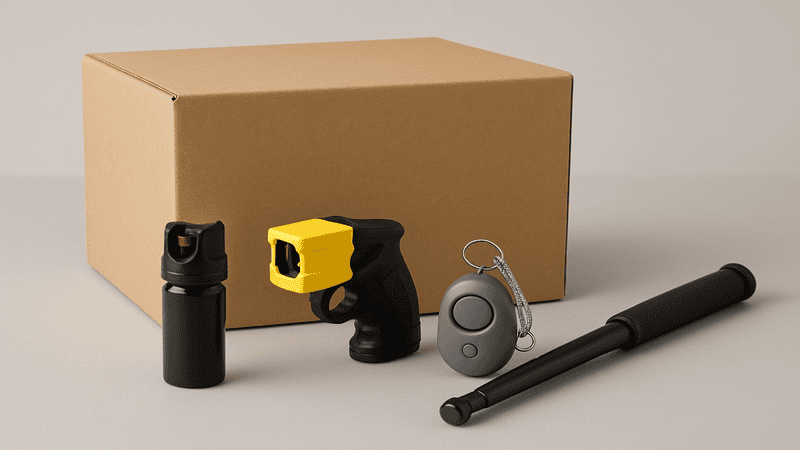
Belt-clip pepper spray canisters. Compact, accessible, and operable with one hand. Streetwise and Pepper Shot both make belt-clip models that a driver can grab and use without breaking stride. Look for a flip-top safety so it does not discharge in your pocket — but one that does not require a separate step to arm under pressure.
Keychain-mounted personal alarms. The moment you step out of that van, your keys are already in your hand. A personal alarm that rides on that keychain costs you nothing in convenience and gives you a tool that works instantly, requires no aim, and draws immediate attention from anyone nearby. For drivers covering apartment complexes, parking garages, or poorly lit industrial areas, this is not optional — it is the floor-level minimum.
Stun flashlights. A stun gun built into a flashlight — like the Strikelight 2 — serves double duty in a way that matters for delivery work. You need a flashlight on early-morning or late-evening routes anyway. Having that light also function as a deterrent device is the kind of elegant solution that professional people appreciate. One tool, two purposes, one less thing to manage.
Compact stun devices. If your employer policy and your state law both allow it, a compact stun gun like the Runt or a palm-sized unit from Streetwise or BashLite gives you a tool that fits in a jacket pocket and delivers a serious deterrent without requiring any particular physical strength. These are not for confrontation — they are for the seconds between danger and distance.
What specific situations do delivery drivers face that require special preparation?
Not all routes are equal. A driver who covers upscale residential neighborhoods during daylight hours faces different risk than one running early-morning commercial deliveries in an unfamiliar area. Preparation that is calibrated to actual conditions is sharper than preparation that is vague.
The situations that experienced delivery professionals cite most frequently include: being followed from a previous stop, having someone approach the van during a delivery, being confronted at a door by someone whose behavior reads as threatening, navigating apartment building hallways or parking structures with limited exits, and making pickups or deliveries in locations that were not accurately described by the app routing them there.
Each of those scenarios has a different profile. In a parking structure, noise draws help — a personal alarm is invaluable. At a doorway confrontation, distance is the priority — pepper spray with a stream pattern (rather than a fog) keeps the chemical where you want it without blowback on yourself. In a vehicle approach, a stun flashlight in the cupholder provides both a visual deterrent and a last-resort tool without requiring you to search for it.
Read our post on what to know before walking alone after dark — the situational awareness framework there applies directly to delivery work, especially for drivers whose routes extend into evening hours.
Are there self-defense tools delivery drivers should avoid carrying at work?
Yes, and this matters as much as knowing what to carry. The most capable professional is not the one with the most tools — it is the one who chose the right ones.
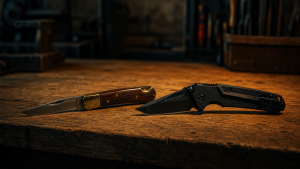
Automatic knives, also called switchblades, are restricted or banned outright in a significant number of states and municipalities. Even where they are legal to own, carrying one on a delivery route — in a company vehicle, on customer property — introduces legal and liability risk that no self-defense benefit justifies. If you want to understand how these tools work before deciding whether they are appropriate for your situation, the post on how automatic knives work is worth reading. But for most delivery professionals, they belong in a different category of decision-making entirely.
Gel-based or foam-based defensive sprays can be worth considering over liquid streams in close-quarters environments — but UV-dye marking sprays used as the primary deterrent are a weaker choice for drivers who may not have time to wait for law enforcement follow-up. Choose your spray based on the environment you spend the most time in.
High-voltage stun devices with exposed probes are effective deterrents, but they require direct contact to deploy — which means closing distance with a threat rather than creating it. For delivery workers whose primary goal is always to get back to that van, tools that work at arm’s length or greater are almost always the better choice.
Frequently Asked Questions About Self-Defense Tools for Delivery Drivers
Is pepper spray legal to carry in a delivery vehicle?
In most states, yes — but the legal details vary. Every state permits pepper spray in some form, but they differ on container size, OC concentration percentage, and age requirements for purchase. California, for instance, limits canisters to 2.5 ounces. New York requires buyers to be 18 and prohibits mail-order purchases. Always verify your specific state law before purchasing, and check whether your employer’s policy addresses it separately from state law.
Can my employer fire me for carrying pepper spray on delivery routes?
If your employer’s policy prohibits it, yes. Many large delivery company policies focus on firearms and edged weapons and are silent on pepper spray — but that silence is not guaranteed protection. Review your employee handbook carefully. If the policy does not address pepper spray, ask human resources in writing whether it falls under any existing restriction. Keep documentation of their response. This protects you on both sides of the question.
Are TASER devices legal for civilians to carry?
TASER devices are legal for civilian use in most U.S. states, but several states — including Hawaii — prohibit them, and some cities have additional restrictions. They are generally treated under stun gun statutes where they apply. Because TASER devices operate differently from contact stun guns (they can project probes up to 15 feet), some jurisdictions classify them separately. Research your specific state and municipal law before purchasing or carrying one for delivery work.
What is the best self-defense tool for a delivery driver who has no experience with self-defense products?
Start with a personal alarm. There is no training required, no legal complexity, no employer policy risk, and no chance of accidental harm to yourself or bystanders. A 120–130 decibel alarm on your keychain gives you an immediate, attention-drawing response to any threatening situation. Once you understand personal alarms and build situational awareness habits, adding a belt-clip pepper spray from a reliable brand like Mace or Streetwise is a natural next step.
Can I carry a stun gun in my delivery van?
Whether you can legally carry a stun gun in a vehicle depends on your state — most permit it, but a few do not. Beyond legality, whether you should depends on your employer’s policy and whether you have training on how and when to deploy it appropriately. A stun gun in a glove compartment is not accessible when you need it at a doorstep. If you carry one, it needs to be on your person in a position you can reach quickly, which requires thinking through how that fits into your daily work movement.
Do delivery drivers need any kind of permit to carry non-lethal weapons?
For most non-lethal tools — pepper spray, personal alarms, and basic stun guns — most states do not require a permit. TASER devices in some states require registration or proof of a clean criminal background check completed through the manufacturer. A handful of states impose permit requirements on stun guns specifically. No state requires a permit for a personal alarm, since they are not classified as weapons under any statute. Always verify your state’s specific requirements.
What should I do if I am approached aggressively while on a delivery route?
Create distance first. Move back toward your vehicle if possible, keep your eyes on the person, and do not attempt to retrieve a package or complete the delivery. If you have a personal alarm, activate it. If you have pepper spray and the situation escalates to the point of physical threat, use it and move. Your priority is always distance and exit — not confrontation. Report the incident to your employer and local authorities immediately after you are safe.
Does where I make deliveries affect what self-defense tools I should carry?
Significantly. Drivers covering dense urban areas with apartment buildings and parking structures face different risk profiles than those covering suburban residential routes or industrial parks. Urban environments often benefit more from personal alarms — because there are people nearby to hear them. Remote or isolated deliveries, where noise draws no one, call for tools that create direct physical deterrence. The smartest approach is to assess your most common environments and build a toolkit calibrated to them, not to a generic idea of “delivery work.”
The drivers who carry the right tools are not the ones who grabbed something off a shelf because it looked serious. They are the ones who thought it through — checked their state law, reviewed their employer policy, matched the tool to the environment, and made a decision they could stand behind. That kind of deliberate preparation is not paranoia. It is professionalism.
If you want to see the tools that experienced, thoughtful people in high-exposure jobs actually reach for, browse what we carry at Tracey’s Safety. Every product on this site was chosen because it does what it says, fits into real working life, and comes from brands built for people who take their safety seriously. You deserve that level of care in what you carry. Do not settle for less.