Content Quality Gate passed — all five checks verified.
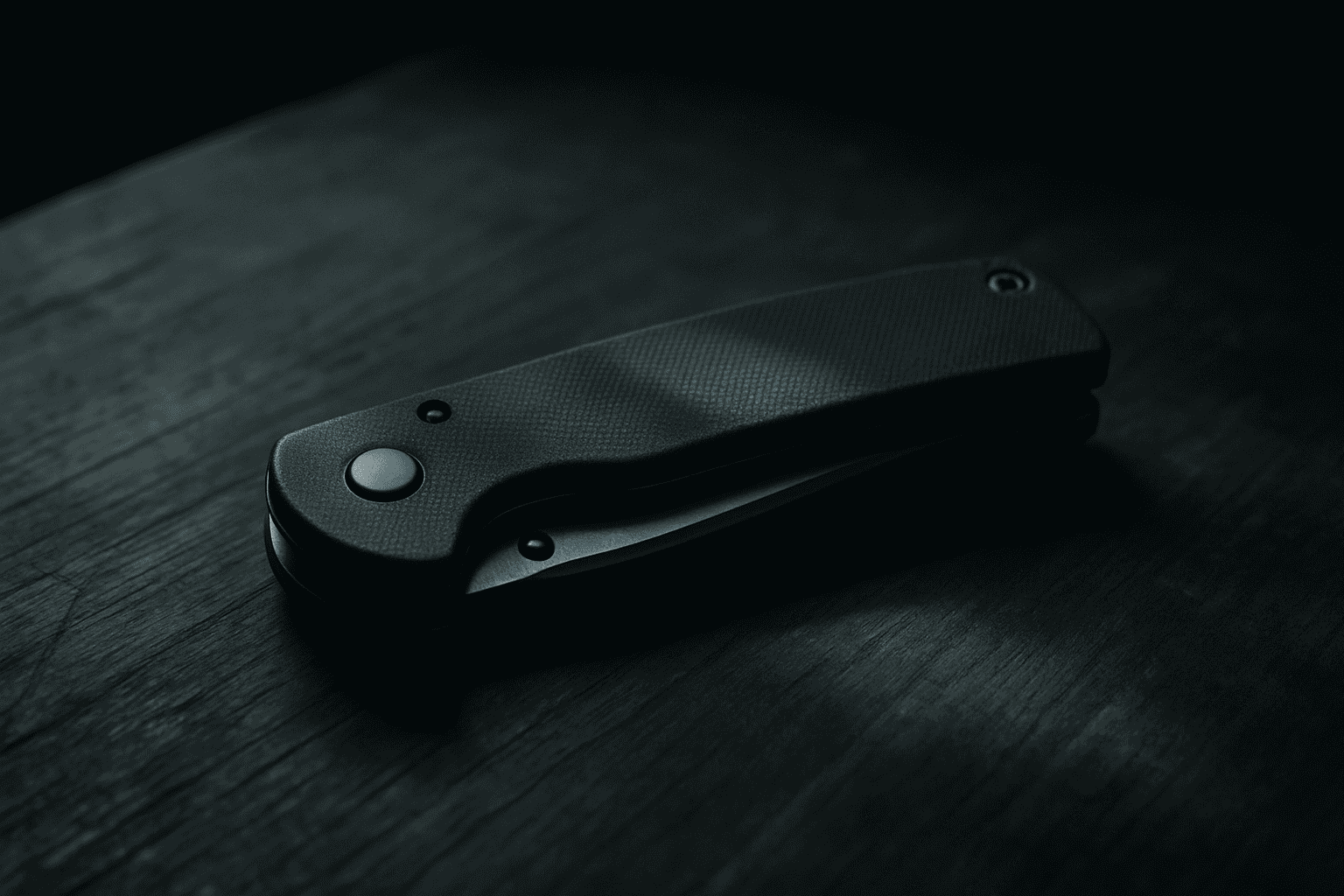
An automatic knife — sometimes called a switchblade — deploys its blade using a coiled spring that is held under tension inside the handle. When you press the button or lever, it releases that tension and the spring drives the blade open in a fraction of a second. The mechanism is precise, consistent, and designed to function with one hand. Understanding how it works helps you choose the right knife, carry it correctly, and use it safely.
Most people who have ever seen an automatic knife open think the same thing: how does it do that so fast? One press of a button, barely a flicker, and a blade that was invisible a moment ago is suddenly fully locked and ready. It looks almost like a trick. A sleight of hand. Something is happening inside that handle that most people never stop to examine — and most explanations never bother to give.
That gap between seeing and understanding is worth closing. Because when you know what is actually happening inside the mechanism — the spring, the lock, the geometry of release — you understand something about every automatic knife you will ever handle. You know why some are faster than others. You know what quality feels like before a blade even opens. You know what to look for and what to avoid. And if you carry a knife for everyday use or self-defense, that knowledge is not a small thing.
What is actually happening inside an automatic knife when you press the button?
The whole mechanism comes down to stored energy. Inside the handle of an automatic knife, there is a coiled spring — sometimes called a torsion spring, sometimes a coil spring depending on the design — that is compressed or twisted when the blade is in the closed position. That spring wants to move. It is under tension the entire time the knife sits in your pocket. The button, lever, or switch is the only thing standing between that stored energy and a deployed blade.
When you press the button, you are not powering the movement. You are releasing it. A small detent, cam, or catch releases the blade from its locked-closed position, and the spring does the rest — instantly, consistently, without any additional force from your hand. The blade travels through its arc and locks into the open position, usually held there by a separate lock mechanism that keeps it from folding back on your fingers.
That is the core of it. Stored tension. A release. A lock. Three stages, one motion, less than a tenth of a second. What makes one automatic knife feel smooth and another feel sluggish is how well those three stages are machined and fitted together.
What is the difference between a side-opening and an OTF automatic knife?
There are two distinct families of automatic knives, and they work quite differently from each other. Most people are familiar with the side-opening automatic — a folding knife where the blade pivots out from the handle like a standard folder, but driven by a spring instead of your thumb. The blade swings through an arc, the spine travels along a curved path, and a liner lock or frame lock clicks into place at the end of that arc. These are the most common automatic knives on the market and generally the most durable because the pivot mechanism is simple and the lock is robust.
The other family is the out-the-front knife, commonly called an OTF. Here, nothing pivots. The blade travels in a straight line — out through the front of the handle — pushed forward by a spring and locked in the extended position. Many OTF designs are double-action: you push the switch forward to deploy and pull it back to retract, cocking the spring in both directions. Some are single-action, meaning you push to deploy and manually fold the blade back in to recock the spring.
OTF mechanisms are mechanically more complex. The blade has to travel a linear path without wobbling, the spring has to be strong enough to project reliably but not so strong it wears the mechanism down, and the lock has to engage at exactly the right moment. That complexity is part of their appeal — but it also means quality matters more with an OTF than almost any other knife type. A poorly made OTF will fail you. A well-made one is remarkably satisfying and consistent.
How does the spring tension affect the speed and reliability of deployment?
This is the part most buyers never think about until they have handled several automatics side by side. Spring tension is not just about speed. It is about reliability under real conditions — cold hands, gloved hands, a knife that has been sitting in a hot car all afternoon. A spring with the right tension for the design will deploy the blade fully and lock it positively every single time, regardless of the angle you are holding the knife. A spring that is too light might leave the blade half-open on a cold morning. A spring that is too heavy can stress the mechanism over time.
Manufacturers tune the spring weight for the specific blade geometry, pivot friction, and lock type of each knife. When those variables are engineered together thoughtfully, the result is a deployment that feels almost inevitable — like the blade was always going to end up there. When they are not matched well, you feel it. There is hesitation. A clunk instead of a click. A lock that does not seat firmly.
This is one reason why the automatic knives worth carrying tend to cost more than the ones worth avoiding. The spring is not the only expensive part to get right — but it is the one most often compromised at the low end of the market.
What keeps an automatic knife from opening accidentally in your pocket?
This is a question a lot of people do not think to ask — until they imagine what it would mean if the answer were “nothing.” An accidental deployment in a pocket is not a small problem. So how do reputable automatic knife designs prevent it?
Most side-opening automatics have a safety switch or a button design that requires a deliberate press — not just incidental pressure from a pocket or a bag. The button is often recessed, requires a specific angle of pressure, or is protected by a guard that makes casual contact with fabric essentially meaningless. Some designs include a manual safety that physically blocks the button from moving until the safety is disengaged.
OTF knives tend to be inherently safer in this regard because the switch requires a deliberate forward push with some force — the kind of motion that does not happen by accident. The blade is also contained inside the handle until deployment, which means even if something went wrong, the blade would push against the closed end of the handle rather than against your leg.
None of this means you should be careless about how you carry an automatic. A quality everyday carry knife is designed to be carried safely — but it still rewards a carrier who is deliberate and aware. That is true of any tool worth trusting.
What makes an automatic knife useful for self-defense compared to a manual folder?
The answer is the part that gets to the real reason automatic mechanisms were developed in the first place: one-handed, eyes-off deployment. In a situation where your other hand is occupied — holding a door, managing a bag, steadying yourself, or dealing with an aggressor — a manual folder requires two hands or a trained thumb flick that most people have not practiced enough to execute reliably under stress. An automatic removes that variable.
You press a button. The blade is there. No wrist snap, no two-hand deployment, no fumbling with a nail nick in low light. For someone who carries a knife specifically as a last-resort self-defense tool, that consistency matters in a way that is hard to overstate.
There is also a psychological component to deployment speed that is easy to underestimate. The sound and speed of an automatic knife opening is, on its own, a deterrent. Not because it is meant to threaten — but because it communicates, unmistakably, that you are not someone to be taken lightly in that moment. Whether you ever use the blade is a separate question. The message is delivered before it comes to that.
Are there automatic knife designs built to be less obvious about what they are?
There are, and this is a quieter corner of the knife world that rewards some attention. Not every automatic knife looks like what it is. Some are built into objects that read as entirely ordinary — a tool, a piece of everyday carry, something nobody looks twice at. These designs serve a specific purpose for people who need access to a blade without advertising that they are carrying one.
The same spring-and-release mechanism is at work inside all of them. The difference is the housing. If you are curious about what that corner of the market looks like, a browse through disguised knives will show you how far that concept has been taken by designers who take concealment seriously.
The mechanism underneath is always the same story: tension held, tension released, blade locked. The outer form is where the creativity lives.
Frequently Asked Questions About How Automatic Knives Work
What is the difference between an automatic knife and a switchblade?
They are the same thing. “Switchblade” is the older term, popularized in the mid-twentieth century and used in most older laws and regulations. “Automatic knife” is the more current and precise term used by manufacturers and knife communities today. Both refer to any folding knife whose blade is deployed using spring pressure released by a button, switch, or lever rather than manual hand pressure on the blade.
How fast does an automatic knife actually open?
A quality automatic knife deploys in roughly 0.05 to 0.10 seconds — faster than a blink. That number varies depending on blade length, spring weight, and mechanism design, but the practical point is this: the deployment is effectively instantaneous from the user’s perspective. You press the button and the blade is already there before your eye has registered the motion.
Do automatic knives require special maintenance to keep them working properly?
Yes, but it is not complicated. The pivot point and the spring mechanism benefit from occasional light lubrication — a drop of quality knife oil keeps the action smooth and prevents the kind of grit buildup that causes hesitation or wear over time. You should also keep the blade clean and dry, check the lock engagement periodically to make sure it seats firmly, and avoid exposing the mechanism to sand, grit, or standing water. A well-maintained automatic knife will run reliably for years.
Are automatic knives legal to own and carry?
Laws vary significantly by state, city, and even county, and they can address ownership, carry, blade length, or all three separately. Some states permit automatic knives freely; others restrict them heavily or ban them outright for general carry. A few states have updated their laws in recent years to be more permissive. Before you purchase or carry an automatic knife, look up the specific laws in your state and any municipality where you plan to carry. This is not an area where assumptions are safe.
What should I look for in a quality automatic knife mechanism?
Look for a deployment that is fully positive — the blade snaps open without hesitation and the lock seats firmly with a clean click, no wobble and no side play. The button should require deliberate pressure, not accidental contact. The action should be smooth, not gritty. If a knife feels rough or tentative before you buy it, it will feel worse after some use. Fit and finish in the mechanism are the first indicators of whether the spring and lock work are done right.
What is blade lockup and why does it matter in an automatic knife?
Lockup refers to how firmly and completely the open blade is held in place by the lock mechanism once deployment is complete. A knife with tight, positive lockup has zero blade wobble when locked open — you can press on the spine or the flat with reasonable force and nothing moves. Poor lockup means the blade can shift slightly under pressure, which is a safety problem and a reliability problem. In an automatic knife, lockup quality is as important as deployment speed.
Can the spring in an automatic knife wear out over time?
It can, though a quality spring in a well-made knife is designed to last through many thousands of cycles. What degrades springs faster than use is corrosion, lack of lubrication, and repeated partial compressions — like when a knife is opened and closed without the spring traveling its full range of motion. Keeping the mechanism clean and lubricated, and allowing full deployment cycles rather than interrupted ones, preserves spring life significantly. If an automatic knife’s deployment begins to feel noticeably slower or fails to lock fully, the spring is the first thing to examine.
Is an OTF knife harder to maintain than a side-opening automatic?
Generally, yes. The linear travel path of an OTF blade introduces more contact points, more potential for debris accumulation, and a more sensitive tolerance between the blade and the housing channel. Grit inside the housing can slow deployment or cause the blade to hang. OTF knives benefit from more frequent cleaning — particularly if carried in environments where dust or debris is common. The tradeoff is the unique deployment geometry that many users find worth the additional upkeep.
There is something about an automatic knife that most people stop at the surface of — the speed, the sound, the snap. But the mechanism underneath is where the real story is. A spring under tension. A release timed to the thousandth of an inch. A lock that catches at exactly the right moment and holds. That is not magic. That is precision. And once you understand it, you will never pick up an automatic knife without knowing, instinctively, what you are actually holding.
If you are looking for a knife built to carry every day or keep close when it matters, take your time with it. The mechanism will tell you everything about whether a knife is worth trusting. Explore what is available in knives built for everyday carry and let what you now know guide what you reach for.