Content Quality Gate passed — all five checks verified.
The short answer: Night shift warehouse workers face real personal safety risks — isolation, poor lighting, long walks to parking lots, and limited backup. The best non-lethal tools for this environment are compact stun guns that can handle rough handling and moisture, high-decibel personal alarms rated for loud industrial settings, and pepper sprays with secure, belt-clip or holster carry options. Whatever you choose, it needs to be accessible in seconds, durable enough for daily industrial use, and legal to carry in your state.
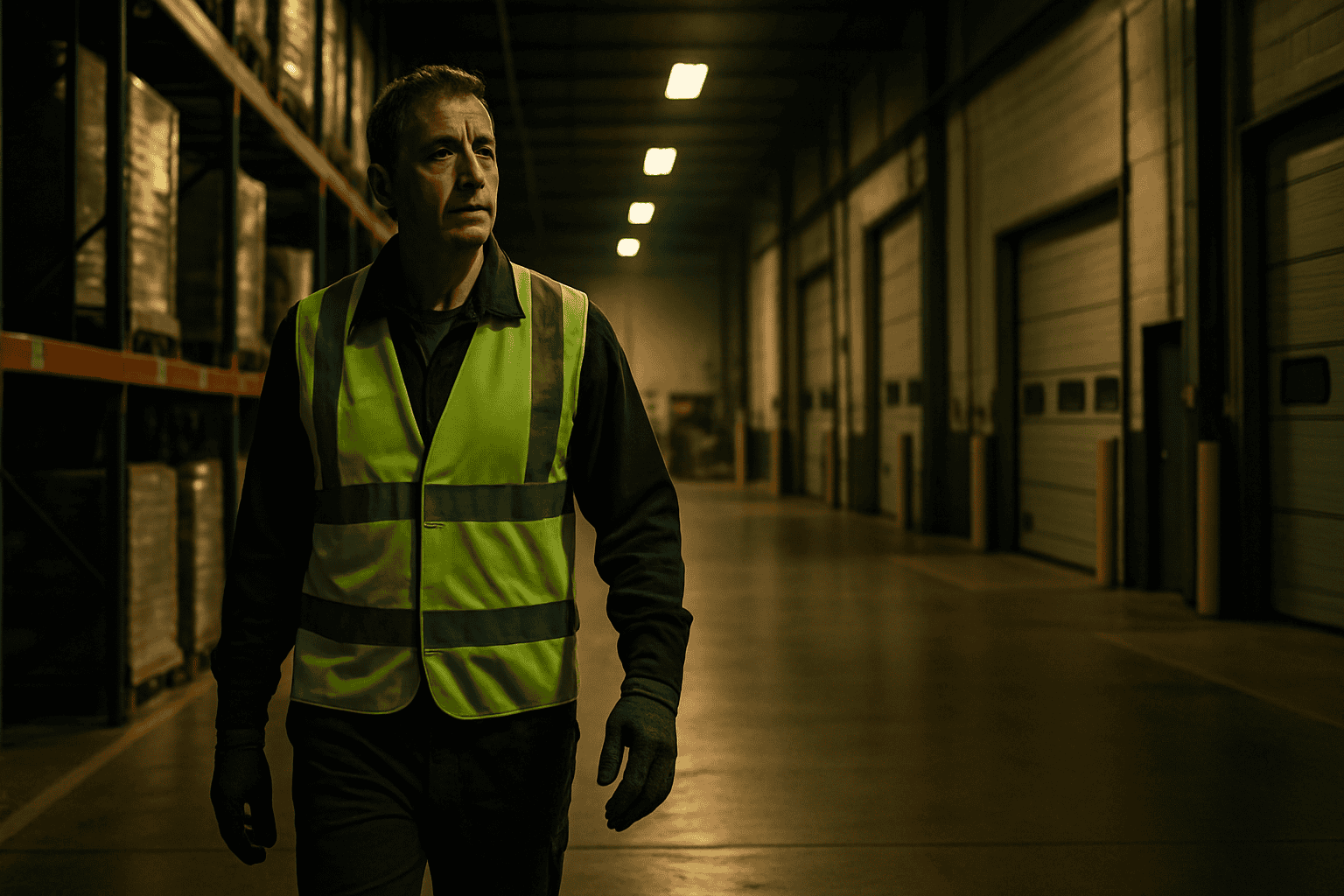
My cousin Darnell has worked nights at a distribution warehouse out in the Inland Empire for going on eleven years. He clocks in at ten, clocks out at six in the morning. By the time he walks to his car, the sun is barely thinking about coming up and the parking lot is half-empty. He has walked that lot alone more times than either of us can count. For most of those years, he walked it with nothing but his keys and his good sense.
I finally got through to him. It took a while — men don’t always want to hear this conversation — but I got through to him. And what I want to do today is have that same conversation with every warehouse worker, every night-shift loader, every forklift operator and dock worker and inventory clerk who punches in when the world goes quiet. Because quiet is not the same as safe. And I want you to have real information, not a sales pitch — just the honest truth about what works in your world and why.
Why are warehouse workers on night shift at higher personal safety risk than other workers?
It is not just the hours, though the hours matter. Night shift workers move through spaces that were designed for maximum efficiency, not personal safety. Wide corridors, loading docks that open to unlocked parking lots, entrances and exits that aren’t always monitored after midnight. Security presence gets lighter. Foot traffic drops off. And if something happens in a back aisle of a 400,000 square foot facility, your coworkers might be three zones away.
The parking lot situation alone is worth taking seriously. Night shift means arriving and leaving in the dark, often in large, poorly lit industrial lots that sit at the edge of industrial parks or near highway corridors — areas that don’t always have the same foot traffic and natural visibility as an urban street. You are frequently the only person between your car and that facility entrance.
And then there is the fatigue factor. Toward the end of a ten-hour overnight, your awareness naturally dulls. Your body wants sleep. That is precisely when your attention to your surroundings is weakest. A good self-defense tool doesn’t replace awareness — but it gives you something real to rely on when your nervous system is running on fumes and you just need to get to your car.
What makes a stun gun actually reliable in a warehouse environment?
Warehouses are hard on gear. If you’ve worked one, you know — it’s dusty, it’s damp near the docks, temperatures swing, and everything you carry gets bumped, dropped, and jostled over the course of a shift. That rules out a lot of cheap, fragile devices right away. What you need is something with a solid housing, a secure safety mechanism that won’t accidentally discharge in your pocket or on your belt, and a charge that holds over days, not hours.
Rechargeable stun guns are the practical choice here — you don’t want to be hunting for a battery at the end of a long shift. Models built with rubberized or textured grips hold up better in damp or gloved hands, which matters on a loading dock. A stun gun with a built-in flashlight, like the Strikelight 2, is genuinely practical in low-light industrial settings — you get utility and protection in one device you’ll actually carry because you actually use it every night.
The Strikelight 2 is worth mentioning specifically because it was built with real-world carry in mind: a hard aluminum body, a bright LED flashlight function that earns its place on a night shift, and a stun capability that doesn’t require you to fumble around finding the right end. Devices that serve double duty tend to get carried more consistently. That is the honest truth about any safety tool — the one that stays in your locker does you no good.
If you prefer something smaller that clips to a belt or sits in a front pocket, compact rechargeable options from Streetwise and the Runt series have built reputations for durability and consistent performance. The Runt in particular is a compact, rubberized unit that fits in a hand without being conspicuous — useful if you want something you can keep on your person throughout a shift without it getting in the way of your work.
What kind of personal alarm actually works in a loud industrial environment?
Here is something people don’t think about until they need to: a 120-decibel alarm in a quiet parking lot and a 120-decibel alarm inside a warehouse with forklifts, conveyor belts, and ambient machinery noise are two different things. Industrial environments are loud by nature. The alarm you carry needs to be loud enough to cut through that ambient noise and reach human ears at a distance.
Look for personal alarms rated at 130 decibels or higher for a warehouse setting. At 130dB, you are producing more sound than a jet engine at 100 feet. That penetrates. That reaches your coworkers two aisles over. That makes a person in a parking lot very visible very fast.
The other thing to consider in an industrial setting is durability and activation style. Alarms that activate by pulling a pin — rather than pressing a button — have a mechanical simplicity that doesn’t fail. No batteries to die, no buttons to stick, no complicated sequence when your hands are shaking. Pull the pin, it screams. Put the pin back in, it stops. That reliability matters.
I carry a personal alarm on my keychain and I’ve recommended them to people in all kinds of situations — from women heading home from the bus stop to elderly neighbors doing their weekly errands. If you want to read more about how these devices work and what to look for, I’ve put together a full guide on personal alarms for women that gets into the specifics. And for workers who commute or travel between facilities, my page on personal alarms for travelers covers carry options that work on the move.
Is pepper spray a practical option for warehouse workers, and what should they look for?
Pepper spray is practical for warehouse workers with some caveats. The carry method matters in an industrial environment. A canister rolling around loose in a work bag or sitting at the bottom of a pocket is not accessible when you need it. What you want is a belt-clip holster or a keychain attachment that keeps the spray where you can reach it in under two seconds — consistently, every time, without searching.
In terms of formulation, look for sprays that use OC resin — that’s oleoresin capsicum, the actual pepper extract — rather than weaker synthetic alternatives. Wildfire and Pepper Shot are two brands sold here that use high-concentration OC formulations and have earned consistent trust from people who carry daily. Mace has been around long enough to be familiar to most people — their products are solid, their carry options are varied, and their pepper gel formula is a good choice for indoor-adjacent situations because gel reduces airborne blowback risk.
Pepper gel specifically is worth considering if you ever need to use your spray indoors or in an enclosed space like a stairwell or a break room. Traditional sprays can drift back toward you in a tight space. Gel formulas travel in a stream, stick on contact, and don’t disperse in the air the same way. That makes them better suited to indoor environments where standard mist could affect you as much as an attacker.
One more practical note: check your employer’s policy. Some warehouses — particularly those handling food products or operating under specific safety regulations — may restrict what employees can carry on the floor. Know your workplace rules, keep your spray in your personal bag during work hours if needed, and make sure it’s accessible for the walk to and from your vehicle.
How should a night shift worker actually carry and access their self-defense tools?
The number one mistake people make with any self-defense tool is carrying it in a place they can’t reach it fast. At the bottom of a backpack. Zipped into a jacket pocket. Locked in a car. None of that is real protection — it is the idea of protection without the practice of it.
Here is what actual accessible carry looks like on a night shift:
- During your shift: A personal alarm clipped to your badge lanyard or belt loop stays with you all night and requires no thought to access. A compact stun gun in a belt holster works the same way. Both of these are low-profile enough to not interfere with your work and high-access enough to be useful.
- Walking to your vehicle: This is your highest-risk moment. Before you leave the building, your spray or stun gun should already be in your hand or immediately accessible — not buried in a bag you’re rummaging through while you walk. Take ten seconds before you step outside. Have it ready.
- In your vehicle: A stun gun or alarm kept in the center console or door pocket is accessible for the moment when you’ve just gotten in and haven’t locked the doors yet. That brief window is real vulnerability for night shift workers in isolated lots.
Consistency is what makes any tool actually protective. The more routine your carry becomes — same place, same access, same habit every single shift — the more reliable your response will be if you ever actually need it. Practice reaching for your tool the same way you practice any other work routine. It should be automatic.
What should older or physically limited workers consider when choosing a non-lethal defense tool?
Not every warehouse worker is young and able-bodied, and that matters when choosing a tool. Night shift warehouses employ a wide range of people — including workers in their fifties and sixties, people managing arthritis or reduced grip strength, and people who may not have the reaction speed they had at thirty. The right tool for a twenty-five-year-old and the right tool for a fifty-eight-year-old are not always the same.
For workers with reduced grip strength, a personal alarm is the most accessible option available — particularly pin-pull designs that require almost no hand strength or fine motor coordination. There is no aim, no trigger discipline, no complex operation. You pull a pin and it screams for you. I’ve written specifically about these considerations on the personal alarms for elderly page, and much of what applies there applies equally to any worker whose physical capacity is a real factor in their carry decision.
For workers who do want a stun gun but find larger models awkward, the compact designs in the Runt line were built for smaller hands and lighter grip. They don’t sacrifice effectiveness for size — they just make the tool more practical for the person actually using it.
Frequently Asked Questions About Personal Protection for Night Shift Warehouse Workers
Can I carry a stun gun or pepper spray at work?
This depends on two things: your state’s laws and your employer’s policies. Most states permit non-lethal self-defense tools for adults, but some have restrictions on stun guns or pepper spray concentration. Your employer may also have rules about what can be carried on the warehouse floor. Check both before you carry. In most cases, keeping your tools in your personal bag and accessible for your commute is a practical middle ground.
What is the most reliable non-lethal tool for a warehouse environment?
A high-decibel personal alarm — 130dB or higher with a pin-pull activation — is the most universally reliable option for industrial settings. No mechanical failure, no aim required, no concern about aim or proximity. A rechargeable stun gun with a rubberized grip and built-in safety switch is the strongest second option for workers who are comfortable with direct-contact tools and have practiced basic use.
How do I keep my pepper spray accessible during a long warehouse shift?
Use a belt-clip holster or keychain attachment rather than keeping spray loose in a bag or pocket. The spray should be reachable in under two seconds without searching. Attach it to whatever you carry on your body throughout the shift — belt, lanyard, or work bag strap — and make reaching for it a deliberate daily habit before you enter and exit the facility.
Will a personal alarm be loud enough to be heard in a noisy warehouse?
A 130dB alarm produces more sound than most industrial machinery at close range and will cut through ambient warehouse noise in the majority of real-world situations. The key is proximity — an alarm is most effective in shared spaces and parking lots where coworkers or passersby are within a few hundred feet. Inside a very loud active production floor, direct personal contact tools like a stun gun may be more practical backup.
How often should I recharge a stun gun I carry daily?
Most quality rechargeable stun guns maintain a charge well for daily carry, but building a weekly charging habit is the safest practice. Treat it the same way you treat charging your phone — pick one day and make it routine. Never start a shift trusting a device you haven’t checked recently. Some models have a visible charge indicator; if yours does, make checking it part of your start-of-shift routine.
Is pepper gel better than pepper spray for warehouse workers?
In many cases, yes — particularly for workers who might need to use a defensive spray in an enclosed space like a stairwell, locker room, or dock vestibule. Pepper gel travels in a targeted stream and does not become airborne the way traditional spray mist does, which reduces the risk of affecting yourself or coworkers in tight quarters. For open outdoor use like a parking lot, traditional spray and gel both perform well.
What if I’ve never used a stun gun before — is it hard to learn?
No. Modern stun guns are straightforward by design. The basic operation — disable the safety, press to contact — takes minutes to learn. The more important practice is carrying consistently and knowing where your tool is without looking. Read the instructions for your specific device, practice the safety mechanism until it’s second nature, and the physical use will be there when you need it. No special training is required for basic competency.
Are there non-lethal tools specifically designed for runners or commuters that also work for shift workers?
Yes — many personal alarms and compact stun guns designed for runners and commuters are equally well-suited for shift workers who walk between facilities and parking lots. Tools built for active carry — lightweight, clip-on or w