A tactical knife is purpose-built around a specific set of demands — rapid one-handed deployment, a blade geometry designed for penetration or utility under pressure, and a grip that holds under stress. A regular pocket knife is designed around convenience and everyday tasks. The difference is in the engineering decisions behind every curve, material, and mechanism.
Now, that sounds simple enough on the surface. But pull back that first layer and things get more interesting.
Most people who ask this question are standing at a crossroads they do not quite realize they are at. They are not just comparing two tools. They are asking a deeper question: what am I actually carrying, and does it match what I actually need? That is the question worth sitting with.
What design features actually separate a tactical knife from a regular pocket knife?
Here is what the catalogs do not always tell you: the word “tactical” gets thrown around so loosely that it has started to lose meaning. Manufacturers slap it on black-handled knives with serrated edges and call it a day. But real tactical design is quieter and more specific than the marketing suggests.
A true tactical folder is built around one-handed operation — period. That means a thumb stud, flipper tab, or assisted-opening mechanism that lets you deploy the blade with the same hand that is holding the knife. In a situation where your other hand is occupied — carrying something, bracing yourself, or holding a door — that detail is not a convenience. It is the whole point.
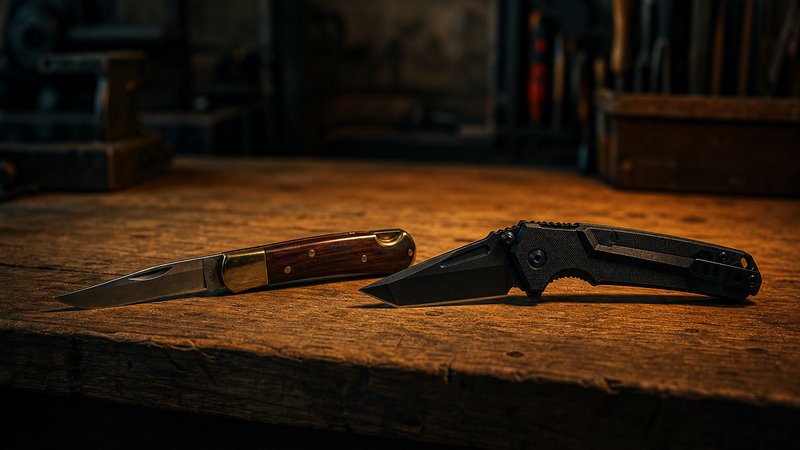
The blade geometry tells another story. Regular pocket knives tend toward drop-point or clip-point blades, which are excellent for slicing, food prep, and box-opening. Tactical knives more often feature a tanto blade — that angular, reinforced tip you see on designs like the tanto blade folding knife — which trades some general utility for a tip that can handle puncture tasks and maintain its point under pressure. The spine is typically thicker. The grind is designed for strength over pure slicing efficiency.
The handle matters too, and most people underestimate how much. Tactical handles are designed to stay put in a wet hand. Textured G10 composite, aluminum with machined ridges, reinforced polymer — these are not style choices. They are the difference between a grip that holds under stress and one that shifts at exactly the wrong moment. Your grandmother’s pearl-handled pen knife is beautiful. You would not want it in your hand on a dark parking lot.
Does a tactical knife count as a weapon — and does a pocket knife not?
This is the question people are actually circling when they ask about the difference. And the honest answer is: the law does not always draw the same line the marketing does.
In most jurisdictions, a folding knife of a certain blade length is legal to carry regardless of whether the handle is tactical-black or candy-apple red. What triggers legal concerns is usually blade length, whether the blade locks open, assisted-opening mechanisms, or double-edged blades — not the word “tactical” stamped on the package.
That said, intent and appearance do matter in certain contexts. A knife displayed or deployed in a threatening manner is a weapon regardless of what it looks like. And some states have specific restrictions on assisted-opening knives, gravity knives, or automatic knives that do not apply equally to traditional slip-joint folders.
I always tell people: know your local laws before you carry anything. That is not me being overly cautious. That is me not wanting you to carry something you do not fully understand. Check your state and local statutes. Know what you have. Carry it correctly.
Why do tactical knives use assisted-opening mechanisms — and should that concern you?
The assisted-opening mechanism is where a lot of people get nervous, and I understand why. There is something about a knife that snaps open fast that reads as aggressive — even when you are the one holding it.
Here is what is actually happening inside that mechanism. An assisted-opening knife uses a small internal spring that only engages once you have already started the opening process — typically by pressing a flipper tab or thumb stud past a certain point. You initiate the motion; the spring completes it. This is meaningfully different from an automatic or switchblade knife, which opens entirely by spring pressure from a button you press before the blade moves at all.
Why does that distinction matter? Because in most states, assisted-opening folders are treated the same as any other folding knife, while automatics carry heavier restrictions. The mechanism delivers fast, reliable, one-handed deployment without crossing into automatic territory. For someone who needs their knife available quickly — a rideshare driver, a night-shift worker, someone who has ever had to find their keys in the dark while walking alone — that response time is the difference between a tool that is ready and a tool that is not.
For people working demanding environments, including healthcare workers reading something like our post on self-defense tools for night shift nurses, the question of what deploys reliably and legally in a moment of stress is not abstract. It is very real.
What materials make a tactical knife different from a standard pocket knife?
Lift a regular pocket knife and a tactical folder side by side. You will notice the difference before you even open either one.
Standard pocket knives often use stainless steel that prioritizes corrosion resistance and ease of sharpening over edge retention. The handles are frequently wood, bone, or basic polymer — beautiful materials that serve a gentleman’s knife just fine. The overall construction tends toward lightness and comfort.
Tactical folders typically run harder steel. You will see grades like 440C, D2, or 8Cr13MoV in mid-range tactical knives — steels that hold an edge longer under hard use but require a little more attention to sharpen properly. Higher-end tactical folders reach into steels like S30V or S35VN, which offer genuinely impressive edge retention. The tradeoff is that these steels are less forgiving to sharpen at home. They reward patience and the right tools.
Handle materials in tactical knives are chosen for grip and durability under stress. G10 — a fiberglass laminate — is a common choice because it is nearly indestructible, does not absorb moisture, and textures beautifully for grip. Anodized aluminum is another popular option: lightweight, strong, and machined for traction. Some handles incorporate finger grooves or a guard — subtle features that prevent the hand from sliding forward onto the blade under pressure. That is a detail that sounds minor until it is not.
Can a tactical knife serve double duty as an everyday carry tool?
This is the question I get most often, and the answer is yes — with some caveats worth understanding.
A well-designed tactical folder handles everyday tasks admirably. Box-opening, cutting cord, food prep at a tailgate, stripping wire — the blade geometry and quality steel serve all of these. The assisted opening is a convenience, not a liability. The solid lock-up means the blade is not going anywhere while you work.
Where you may notice the tradeoff is in profile. Tactical folders tend to run thicker and heavier than slim everyday carry knives designed purely for pocket comfort. A knife built for hard use has to be built to absorb that use, and that means more material, more weight. For some people, that is a non-issue. For others — people who want something truly disappearing in a jeans pocket — a dedicated everyday carry design might serve better.
The honest answer is that many people carry a tactical folder every day and find it serves both purposes well. The design simply has to account for both jobs, and the best designs do. The tanto blade folding knife is a good example of that balance — built with tactical geometry but sized for realistic everyday carry.
Frequently Asked Questions About Tactical Knives vs. Pocket Knives
Is a tactical knife legal to carry in California?
California law generally permits folding knives with blades under certain lengths when carried in a folded position. Switchblades and automatic knives with blades over two inches are restricted. Assisted-opening folders are typically legal but always check current state and local ordinances, as specifics vary by city and context. Never rely solely on a blog post for legal guidance — consult your local statutes directly.
What does “tanto blade” mean and why do tactical knives use it?
A tanto blade has an angled, flat secondary edge that creates a reinforced, angular tip rather than a curved point. This geometry strengthens the tip significantly, making it better suited to puncture tasks and hard use where a thinner clip-point or drop-point tip might deflect or chip. Tactical knives favor the tanto because durability under stress matters more than pure slicing efficiency.
Are assisted-opening knives the same as switchblades?
No, and the distinction matters legally. An assisted-opening knife requires the user to initiate the opening by pressing a thumb stud or flipper tab — the internal spring only engages after that motion begins. A switchblade opens automatically when you press a button, before any manual movement. Most states treat these differently, with switchblades facing stricter restrictions. Always verify your local laws.
How do I know if a tactical knife lock is reliable?
Look for liner lock, frame lock, or lockback mechanisms — all tested and widely trusted designs. A quality lock will have zero blade play side to side and front to back when engaged. Test it: open the blade, apply firm lateral pressure with your thumb, and check for movement. If the blade shifts, the lock is not right. A dependable tactical knife should feel completely solid when open.
Can I carry a tactical knife for self-defense purposes?
A knife carried for self-defense carries serious legal and ethical weight. Even legal carry does not mean legal use, and use in a defensive situation can result in significant legal consequences regardless of circumstances. Most self-defense professionals recommend non-lethal tools — pepper spray, personal alarms, stun devices — as primary options. A knife is a tool; know what you are carrying and what carrying it means in your jurisdiction.
What is the difference between G10 and polymer knife handles?
G10 is a fiberglass laminate pressed under heat — denser, harder, and more resistant to moisture and impact than standard polymer. Basic polymer handles can be perfectly serviceable and are often lighter, but they vary widely in quality. G10 is consistently grippy, nearly impervious to temperature changes, and holds texture well over time. For a hard-use knife, G10 or aircraft-grade aluminum handles are worth the premium.
How long should a tactical knife blade be for everyday carry?
Most everyday carry tactical folders run between 3 and 3.75 inches of blade length. That range keeps the knife useful for real tasks while staying within the legal limits of most jurisdictions. Blades over 4 inches start to raise questions in some states and can draw attention in contexts where a shorter blade would not. Know your local laws, and carry the shortest blade that meets your actual needs.
Do tactical knives require more maintenance than regular pocket knives?
The higher-performance steels in quality tactical knives hold an edge longer but can require more effort to sharpen when they do dull. Harder steel needs the right sharpening tools and technique. The pivot and locking mechanism should be cleaned and lightly oiled periodically, especially if the knife is carried daily. A little maintenance done consistently keeps a tactical folder performing exactly as it should, season after season.
There is something quiet about a well-made knife. You pull it out, it opens clean, it does the job, it goes back in your pocket. Nobody around you knows anything about what just happened. That simplicity is earned through a lot of engineering that never shows on the surface.
The difference between a tactical knife and a regular pocket knife is not really about attitude or aesthetics. It is about what the tool was built to do under pressure — what happens when conditions are not ideal, when your hands are cold or damp, when you need that blade open right now, when the design has to hold. The best tactical folders are designed for exactly those moments, even if you spend most of your time using them to open packages and cut zip ties.
Know what you are carrying. Know why you chose it. And if a knife is part of your daily carry, make sure the rest of your safety plan is solid too — because no single tool does everything.