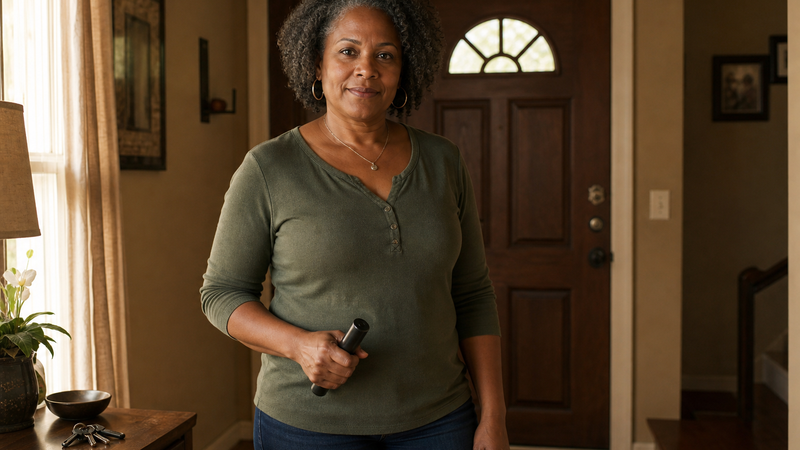
For most adults, a telescopic baton between 16 and 21 inches extended is the right length for self-defense. Smaller individuals or those who carry in confined spaces often do better with a 16-inch baton, while taller people or those who want more reach generally prefer 21 inches. The closed length — typically 6 to 9 inches — matters just as much, because that is what you are actually carrying day to day.
I want to take some time with this question, because I get it a lot and I think it deserves a real answer — not a quick number thrown out without any context. The length of a self-defense baton is not a one-size-fits-all thing. It depends on your body, your environment, your daily carry habits, and what you are actually trying to accomplish. Let me walk you through what I know, so you can make a decision you feel solid about.
What do the different telescopic baton lengths actually mean for self-defense?
Telescopic batons — sometimes called expandable batons or collapsible batons — come in a handful of standard extended lengths: 16 inches, 18 inches, 21 inches, and 26 inches. Each size represents a real trade-off between reach and manageability, and understanding that trade-off is how you find the right fit.
A 16-inch baton is the most compact option in the expanded position. It is easier to control in tight spaces — a narrow hallway, a car interior, an elevator. If you are shorter than about 5’4″, this length often gives you better handling because the swing arc is proportional to your arm length. The downside is obvious: less reach. If someone bigger is coming at you, a 16-inch baton requires you to be closer to make contact.
An 18-inch baton hits a middle ground that works well for most people. It adds a few critical inches of distance without becoming unwieldy. This is often where people who have never carried a baton before end up after they have a chance to hold one.
The 21-inch baton is the most popular length among civilians who carry telescopic batons for self-defense, and there is a reason for that. It gives meaningful reach, generates real force when deployed, and still folds down to a manageable closed length — usually around 8 inches. For most adults of average height, it is the sweet spot.
The 26-inch baton is in a different category. It is longer than most people can use effectively without training. The swing arc is wide, the momentum is harder to control, and in close quarters it can work against you. If you have had formal baton training, it may make sense. For the average person carrying for personal protection, it is usually more baton than they need.
How does body size affect which telescopic baton length is right for you?
Your arm length matters more than your height, but the two tend to move together. A longer arm means you can naturally extend a longer tool without losing control of it. A shorter arm means a shorter baton will feel more natural and hit with better accuracy because you are not fighting the reach.
Here is a rough guide that holds up in practice. If you are under 5’2″, look at a 16-inch baton first. Between 5’2″ and 5’8″, an 18-inch or 21-inch baton will likely feel right. Above 5’8″, a 21-inch baton is usually comfortable and a 26-inch becomes worth considering only if you have training behind you.
What I tell people is this: do not pick a length because it sounds impressive. Pick a length you can handle. A 16-inch baton you can control is worth far more than a 26-inch baton that throws off your balance. The goal is not to have the biggest stick in the room. The goal is to create enough space and enough deterrence to get yourself to safety.
Does the closed length of a telescopic baton matter as much as the extended length?
In everyday practical terms, yes — the closed length matters enormously. Because that is what you are living with. You are not walking around with a baton deployed. You are carrying it collapsed, and if the collapsed size does not fit your carry method, you will stop carrying it. And a baton sitting in a drawer at home protects nobody.
Most 16-inch batons collapse to about 6 to 6.5 inches. Most 21-inch batons collapse to roughly 7.5 to 8.5 inches. A 26-inch baton may collapse to 10 inches or more. Think about where this lives when you are not using it. In a coat pocket, a purse, a bag, a car center console? Each of those spaces has a real size limit.
If you carry a purse, a 21-inch baton will almost always fit without issue. If you are carrying in a jacket pocket, a 16-inch collapsed baton is more realistic. If this baton is going to stay in the car as a secondary tool, length matters less. Make the carry method real in your mind before you commit to a size.
What environments should influence the telescopic baton length you choose?
Where you spend your time shapes what length actually serves you. This is something that does not come up enough in these conversations, and I think it should.
If you commute on public transit, use rideshares, or spend time in urban environments with narrow spaces — hallways, parking garages, stairwells — a shorter baton is genuinely more practical. In tight quarters, a longer extended baton can be harder to swing effectively and may give an attacker a chance to grab it.
If you walk trails, live in a more rural area, or are concerned about threats at greater distances — an unleashed dog, a person approaching from across a parking lot — a 21-inch baton gives you more working distance.
For women who walk alone at night, I always encourage a layered approach. A baton is not the only tool in the conversation. Check out The Walk Home for a fuller picture of what that preparation looks like. Awareness is always your first line. The baton is the backup when awareness alone is not enough.
Are there legal considerations that affect which telescopic baton length you can carry?
Yes, and this one I have to be direct about: telescopic batons — also called expandable batons or ASP-style batons — are not legal to carry everywhere. Some states restrict them entirely. Some cities have their own rules. Some jurisdictions allow them only in certain lengths or only with a permit. I am not in a position to give you legal advice, and I would not be doing right by you if I pretended otherwise.
What I will say is this: before you purchase a telescopic baton for carry, look up the laws in your specific state and city. Do not rely on what someone told you online. Call your local police non-emergency line if you are not sure. Laws around batons for civilians vary enough that the answer in one city can be completely different two counties over.
If you are in an area where batons are restricted or you are unsure, there are other solid non-lethal options worth considering — pepper spray, personal alarms, stun devices — and I carry information on all of them right here. You can also look at self-defense tools for people who are out and moving for a broader picture of what is available and what fits different situations.
How does weight and material affect the usable length of a telescopic baton?
Length and weight are connected in ways that matter for real-world use. A heavier baton generates more force, but it also fatigues the wrist faster and can be harder to deploy quickly under stress. A lighter baton is easier to carry and faster to swing, but may not hit with the same stopping impact.
Most civilian-grade telescopic batons are made from steel or aircraft-grade aluminum. Steel is heavier and more durable. Aluminum is lighter and still effective. If you are choosing a longer baton — say, 21 inches — aluminum construction makes the weight much more manageable for everyday carry.
The grip matters too. A textured rubber or foam grip helps you hold on under stress, especially if your hands are sweaty or you are in rain. A smooth grip on a 21-inch baton extended is a real liability. Look at the grip before you look at the length.
Frequently Asked Questions About Telescopic Baton Length for Self-Defense
What is the best telescopic baton length for a woman?
For most women, a 16-inch or 21-inch telescopic baton is the most practical choice. Women under 5’4″ often find the 16-inch easier to control and swing accurately in close quarters. Women of average to taller height typically do well with a 21-inch baton, which provides meaningful reach without becoming difficult to handle. Personal comfort and carry method should guide the final decision.
Can I carry a telescopic baton in my purse?
Most telescopic batons collapse to between 6 and 9 inches, which fits easily in a standard purse or tote bag. The 16-inch and 21-inch models are the most purse-friendly when collapsed. Before carrying in a bag, practice drawing and deploying the baton quickly — the whole point is that you can access it when you need it, not just store it.
Is a 26-inch telescopic baton too long for a civilian?
For most civilians without formal baton training, yes. A 26-inch baton requires a wide swing arc, generates a lot of momentum that can be hard to control, and is cumbersome in close quarters. The stopping power advantage over a 21-inch baton is minimal for most situations, while the handling difficulty is real. Stick with 21 inches unless you have trained with longer tools.
How do I know what closed length fits my carry style?
Think concretely about where the baton will live on your body or in your bag every day. Coat pocket carry works best with a collapsed length under 7 inches. Purse or bag carry can usually accommodate up to 9 inches collapsed. Car console or glove box storage is the most flexible. If the collapsed size does not fit your real carry method, you will not carry it consistently — and consistency is what protects you.
Does a longer baton hit harder than a shorter one?
Generally, yes — a longer baton creates more swing momentum and therefore more impact force at the tip. But this is only true if you can control the swing. A 21-inch baton swung accurately delivers more effective force than a 26-inch baton you cannot control properly. The practical hitting power of a baton depends more on technique and confidence than on the last few inches of length.
Are telescopic batons legal to carry in California?
California law prohibits carrying a concealed baton, and there are specific restrictions around who may possess telescopic batons in public. The rules are detailed and worth reading carefully before you carry. I strongly recommend checking current California Penal Code sections and, when in doubt, consulting a local attorney or calling your local law enforcement non-emergency line. Do not assume legality based on what you read in a forum.
What is the difference between a telescopic baton and a fixed-length baton for self-defense?
A telescopic (expandable) baton collapses for carry and extends for use, making it far more portable and discreet than a fixed-length baton. A fixed-length baton is typically 18 to 26 inches at all times, which means it is harder to carry daily. For civilian self-defense use, the telescopic style is almost always the more practical option because the carry size is manageable and the deployed length is still effective.
Should I practice with a telescopic baton before carrying it?
Absolutely. You should know how to open it quickly under stress, how to hold it properly, and how to swing it with control before you ever need to use it in a real situation. Practice the deployment motion until it is muscle memory — a snap of the wrist, not a slow, deliberate motion. Even basic practice at home makes a genuine difference in whether the tool actually works for you when it counts.
The right telescopic baton length is the one you will actually carry, can actually control, and fits the life you are actually living — not the life on a spec sheet. For most people, that means a 21-inch extended baton with a solid grip and a collapsed length that disappears into their daily bag without a second thought. If that is a 16-inch for you because of how you carry, how you move, or where you are, that is the right answer too.
Take your time with this decision. Hold one if you can. Think through your real carry situation before you buy. And if you want to see what I carry and what I recommend for different needs, start with the telescopic batons available here at Tracey’s Safety — everything I stock, I would hand to someone I love. That is the standard I hold myself to, and it is the one I hold this inventory to too.