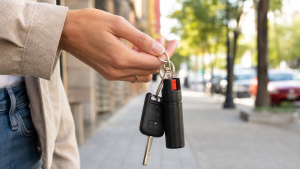
Personal safety alarms are effective — when used correctly, in the right situation, with realistic expectations about what they can and cannot do. A quality alarm emitting 120 to 130 decibels will startle an attacker, draw immediate attention from bystanders, and create the critical seconds needed to get away. They work best in populated areas, and their effectiveness drops significantly in isolated locations. They are not a replacement for full situational awareness, but for millions of people — especially children, elderly adults, and anyone walking alone — they are one of the most reliable first-line tools available.
Now let me give you the full picture, because a one-sentence answer only gets you so far when your safety is on the line.
I have given personal alarms to my mother, my daughter, three ladies from church, and a neighbor who walks her dog alone every evening after dark. I did not give them out because they were cheap or easy. I gave them out because I understood exactly how they work — and because I made sure the people I love understood it too. That’s the difference between carrying something useful and carrying something that just makes you feel better. Let me walk you through what you actually need to know.
How does a personal safety alarm actually stop an attacker?
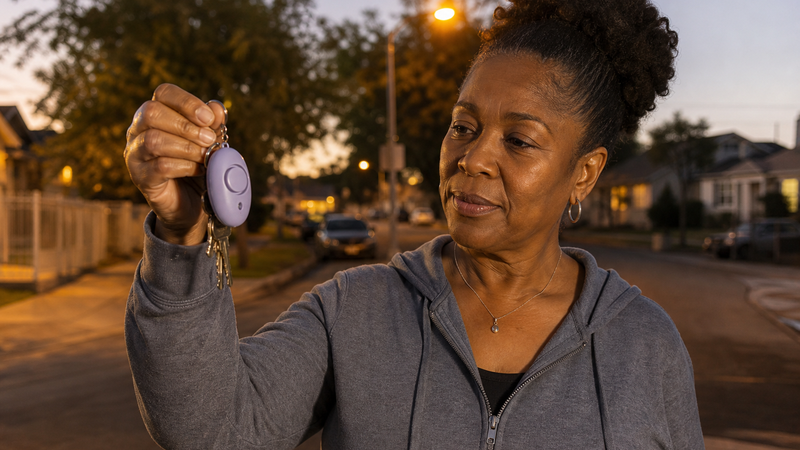
Here is what happens in the first two seconds after you activate a personal alarm: 130 decibels of sound — that is louder than a jackhammer, louder than most car horns, louder than a lot of people have ever heard at close range — erupts from a device the size of your fist. The person closest to that sound is the one who wanted to hurt you. That sound hits them before anything else does.
Predators operate on calculation. They choose targets they believe will be easy, quiet, and quick. The moment that alarm goes off, every one of those calculations falls apart. Suddenly there is noise. Suddenly there is attention. Suddenly anyone within two hundred feet is looking in your direction. That is not the situation an attacker planned for, and most of them will not stay to find out how it ends.
What the alarm buys you is not a guaranteed escape. What it buys you is time and attention — two things that work directly against the person trying to harm you. Ten seconds. Fifteen seconds. Long enough to run. Long enough for someone nearby to call 911. Long enough for the attacker to decide you are not worth it.
The alarm does not fight for you. It fights for your window. And sometimes that window is everything.
What situations are personal alarms most effective in?
Personal alarms perform best in environments where other people are present or nearby. A parking lot. A college campus. A neighborhood sidewalk. A shopping center. Any place where 130 decibels of screaming sound is going to reach human ears within seconds — those are the conditions where this tool earns its keep.
They are also highly effective for populations who may not be able to use other tools. Children cannot legally carry pepper spray. Elderly adults may not have the grip strength or reaction time to operate a stun gun under stress. People with certain disabilities need something that requires minimal action — pull a pin, press a button — and still produces a powerful response. For all of those people, a personal alarm is not a compromise. It is the right tool for the situation. If you are looking for options specifically designed for younger users, take a look at the personal alarm for children options available on this site.
There is also a category of threat that people do not think about enough: the threat that starts at home. A sleepwalking child. A door or window left unsecured. These are situations where an alarm mounted at an entry point does exactly what a carried alarm does — it screams before something bad can quietly become worse. That is a different use case, but the same principle at work.
Where personal alarms are less effective is in isolated areas with no bystanders to hear them. If you spend time hiking remote trails, running in rural areas, or working in places where help is far away, the alarm alone is not enough. You need to know that going in. I wrote more about this in the post on personal alarms in remote areas — it is worth reading if that describes any part of your routine.
How loud does a personal alarm need to be to be effective?
This is not a question to guess at. The number matters.
120 decibels is the floor. That is the minimum you should accept. At 120 dB, the sound is painful at close range and audible from a significant distance. At 130 dB — which is what most quality alarms reach — you are producing a sound that physically hurts to be near. That is not an accident. That is the point. The disorientation and pain caused by that level of sound is part of what disrupts an attacker’s ability to act.
Anything marketed under 110 decibels is not doing enough work. I have seen little keychain alarms that claim to be “loud” but register somewhere around 95 dB — which is loud in a quiet room and completely lost on a busy street. Do not buy those for yourself or for someone you love. Check the stated decibel rating before you purchase. If the seller will not tell you, that is your answer.
The form factor matters too. The alarm should be easy to activate under stress — one motion, not three. Pin-pull designs are reliable because they work even with shaking hands. Button designs can work too, but make sure the button cannot be accidentally pressed or muted in a bag. The alarm that is buried at the bottom of a purse when you need it is no alarm at all.
Are personal alarms more effective when combined with other tools?
Yes — and this is not a question with any real debate behind it. A layered approach to personal safety is always more effective than relying on a single tool.
Think of it like this: the alarm creates the disruption. Your feet carry you away. A secondary tool — pepper spray, a stun gun — gives you something to fall back on if the alarm does not end the situation on its own. These tools work together because they address different moments in the same crisis.
For someone who wants a comprehensive approach, a personal alarm combined with a reliable stun gun for personal protection covers two completely different points of response: the loud, public deterrent and the close-contact backup. Some people also carry pepper spray as a middle option — something that reaches further than a stun gun but does more than an alarm. The right combination depends on the person, the environment, and what they can realistically carry and deploy under pressure.
The one thing that works underneath all of these tools is awareness. If you do not see the threat developing, no tool gets activated in time. Awareness is not paranoia — it is simply the habit of knowing who is around you, what exits are available, and what feels wrong before it becomes dangerous. The alarm is the last line. Your eyes and your instincts are the first.
Who benefits most from carrying a personal safety alarm?
I want to be specific here, because “everyone” is too easy an answer and does not help anyone make a real decision.
Personal alarms provide the clearest benefit to people who face elevated risk and may have limited options for other tools. That includes:
- Children and teenagers — especially those who walk to school, take public transit, or spend time in places where adults are not immediately present. A child who knows how to activate an alarm and has practiced doing it is far better prepared than one who has not. For children with additional vulnerabilities, there are personal alarm options designed for kids with autism that account for the specific ways those children may respond under stress.
- Elderly adults — particularly those who live alone, walk independently, or are at risk of medical emergencies as well as crime. An alarm that can be activated with minimal strength and serves double duty as an emergency signal is a serious quality-of-life tool, not just a safety one.
- College students — navigating new environments, often at night, often without the street instincts that come with years in a particular city. I covered this in depth in the post on personal alarms for college students, including the honest limitations.
- Night-shift workers and rideshare drivers — people whose hours put them in parking lots and on streets when the rest of the world is asleep.
- Anyone who travels frequently — personal alarms are TSA-compliant, which makes them one of the few self-defense tools you can carry on a plane without any complications.
This is not an exhaustive list. It is a starting point for thinking honestly about your own situation and the situations of the people who depend on you.
What are the real limitations of personal safety alarms?
I would not be doing right by you if I only told you what alarms do well. Here is where they fall short, and you need to know this before you put one in your pocket and call it done.
They require bystanders to work fully. In a populated area, the sound brings attention and help. In an empty parking garage at midnight, the sound may echo off concrete walls and reach nobody. That is not a flaw in the device — it is a limitation of the strategy. In isolated environments, an alarm should always be paired with another tool and a clear exit plan.
A determined attacker may not stop. Most predators are opportunists. When the alarm goes off and attention arrives, they leave. But someone who is committed, intoxicated, or in a mental health crisis may not respond to sound the way a rational person would. That is the edge case — and it is the reason an alarm should not be your only plan.
They must be accessible to work. An alarm at the bottom of a bag is useless. A clip-on design that rides on the outside of your bag, on your keychain, or on a lanyard around your wrist is the right configuration. If you cannot activate it in two seconds without looking down, you need to change how you carry it.
Battery life and maintenance matter. Some alarms run on replaceable batteries. Some are built to last for years without maintenance. Know which one you have, check it periodically, and replace batteries before they fail — not after.
Frequently Asked Questions About Personal Safety Alarms
How far away can a 130dB personal alarm be heard?
A 130-decibel alarm can typically be heard from 300 to 600 feet away under calm conditions, which is roughly one to two city blocks. Wind, traffic noise, and building structures reduce that range. In a quiet suburban neighborhood at night, you can expect strong audibility across a significant distance. In a loud urban environment, the range is shorter but still meaningful at close quarters where it matters most.
Can a personal alarm be used inside a building?
Yes, and it is often more effective indoors because the sound is contained and amplified by walls. In a hallway, stairwell, or enclosed parking structure, 130 decibels is impossible to ignore. For home security purposes, door and window alarms use the same principle — a loud, immediate alert that signals a breach and draws attention from anyone in the house or nearby.
Will a personal alarm scare off a dog attack?
In many cases, yes. Dogs are sensitive to high-pitched, sudden sounds, and a personal alarm activated close to an approaching dog often causes them to stop and retreat. It is not guaranteed against every animal, but it is a reasonable first response that does not require getting within striking distance of the dog. Many runners and cyclists carry a personal alarm specifically for this reason.
Are personal alarms legal everywhere in the United States?
Personal alarms have no significant legal restrictions across the United States. Unlike pepper spray or stun guns, which vary by state and municipality, personal alarms are universally legal for all ages. They are also TSA-approved for carry-on luggage, making them one of the most travel-friendly personal safety tools available.
How do I know if my personal alarm battery is still good?
Test it. Pull the pin or press the button briefly in a safe location — outdoors or in a room where the noise will not cause alarm — every few months. Most quality alarms will show a clear decline in volume before they fail completely. If the sound seems weaker than it was when you first used it, replace the battery immediately. Do not wait until you need it to find out it is dead.
What is the best way to carry a personal alarm so it is actually usable?
On the outside of your bag or attached to your keychain where you can reach it without looking. Many people clip them to a bag strap with the pull-pin facing outward so they can grab and activate with one motion. If you run or walk for exercise, a wrist-worn alarm keeps it accessible without requiring you to reach for anything. The goal is zero friction between you and the alarm in a high-stress moment.
Can children use personal alarms effectively?
Yes — in fact, personal alarms are one of the most appropriate safety tools for children precisely because they require minimal strength and no training to use effectively. A child who has practiced pulling the pin or pressing the button at home will be able to do it under stress. Practice matters. Do not just hand a child an alarm and hope for the best. Show them how it works, talk about when to use it, and make it part of their routine.
Is a personal alarm enough on its own, or do I need additional tools?
For low-risk, populated environments — daily commutes, campus walks, errands — a personal alarm is a solid standalone tool for most people. For higher-risk situations or isolated environments, pairing it with a secondary tool like pepper spray or a stun gun gives you options across different scenarios. No single tool is enough for every situation. The alarm handles the deterrence and disruption. Other tools handle close-contact threats the alarm alone may not stop.
Personal safety alarms work. Not perfectly, not in every situation, not without limits — but they work. They have interrupted attacks. They have drawn help. They have given people the seconds they needed to get to safety. That is not marketing language. That is what loud, sudden, unexpected noise does to someone who was counting on quiet.
Get one. Carry it where you can reach it. Test it every few months. And make sure the people you love have one too. That is all. That is the whole thing right there.