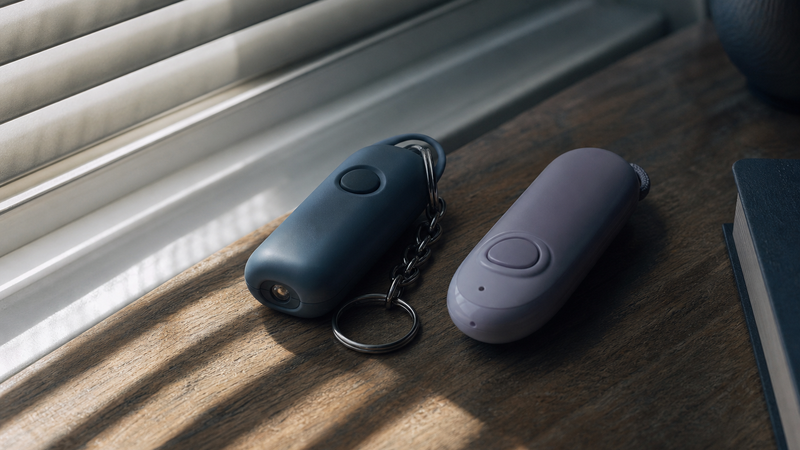
A panic alarm and a personal alarm are not the same device — though most people never know the difference until they need one. A personal alarm is a handheld or wearable device that produces a loud sound — typically 120 to 130 decibels — when activated, designed to attract attention and deter a threat. A panic alarm is a broader category that includes fixed, wired, or wireless systems used in homes, businesses, and vehicles to signal an emergency to a monitoring center or nearby responders, often silently or with a localized alert rather than a street-level scream.
Here is what surprises most people: the word “panic” sounds more urgent, more serious. And yet for the woman walking to her car alone at 10 p.m., the modest little device clipped to her keychain is doing something that a mounted panic button on a wall simply cannot do. The real question is not which one sounds more alarming. It is which one you can actually reach, in the dark, in three seconds or less.
Why do people confuse panic alarms and personal alarms in the first place?
The language around these devices has never been precise. Manufacturers, retailers, and even safety professionals use the terms interchangeably — and that confusion has consequences. Someone searching for a panic alarm for their elderly mother may end up looking at commercial security panels. Someone shopping for a personal alarm for their college student may not realize they are actually looking for the same category of device that gets called a “panic button” in a doctor’s office.
The overlap exists because both devices share a purpose: summon help when something goes wrong. But one is architecture — built into a space — and the other is something you carry in your hand. That distinction is what determines which one actually protects you.
There is also a subtler confusion worth naming. Some personal alarms are marketed specifically as “panic alarms” to signal their severity — the loudest of the loud, the ones designed for worst-case moments. In that narrower usage, a panic alarm is simply a personal alarm tuned for maximum disruption. Either way, the device lives in your pocket or on your keys, not hardwired into your wall.
What does a personal alarm actually do that makes it effective?
When you pull the pin or press the button on a personal alarm, what happens next is not subtle. A sound somewhere between 120 and 130 decibels — louder than a chainsaw, louder than a motorcycle, loud enough to be physically uncomfortable at close range — erupts from a device smaller than your fist. That sound does two things simultaneously: it announces to everyone within earshot that something is wrong, and it makes the person causing the problem the immediate center of unwanted public attention.
Most predators operate in the shadow of anonymity. They choose moments when nobody is watching. A 130-decibel scream from a keychain eliminates that shadow instantly. It does not require aim. It does not require strength. It does not require any training whatsoever. You pull, it screams, and the dynamic of the moment shifts — often in under two seconds.
What it does not do is contact anyone directly. There is no dispatcher. No GPS ping to a monitoring center. No notification to your family. The alarm draws attention from whoever happens to be nearby. In a populated area — a parking lot, a campus, a crowded block — that is often enough. In a truly isolated location, it is a louder version of silence. That is not a reason to skip it. It is a reason to understand it clearly before you rely on it.
If you want to understand more about what these devices can and cannot do, this honest look at whether personal safety alarms are effective lays it out straight.
What makes a fixed panic alarm different from what you carry on your keys?
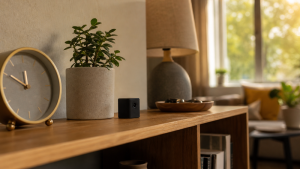
Fixed panic alarms — the kind you see mounted under a pharmacy counter, installed in a hotel room, or hardwired into a home security system — operate on a fundamentally different model. When triggered, they typically send a silent or audible alert to a central monitoring station, a security desk, or directly to law enforcement. Some are paired with GPS systems, cellular transmitters, or home networks that log the alert with a timestamp and location.
That infrastructure is genuinely powerful — when you are in range of it. A fixed panic alarm in your bedroom does nothing for you in a parking structure three miles from home. And a commercial panic button under a retail counter is not available to the employee who just got followed into the stockroom. Fixed systems protect specific spaces. Portable personal alarms protect people.
Medical alert devices occupy an interesting middle ground. Devices worn around the neck or on the wrist — designed for seniors who may fall or experience a medical emergency — often combine both functions: they produce a local alarm and simultaneously contact a monitoring service. They are closer to a portable panic alarm system than a traditional personal alarm. They are worth knowing about, especially for older adults living alone, but they come with monthly service fees and cellular connectivity requirements that a simple keychain alarm does not.
Who should be carrying a personal alarm, and what should it look like?
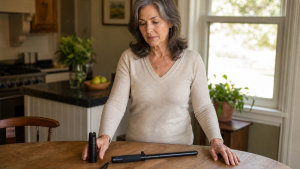
The honest answer: almost anyone who walks somewhere alone. That covers more people than most realize. Night-shift workers heading to their cars. Runners with earbuds in. Students crossing campus in the dark. Children who walk to school. Seniors who want to keep their independence without depending on a family member to escort them everywhere.
The form factor matters more than most buyers think about. A personal alarm that lives at the bottom of a bag is not a personal alarm — it is a good intention. Look for one that clips to a keychain, attaches to a wrist strap, or rides in an accessible pocket. The pin-pull mechanism tends to be more reliable than a button under pressure, because your grip closes naturally around the device when you are startled. A button requires deliberate aim at a specific point. A pin requires only that you pull.
For children specifically, the calculus shifts a little. A child needs something that is easy to activate, impossible to mistake for a toy, and loud enough to carry across a schoolyard. Personal alarms designed for children take those requirements seriously in ways a standard adult model may not. And for children with sensory sensitivities or communication differences, the conversation gets more nuanced — which is why there is a whole separate consideration for personal alarms for kids with autism that addresses those specific needs directly.
Is one louder than the other — and does decibels actually matter?
Here is a thing most people do not ask but should: what does 130 decibels actually mean, and is louder always better?
At 130 decibels, a personal alarm exceeds the human pain threshold. At 20 feet, it is physically uncomfortable. At 100 feet, it is still clearly audible as an emergency signal. For the purpose of drawing attention — which is what a personal alarm is doing — that range is more than sufficient in most real-world situations.
What matters more than the top-end decibel rating is how that sound projects. Some alarms direct sound outward in all directions. Others are more directional. The frequency of the alarm also affects how far it carries through ambient noise. A siren-style sweep tends to cut through background sound better than a single sustained tone. Those are the quiet details that separate a device that works from one that merely reads well on a product page.
Some personal alarms also double as other tools — built-in LED lights, clip attachments, or wristband forms that make them harder to lose in a crisis. The Mace brand, for instance, offers personal alarms that pair sound with additional features worth looking at. But the core job — make noise, get attention, buy seconds — is one a well-made simple alarm can do without any extras at all.
If you are comparing a personal alarm to other tools you might carry on a run or a commute, this comparison of personal alarms versus pepper spray for runners goes deeper on how these tools stack up depending on your situation.
Can a personal alarm replace a stun gun or pepper spray?
No. And it does not pretend to.
A personal alarm’s job is deterrence and attention, not direct intervention. It does not incapacitate anyone. It does not create a physical barrier between you and a threat. What it does — reliably, legally, and without any training — is shatter the silence that predators depend on.
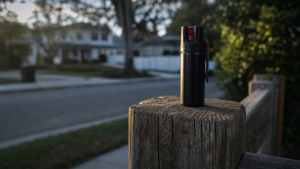
The people who carry personal alarms as their only tool do so because they want something with zero barrier to use, zero legal complexity, and zero chance of being turned against them. Those are legitimate reasons. But the people who are most protected tend to layer their tools: a personal alarm for the first three seconds, and something else — a stun gun for personal protection, or pepper spray — for anything that comes after. The alarm buys the window. The secondary tool is what you use if the window closes before help arrives.
Whether you are considering a personal alarm as your primary tool or as one piece of a larger approach, understanding where personal alarms fit in the non-lethal self-defense category helps you build that approach on solid ground.
Frequently Asked Questions About Panic Alarms and Personal Alarms
Are panic alarms and personal alarms the same thing?
Not exactly. Personal alarms are handheld or wearable devices that produce a loud sound — typically 120 to 130 decibels — when triggered, designed to attract nearby attention. Panic alarms more often refer to fixed systems that send alerts to a monitoring center or security service, sometimes silently. Both serve emergency signaling purposes, but one travels with you and one is built into a location. For personal, on-the-go safety, a portable personal alarm is typically what you want.
How loud does a personal alarm need to be to be effective?
Most effective personal alarms produce between 120 and 130 decibels — roughly equivalent to a jet engine at close range, or a live rock concert right at the speakers. That level of sound is physically uncomfortable at close range and clearly audible at 100 feet or more. For most real-world situations — parking lots, campus paths, residential streets — that range is more than enough to draw attention and disrupt a threat’s plan.
Can I carry a personal alarm on an airplane?
Yes, in most cases. Personal alarms are permitted in both carry-on and checked luggage under current TSA rules. They contain no prohibited substances or components, unlike pepper spray, which has strict restrictions. It is always worth confirming current rules before you travel, since regulations can change. A personal alarm is one of the most travel-friendly safety tools available precisely because of this flexibility.
Do personal alarms work in isolated areas where no one is around?
This is the honest limitation most people do not hear upfront: a personal alarm depends on someone being close enough to respond. In a truly isolated location — a remote trail, an empty parking structure at 3 a.m. — it may not draw a rescuer. What it can still do is startle and disorient an attacker, buying critical seconds. In isolated settings, a personal alarm works best as one layer of a broader approach that includes a secondary tool like pepper spray or a stun gun.
What is the best way to carry a personal alarm so I can actually reach it?
Clipped to your keychain or attached to a wrist strap are the most reliable methods — they keep the alarm in your hand or immediately accessible without searching. An alarm buried in a bag or coat pocket is nearly useless in an actual emergency when time is measured in seconds. The pin-pull activation style is generally more reliable under stress than a button, because closing your fist activates it naturally without requiring precise aim.
Are personal alarms a good option for children?
Yes, and they are one of the few safety tools that are age-appropriate for young children. Unlike pepper spray or stun guns, personal alarms require no training and carry no risk of injury to the child or others. For children who walk to school, ride buses, or spend time away from direct adult supervision, a loud personal alarm gives them a tool they can actually use — and teaches them that calling for help is strength, not weakness.
What is the difference between a personal alarm with a pin pull and one with a button?
Pin-pull alarms activate when a physical pin is removed from the device — separating the pin stops the alarm. Button-activated alarms require pressing a specific spot on the device. Under stress, the pin-pull style tends to be more reliable because your natural grip and pull motion triggers it without requiring precise finger placement. Both can work well; the pin-pull style simply removes one more variable in a high-pressure moment when your hands may not be perfectly steady.
Is a personal alarm enough protection on its own?
It depends on your situation, your environment, and how you carry it. For many people — especially those who want something they can carry without training, without legal complexity, and with zero risk of misuse — it is a meaningful and practical first line of defense. For situations involving higher risk, closer contact, or more isolated settings, most safety professionals recommend pairing a personal alarm with a secondary tool like pepper spray or a stun gun for more complete coverage.
Most people spend more time thinking about what kind of coffee they want in the morning than about what they would actually do if something went wrong on the walk to their car. That is not a judgment — it is just human nature to put the uncomfortable questions off until tomorrow.
But here is what I know after years of doing this work: the difference between a panic alarm and a personal alarm is interesting trivia until the moment it is not. Until the moment somebody realizes they bought the wrong thing for the wrong situation. The device that protects you is the one you understood clearly, chose deliberately, and can actually reach when your hands are shaking and your heart is hammering and you have about four seconds to figure out what to do next. Take a few minutes today — before tomorrow arrives — and make sure you have the right answer to that question. I’d rather you have it and never need it than need it and wish you’d thought this through sooner.