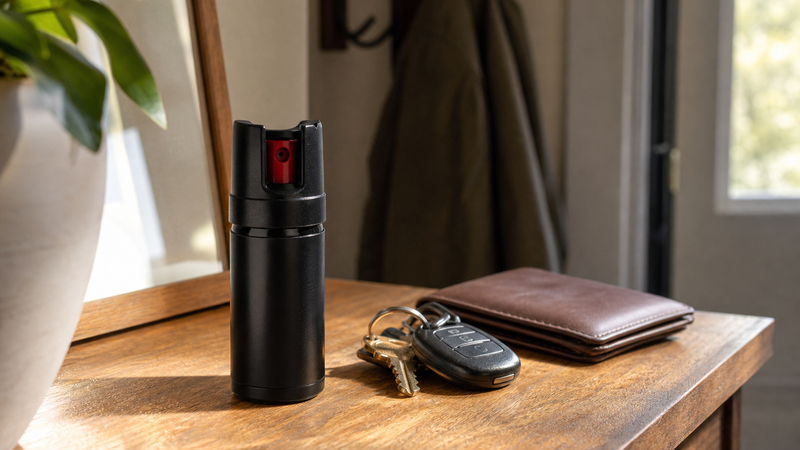
Pepper gel typically has a shelf life of two to four years from the date it was manufactured, and that date is stamped directly on the canister. Once a canister reaches its expiration date, the OC resin — the active ingredient that causes the burning, disorientation, and temporary vision impairment — begins to lose potency. The propellant pressure can also degrade, meaning it may not spray with the force or distance it was designed to deliver. Replace it before that date, not after.
There is a difference between carrying pepper gel and carrying good pepper gel. Anyone can toss a canister in a purse and forget about it for three years. But the person who checks the expiration date, stores it properly, and selects a formula that performs under real conditions — that person has made a genuine investment in their own safety. That is what we are going to talk about here: not just how long pepper gel lasts, but what it takes to keep it ready to do its job.
What does the expiration date on pepper gel actually mean?
The expiration date on your pepper gel canister is not a suggestion. It is the manufacturer’s verified cutoff point for reliable performance. Before that date, the OC concentration — that is the oleoresin capsicum, derived from hot peppers, measured in percentages — should be stable, and the aerosol propellant should maintain enough pressure to project the gel formula at the rated distance.
After expiration, two things happen that you cannot see from the outside. First, the capsaicin concentration can degrade. The gel may still come out looking the same, but its stopping power is diminished. Second, the pressurized propellant inside the canister slowly loses integrity, which means the spray may dribble rather than shoot. In a situation that requires maximum distance and maximum effect, a degraded canister is not a backup plan. It is a liability.
Most reputable manufacturers print the expiration date on the bottom or side of the canister in a clear format. Check it when you buy the product, and write the replacement date on your calendar the same day. Treat it the same way you treat a smoke detector battery — not something you get to when you get to it.
How does storage affect how long pepper gel stays effective?
The way you store your pepper gel matters as much as the date on the canister. Heat is the primary enemy. Temperatures above 120 degrees Fahrenheit — which a car’s glove compartment or cup holder can reach on a hot California afternoon — accelerate propellant degradation and can cause the canister to leak or, in rare cases, rupture. This means leaving your pepper gel locked in a hot car all summer is not storage. It is disposal.
Cold is less dangerous but still worth managing. Freezing temperatures can thicken the gel formula and temporarily reduce the spray’s range and projection. A canister kept in a cold garage through winter may still function, but let it return to room temperature before you rely on it.
The ideal storage environment is cool, dry, and out of direct sunlight. A bedroom nightstand drawer, a kitchen cabinet away from the stove, or a dedicated pocket in a bag you carry consistently — those are the right places. If you keep a canister in your car, store it in the cabin rather than the trunk, and swap it out seasonally if you live somewhere with extreme summers.
Why does pepper gel last longer than spray in some conditions?
Pepper gel’s thicker, adhesive formula gives it some inherent advantages over traditional liquid spray when it comes to real-world reliability. Because it is formulated as a gel rather than a fine mist, it is less susceptible to wind interference during use — but that same consistency also makes it more stable inside the canister during storage. There is less risk of separation or settling that you sometimes see with lower-quality liquid formulas.
The gel clings to what it contacts. That is true when you use it against a threat, and it is also true in terms of how the formula behaves internally during storage. A well-formulated gel maintains its chemical structure longer than a watered-down liquid spray, which is part of why premium manufacturers have moved toward gel formulas for civilian carry products. If you want to understand the full difference between gel and stream delivery systems, this breakdown of gel pepper spray vs. stream formulas covers exactly what sets them apart.
That said, gel is not immune to the same expiration rules. A superior formula still has an endpoint. The advantage is not indefinite life — it is more consistent performance up to that date.
How can you tell if your pepper gel has gone bad before the expiration date?
There are a few things worth checking even before you reach the stamped date. First, inspect the canister for any visible leakage around the nozzle or cap. Even a small amount of residue on the outside can indicate the seal is compromised. If the cap has spray residue on it that you did not put there, the pressure inside may be escaping.
Second, if you have access to a safe outdoor space — and I mean somewhere you are not going to affect anyone around you — a brief test spray into the ground is a legitimate way to verify that the propellant is still functional. Some manufacturers actually recommend this. It confirms pressure and spray pattern without wasting a meaningful amount of product.
Third, pay attention to how the canister feels. A full, properly pressurized canister has a certain weight and firmness to it. If it feels noticeably lighter than when you bought it, or if the button mechanism feels loose or inconsistent, those are signals worth taking seriously.
When in doubt, replace it. A quality canister of pepper gel is not an extravagant expense. Carrying one you cannot trust is.
What is the right replacement schedule for pepper gel you carry every day?
If you carry pepper gel daily — clipped to your bag, in your jacket pocket, on your keychain — the manufacturer’s expiration date is your hard outer limit, but I recommend building in a buffer. Replace annually if the canister is two years or older from manufacture date, regardless of what the stamp says. Daily carry means daily handling, and repeated temperature changes, jostling, and minor pressure on the canister all add wear that a lab expiration test does not account for.
For home storage canisters — the one on your nightstand, the one near the front door — the full rated shelf life is reasonable to use. These are in controlled environments, handled infrequently, and not subjected to the wear of a daily carry item. But you still need a system. Mark the purchase date in permanent marker on the bottom, and set a calendar reminder for two years out.
If you keep a canister in a vehicle, treat it as an annual replacement item. Full stop. The temperature variance a car experiences over twelve months in most American climates is enough to justify it. If you are stocking gel canisters for household members or want to keep several on hand, take a look at bulk pepper spray options — buying in volume lets you rotate stock properly without the cost becoming a barrier.
Does the percentage of OC in pepper gel affect how long it stays potent?
This is a question worth knowing the answer to. OC percentage — the concentration of oleoresin capsicum in the formula — affects the initial strength of the product, but it is not a reliable indicator of how long that strength holds. A product with a higher OC percentage does not necessarily retain potency longer than one with a lower percentage. What matters more is the quality of the formulation and the integrity of the propellant system.
What a higher OC percentage does tell you is the quality tier of the product you are buying. Professional-grade formulas designed for law enforcement carry, like those in the Defense Technology pepper spray line, or the civilian-grade versions from Fox Labs, are engineered to perform consistently at their stated concentration for the full rated shelf life. A discount canister with a flashy label may have the same OC number printed on it and a fraction of the actual stopping reliability.
Spend once on something that performs. Replace it on schedule. That is the strategy.
Frequently Asked Questions About Pepper Gel Shelf Life
How long does pepper gel last after the expiration date?
Pepper gel should not be relied upon after its expiration date. The OC concentration may degrade and the propellant pressure can drop, reducing both potency and spray distance. An expired canister might still discharge something, but you cannot count on it to perform the way it needs to when it matters. Replace it before the date, not after.
Can I carry the same canister of pepper gel for five years?
Most pepper gel canisters are rated for two to four years from manufacture date, so a five-year-old canister is well past its reliable service window. Even if the stamp on a particular product shows four years, daily carry conditions — heat, handling, pressure changes — can shorten effective life. Follow the manufacturer’s expiration date as your hard deadline and build in a buffer if you carry it every day.
Is it safe to leave pepper gel in a hot car?
No. Temperatures above 120 degrees Fahrenheit can degrade the propellant, cause leakage, and in rare cases rupture the canister. Car interiors commonly exceed that temperature on hot days. If you keep gel in a vehicle, store it in the cabin where you can moderate temperature exposure, and replace it at least once a year regardless of the expiration date.
Does pepper gel expire faster than regular pepper spray?
Quality pepper gel formulas are generally stable throughout their rated shelf life and in some cases resist separation and settling better than lower-quality liquid sprays. However, both formats follow similar expiration timelines — typically two to four years. Storage conditions affect both equally. Gel’s advantage is consistency of formula, not an extended expiration window.
How do I know what date my pepper gel was manufactured?
Most manufacturers print the expiration date directly on the canister, typically on the bottom or along the label. Some print a manufacture date and others print the expiration date directly — either way, the information should be visible before you purchase. If a product does not have a clear date printed on it, that is itself a signal about the quality tier of what you are buying.
Should I test my pepper gel to make sure it still works?
An occasional brief test spray in a safe outdoor area — away from people and wind — is a legitimate way to verify that the propellant is still pressurized and the nozzle is clear. It uses a small amount of product but confirms function. Do not do this indoors or in any enclosed space. If the spray seems weak, inconsistent, or the canister feels significantly lighter than when purchased, replace it immediately.
Is pepper gel a good choice for teenagers who are new to carrying defense spray?
Pepper gel is often considered one of the better choices for new carriers because its reduced airborne drift lowers the risk of self-contamination. The gel formula sticks to what it contacts rather than misting back toward the user. It requires the same situational awareness and legal understanding as any defense spray. If you are looking into options for a younger person, this guide on pepper spray for teenagers covers what to look for and what to consider before you buy.
How does pepper gel compare to other spray formulas in terms of reliability?
Pepper gel tends to perform more predictably in outdoor conditions because it is not affected by wind the way a fine mist can be. It also sticks on contact, which makes it harder for an attacker to wipe away quickly. For a fuller comparison of how gel holds up against stream and fog delivery systems, this breakdown of pepper spray gel vs. stream vs. fog formulas is worth reading before you decide what to carry.
The canister in your bag is only as good as the care you put into it. A quality pepper gel from a reputable manufacturer — checked, stored properly, and replaced on schedule — is a serious tool. It deserves to be treated like one. Know your expiration date, keep it in the right environment, and buy from a source you can trust to carry products that are engineered to perform, not just packaged to sell.
If you are carrying something you bought three years ago and cannot remember when, today is the day to replace it. That is not an overreaction. That is what taking your own safety seriously actually looks like.