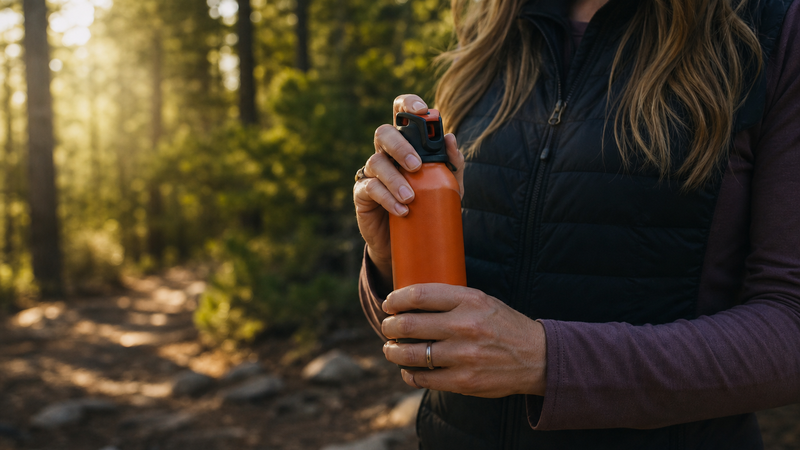
If bear spray gets on you, expect immediate, intense burning to any exposed skin, severe eye pain, temporary loss of vision, and a burning sensation in your throat, nose, and lungs that makes it difficult to breathe normally. These effects begin within seconds of contact and can persist anywhere from 30 minutes to over an hour, depending on concentration and how quickly you rinse. The discomfort is serious — but it is not permanent, and it is treatable.
Most people who carry bear spray have never thought carefully about what it would actually do to a human being — including themselves. That gap in knowledge is worth closing, because the people who carry serious tools deserve to understand them seriously. Bear spray is not a casual product. It is a high-concentration aerosol formulation designed to stop an animal that can weigh 600 pounds and close 30 yards in under two seconds. When it lands on you — by accident, by wind drift, by a moment of confusion in a stressful situation — the results are not subtle. Knowing exactly what you are dealing with, and what to do about it, is the difference between a handled situation and a real emergency.
What makes bear spray different from standard pepper spray, and why does it matter?
Bear spray is regulated by the EPA and required by federal law to contain between 1% and 2% major capsaicinoids — the active compounds derived from hot peppers that cause the burning, inflammatory response. That range sits at or above the upper end of most civilian pepper spray formulations. More significantly, bear spray is engineered to dispense as a wide, billowing fog cloud — not a stream or gel — because it needs to fill the sensory field of a charging animal from a distance. That delivery method is what makes accidental human exposure so thorough.
When you compare this to gel pepper spray versus stream formulations designed for personal defense, the contrast becomes clear. A gel or stream is precise — it goes where you point it, clings to a target, and minimizes drift. Bear spray is the opposite. It is designed to saturate the air in front of you. A shift in wind, a spray that catches the side of a tent, a canister discharged at close range — any of these can put a full dose of high-concentration capsaicinoid directly on your face, your hands, or inside your lungs. The people who get caught in accidental bear spray exposure are often experienced outdoors people who simply underestimated the dispersion.
What does bear spray feel like on skin, and how long does the burning last?
On bare skin, bear spray produces an intense burning sensation almost immediately — not unlike pressing a hot iron to the surface of your arm, except it covers everything the spray touched. The skin reddens, swells slightly, and becomes extremely sensitive to any additional contact. The urge to rub or scratch is powerful. Resist it. Rubbing drives the capsaicinoid deeper into the pores and spreads it to areas that weren’t initially affected.
The burning on skin typically peaks within the first 10 to 15 minutes. With proper rinsing — cool water, generous amount, sustained — you can begin to manage the discomfort within 20 to 30 minutes. Without rinsing, the burning continues at peak intensity for 45 minutes to an hour before it begins to subside on its own. The skin may remain sensitive, warm, and slightly irritated for several hours after that. People with sensitive skin or pre-existing conditions like rosacea or eczema may experience a more pronounced and longer-lasting reaction.
One thing most people don’t anticipate: the burning can seem to return if you step into a warm shower too quickly. Heat opens the pores and reactivates the capsaicinoids. Cool or lukewarm water only, at least initially.
What happens when bear spray gets in your eyes?
Eye exposure is the most immediately debilitating aspect of bear spray contact. The eyes respond to capsaicinoids with almost instantaneous inflammation — the eyelids swell, the blood vessels dilate, the eyes clamp shut involuntarily, and vision becomes severely impaired or completely lost within seconds. This is not a temporary blink. It is a functional, though temporary, loss of sight that can last 20 to 45 minutes depending on concentration and the speed of rinsing.
The inflammatory response in the eyes is involuntary and complete. Even people who know what is happening cannot simply force their eyes open and push through it. The swelling and involuntary closure are physiological, not psychological. This is precisely why bear spray works so well on large animals — and why accidental self-exposure or exposure to a hiking companion is a genuine emergency that requires immediate, unhurried, methodical treatment.
Flush the eyes with large amounts of cool, clean water. Tilt the head so the water runs from the inner corner of the eye outward, carrying the irritant away from the eye rather than across it. Do not use milk, which is a common misconception. Cool water, sustained and generous, is the correct answer. If contact lenses are in, remove them — but rinse your hands thoroughly before you attempt this.
What does bear spray inhalation do to your lungs and throat?
Inhaling bear spray — even partially, even briefly — is the aspect of accidental exposure that moves the situation from very uncomfortable to potentially serious. The mucous membranes of the nose, throat, and upper airways respond to capsaicinoids with immediate inflammation. You will experience a burning sensation from your nostrils down into your chest. The airway may feel constricted. Coughing, gagging, and a sensation of not being able to get a full breath are all common.
For most healthy adults, this resolves on its own within 30 to 45 minutes with fresh air. Move away from the contaminated area immediately. Breathe slowly and deliberately. Sit down if you need to. The panic response — rapid, shallow breathing — makes inhalation symptoms worse. Slow, measured breaths allow the respiratory system to manage the irritation more effectively.
For people with asthma, COPD, or other chronic respiratory conditions, even partial inhalation of bear spray is a more serious event. Bronchospasm is possible. If someone with a known respiratory condition is exposed, monitor them closely, help them use any prescribed rescue medication, and do not hesitate to seek emergency medical help if breathing does not improve within a few minutes of fresh air exposure.
How should you treat bear spray exposure on skin and clothing?
The treatment hierarchy is straightforward, but the order matters. First, remove yourself — and the exposed person — from the area where the spray was discharged. Even a few feet of drift can re-expose you if you stay close to the source. Second, remove contaminated clothing carefully, peeling it off rather than pulling it over the face. Bear spray saturates fabric and remains active. A contaminated shirt pulled over the head delivers a second dose directly to the face and lungs. Cut it off if necessary.
Third, rinse with cool to lukewarm water. Lots of it. Continuously. For skin, this means at least 15 to 20 minutes of flushing under running water or poured water if running water is unavailable. Dawn dish soap — or any degreasing dish soap — can help break down the oily capsaicinoid residue after the initial flush. Do not use hot water. Do not use oil-based products. Do not scrub. Pat dry gently when you are done.
Contaminated clothing should be laundered separately from other garments, in cold water, with a full cycle. Do not put it in a dryer until you are confident the smell and residue are fully gone — heat will set the capsaicinoids into the fabric and potentially affect anything else in the dryer.
For a deeper look at how storage conditions affect spray potency and safety — because a canister that has been through extreme heat or cold may not behave predictably — the post on storing bear spray safely is worth reading before your next trip.
Can bear spray cause permanent damage?
The research on capsaicinoids and permanent damage is clear: for healthy adults, properly treated exposure does not cause permanent injury. The effects on skin, eyes, and respiratory function are temporary and self-limiting. The inflammation resolves. Vision returns. Breathing normalizes. This is a feature of the compound, not an accident — capsaicinoids were selected as an active agent precisely because they are highly effective at causing temporary incapacitation without causing lasting physiological harm.
The exceptions worth knowing: untreated eye exposure that is not flushed promptly can result in more prolonged irritation and a longer recovery window, but permanent vision damage from bear spray exposure is not documented in the medical literature under normal circumstances. Chemical keratitis — superficial injury to the cornea — is possible with extreme exposure, and if eye symptoms persist beyond a few hours after thorough flushing, evaluation by a medical professional is warranted.
Bear spray is, at its core, a formulation of the same capsaicinoid family used in products like Defense Technology pepper spray and Fox Labs pepper spray — two of the most rigorously tested formulations available to civilians. The chemistry is shared. The concentration and delivery system are what make bear spray distinct, and what make accidental exposure worth taking seriously.
Frequently Asked Questions About Bear Spray Exposure
How long does bear spray burning last?
For most people, the peak burning sensation on skin lasts 30 to 45 minutes without treatment. With prompt flushing using cool water and a degreasing soap, discomfort begins to reduce significantly within 15 to 20 minutes. Eye symptoms can last longer — 45 minutes to over an hour — even with flushing, due to the sensitivity of ocular tissue. Respiratory symptoms typically resolve within 30 to 45 minutes in fresh air.
Is bear spray dangerous to humans?
Bear spray causes serious temporary symptoms — intense burning, temporary blindness, and respiratory distress — but it does not cause permanent harm to healthy adults when treated promptly. People with asthma or chronic respiratory conditions face higher risk from inhalation. The compound is designed to incapacitate without causing lasting injury, which is why it is used as a deterrent rather than a lethal tool.
What should I do immediately if I get sprayed with bear spray?
Move away from the source area, remove contaminated clothing by cutting or carefully peeling it away from your face, and flush affected skin and eyes with large amounts of cool water for at least 15 to 20 minutes. For eyes, tilt the head so water flows from inner to outer corner. Get to fresh air immediately if you inhaled any of the spray. Do not rub skin or eyes — it worsens the reaction.
Does milk help with bear spray exposure?
Milk is sometimes suggested as a remedy based on its use for hot pepper burns from cooking. Cool water is more effective for bear spray exposure and far more practical in an outdoor setting. The goal is to physically flush the capsaicinoid off the tissue, not to neutralize it chemically. Milk does not rinse as efficiently and is rarely available in the field. Stick to cool water and a degreasing soap when possible.
Can you wash bear spray out of clothes?
Yes, but wash contaminated clothing separately from everything else. Use cold water and a full laundry cycle. You may need to run the garment through more than one wash if the smell persists — that smell indicates active capsaicinoid residue. Do not put the clothing in a dryer until the residue is confirmed gone. Heat sets the compound into the fabric and can contaminate your dryer drum.
Is bear spray stronger than regular pepper spray?
Bear spray is typically at the higher end of civilian capsaicinoid concentration — between 1% and 2% major capsaicinoids, as required by EPA regulation. Many civilian pepper spray products fall within a similar or overlapping range, but the delivery system is very different. Bear spray disperses as a wide fog cloud covering a large area, while pepper spray in stream form is precise and directional. That fog dispersion is what makes bear spray more likely to cause accidental self-exposure.
What if someone inhales a large amount of bear spray?
Get them to fresh air immediately and have them breathe slowly. If the person has a known respiratory condition like asthma, help them use their prescribed rescue inhaler and monitor them closely. If breathing does not improve within several minutes, or if the person is struggling significantly, call emergency services. Most healthy adults recover fully with fresh air alone, but prolonged or severe respiratory symptoms always warrant medical evaluation.
How is bear spray different from the pepper spray used in personal defense products?
The active compound — capsaicinoids — is the same family, but bear spray is designed for wide-area fog dispersion at longer range, while personal defense sprays come in gel, stream, or cone mist formats optimized for controlled, targeted use. If you are exploring which format makes the most sense for your specific situation, the comparison of gel versus stream pepper spray is a good place to start thinking through the tradeoffs.
Bear spray is a serious tool. The people who carry it — whether on a backcountry trail or kept in a vehicle for emergencies — deserve to understand it completely, not just in theory but in practice. Knowing what happens when it gets on you is not pessimism. It is the mark of someone who has thought carefully about what they carry and why. That preparation is what separates informed carrying from false confidence.
If you are still working out which kind of spray is the right fit for your daily life — not wilderness situations, but the streets and neighborhoods where most of us actually live — take a look at what makes pepper spray effective and how those same principles apply closer to home. The right tool, understood fully, is worth more than ten products grabbed without thought. That is always the standard here.